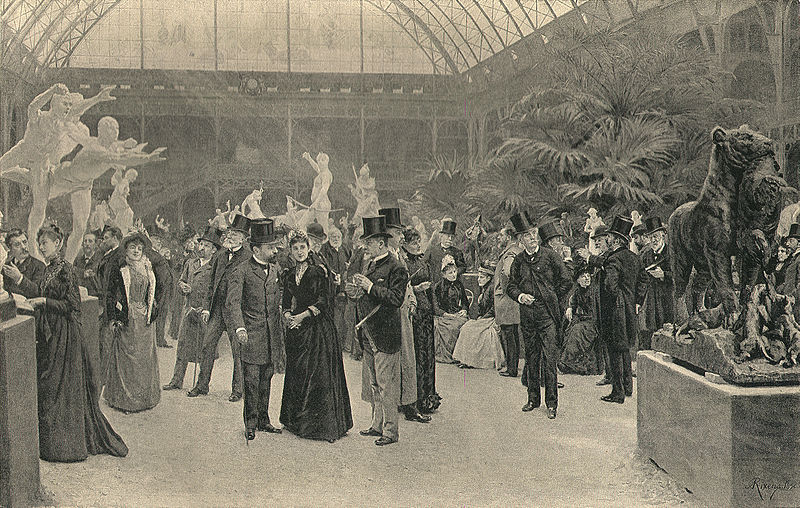
File:Rixens_jour_de_vernissage.jpg · Wikimedia Commons · See Wikimedia Commons
Paris Salon
Sign in to saveAlso known as Salon de l'Académie royale des beaux-arts, Salon des Artistes Français, Salon
art exhibition periodically held in Paris from 1667 to 1880
Described at

Pera Museum | From the Age of Reason to the “Tortoise Trainer”
peramuseum.org →A Salon exhibition held in the Grand Palais in Paris on May 1, 1906 showcased an Ottoman painting. This was Osman Hamdi Bey’s famous “Tortoise Trainer”. The catalogue for the exhibition, managed by Ludovic Baschet, featured 1734 paintings and 845 sculptures (figs. 1, 2). Number 783, painted by “Hamdy Bey” was titled “L’homme aux tortues” (The man with tortoises) (fig. 3). Even though the initials of most artists’ last names were included in the descriptions, Osman Hamdi’s name was written as “Hamdy Bey”, probably as this was how he was recognized in France. The painting was also featured as an engraving in the middle pages of the catalogue and titled in English as “Tortoises”. The same catalogue also informs us that the museum opened at 8 am every day, except for Mondays, when it opened at 10 am, and remained open until 6 am the next day. The entrance fee was 10 francs on opening day and 1 franc on other days, expect for Sunday afternoons, when it cost 50 cents. 1. Cover page of the 1906 Salon exhibition catalogue. 2. Inner cover of the 1906 Salon exhibition catalogue. This exhibition was the result of a long-standing tradition. Until the 20th century, this tradition went through many stages, inspired the creation of art criticism (which would go on to shape social taste in art), adapted to the political climate of its time, and finally, being the symbol of a higher authority, created its own opposition. In 1737, the exhibitions began being held on odd-numbered years, opening on the Feast Day of St. Louis (August 25) and lasting for three to five weeks. During their run, Salon exhibitions were the dominant public entertainment in the city. The Salon Carré (Square Salon) in the Louvre was filled with paintings from the eye level to the ceiling, creating a feast for the eyes. (figs. 4, 5). Endless waves of spectators filled the room, sometimes making movement inside impossible (Crow 1985: 1). From the beginning, Salon exhibitions triggered an immediate and dramatic transformation in the French cultural life. Painters were pressured by the press to address the needs and desires of the public; journalists and critics who demanded this claimed to have public support. State officials stated that their decisions were taken in the public’s interest, and collectors began to prefer paintings that received public approval. In the previous periods, art was displayed in religious rituals and other social spaces and only a minority group composed of artists and their patrons had authority over aesthetics. Now, the tastes and needs of the masses mattered. With the Salons, which were the first platforms for the display of art to be offered in a secular setting, audiences’ aesthetic response became important (Crow 1985: 2-3). For Diderot, creating and appreciating art is a matter of “passion” and like literature, it matures humans. He thinks of artists as people who are following a higher passion. In his letters, Diderot talks about passion to his lover, Sophie Volland, who contributed to his thinking through their correspondences: “All my life, I have been an advocate of strong passions. Only strong passions excite and inspire any admiration and fear in me. They give me strength. Passion is what turns talent into art, and without it, art dies. If the degrading nature of humans is not tamed with passion, the result is mediocre and talentless humans, those who live and die like animals. While they are alive, they spend no effort to distinguish higher passions from the rest, and no one remembers them when they are gone. Their names mean nothing to anyone, and no one knows where their graves are, as they are lost in the weeds. (Özsezgin 1996: 9).” This painting depicts a father who has paid for her daughter’s dowry. It is a moving subject which stirs excitement in the audience. I found the composition really pleasing. We are witnessing a scene that every family is familiar with. There are twelve figures in the painting, all performing thei
Excerpt from a page describing this subject · 27,056 chars · not written by Vinony
Wikidata facts
- Instance of
- salon
- Subclass of
- exhibition
- Named after
- Salon Carré
- Official name
- Salon de peinture et de sculpture
- Country
- France
- Followed by
- Salon of French Artists
- Location
- Salon Carré
- Image
- Edouard Dantan Un Coin du Salon en 1880.jpg
- Participant
- Alfred Barye
Show 6 more facts
- described at URL
- www.artic.edu/library/discover-our-collections/research-guides/paris-salons-1673present
- partially coincident with
- Salon of French Artists
- winner
- Giovanni De Martino
- Commons category
- Salon de peinture et de sculpture
- topic's main category
- Category:Salon de peinture et de sculpture
- different from
- Salon
Sources (2)
via Wikidata · CC0
~9 min read
Encyclopedic overview
Formally dressed patrons at the Salon in 1890. Un Jour de vernissage au palais des Champs-Élysées by Jean-André Rixens featuring Tigresse apportant un paon à ses petits by Auguste Cain. The Salon, or sometimes Paris Salon (French: Salon de Paris [salɔ̃ d(ə) paʁi]), beginning in 1667, was the official art exhibition of the Académie des Beaux-Arts in Paris. Between 1748 and 1890 it was arguably the greatest annual or biennial art event in the Western world.
At the Salon of 1761, thirty-three painters, nine sculptors, and eleven engravers contributed. From 1881 onward, it was managed by the Société des Artistes Français.
Excerpted from Wikipedia’s “Paris Salon” article, available under the CC BY-SA 4.0 licence.
Gallery (10)
Available in 43 languages
- Español
- Français
- Deutsch
- 中文
- 日本語
- Русский
- Português
- Italiano
- العربية
- Armenian
- Azerbaijani
- Bahasa Indonesia
- Basque
- Belarusian
- Bulgarian
- Catalan
- Central Kurdish
- Czech
Show 24 more
via Wikidata sitelinks · CC0