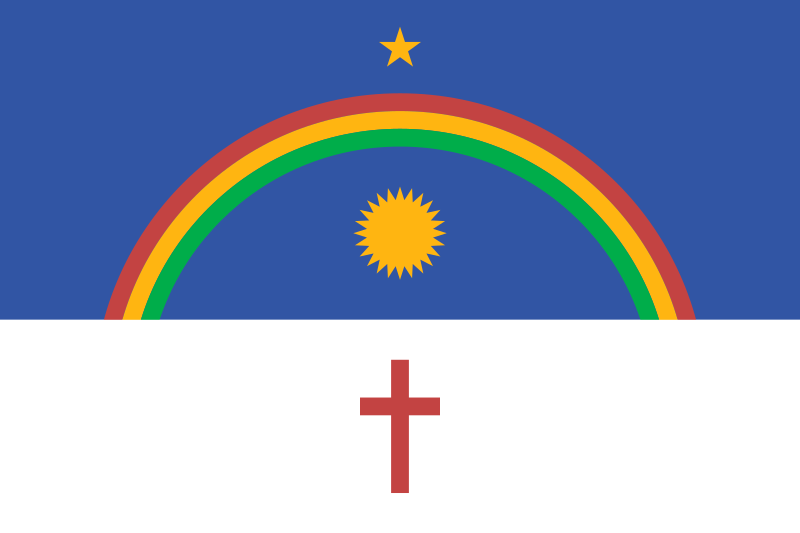
File:Bandeira_de_Pernambuco.svg · Wikimedia Commons · See Wikimedia Commons
Pernambuco
Sign in to saveAlso known as PE, Pernambuco state, Pernambuco State
Pernambuco ( ; , ) is a state of Brazil located on the east coast in the Northeast region of the country. With an estimated population of 9.5 million people as of 2024, it is the seventh-most populous state of Brazil and with around 98,067.877 km2, it is the 19th-largest in area among federative units of the country. It is also the sixth-most densely populated with around 92.37 people per km2. Its capital and largest city, Recife, is one of the most important economic and urban hubs in the country. Based on 2019 estimates, the Recife Metropolitan Region is seventh-most populous in the cou
Pernambuco is a state located on Brazil's northeastern coast with a population of 9.5 million people, making it the seventh-most populous state in the country. It matters because its capital, Recife, is one of Brazil's most important economic and urban centers, and the Recife Metropolitan Region ranks among the country's largest metropolitan areas.
AI-generated from the Wikipedia summary — may contain errors.
Key facts
- Settlement.name
- Pernambuco
- Settlement.native_name_lang
- pt
- Settlement.settlement_type
- State
- Settlement.image_flag
- Bandeira de Pernambuco.svg
- Settlement.flag_size
- 125px
- Settlement.image_shield
- Brasão do Pernambuco.svg
- Settlement.motto
- "I am the strongest and the one who leads"
- Settlement.anthem
- Hino de Pernambuco
- Settlement.image_map
- Pernambuco in Brazil.svg
- Settlement.map_caption
- Location in Brazil
- Settlement.subdivision_type
- Country
- Settlement.subdivision_name
- Brazil
- Settlement.subdivision_type2
- Region
- Settlement.subdivision_name2
- Northeast
- Settlement.seat_type
- Capital and largest city
- Settlement.seat
- Recife
- Settlement.leader_title
- Governor
- Settlement.leader_name
- Raquel Lyra (PSD)
via Wikipedia infobox
Official website
Link to the official site · 9,196 chars · not written by Vinony
Wikidata facts
- Instance of
- federative unit of Brazil
- Part of
- Northeast Region
- Official name
- Pernambuco
- Demonym
- pernambucano
- Country
- Brazil
- Located in
- Brazil
- Contains
- Pombos
- Capital
- Recife
- Population
- 9058931
- Area
- 98937.8
- Elevation
- 504
- Head of government
- Paulo Câmara
- Anthem
- Hino de Pernambuco
- Shares border with
- Alagoas
- Highest point
- Pico do Papagaio
- Official website
- www.pe.gov.br
- Image
- Capitais do Brasil - Capital Cities of Brazil - Recife-PE (36163973822).jpg
Show 16 more facts
- Commons category
- Pernambuco
- topic's main category
- Category:Pernambuco
- category for people born here
- Category:Births in Pernambuco
- category for people who died here
- Category:Deaths in Pernambuco
- category of associated people
- Category:People from Pernambuco
- Commons gallery
- Pernambuco
- described by source
- Encyclopædia Britannica 11th edition
- inception
- 1889-00-00
- different from
- Paraíba do Norte River
- short name
- PE
- language used
- Tuxá
- postal code
- 50000-000 to 56990-000
- Human Development Index
- 0.737
- electorate
- 6706779
- P12749
- Clyde Donovan
- P8168
- Gareth Thomas
Sources (10)
via Wikidata · CC0
~47 min read
Encyclopedic overview
50 sectionsContents
- Etymology
- Geography
- Regions
- Hydrology
- History
- Prehistory
- European contact
- Portuguese settlement
- Slavery
- Dutch conquest
- Jewish immigration
- Portuguese reconquest
- Three centuries of the sugar cycle
- 17th-century class conflict
- 18th century: mining eclipses sugar
- 19th century: a province, then a state
- The end of slavery and the beginning of the republic
- 20th century
- Post-dictatorship progress
- Government and politics
- Local government
- Federal representation
- Demographics
- Population
- Religion
- Racial/Ethnic composition
- Largest cities
- Education
- Higher education
- Economy
- Livestock
- Agriculture
- Ethanol
- Industry
- Infrastructure
- Airports
- Ports
- Railways
- Roads
- Festivals
- Carnival
- Saint John's Day
- Winter Festival
- Tourism and recreation
- Main cities
- Sports
- Gallery
- See also
- References
- External links
Pernambuco ( ; , ) is a state of Brazil located on the east coast in the Northeast region of the country. With an estimated population of 9.5 million people as of 2024, it is the seventh-most populous state of Brazil and with around 98,067.877 km2, it is the 19th-largest in area among federative units of the country. It is also the sixth-most densely populated with around 92.37 people per km2. Its capital and largest city, Recife, is one of the most important economic and urban hubs in the country. Based on 2019 estimates, the Recife Metropolitan Region is seventh-most populous in the country, and the second-largest in northeastern Brazil. In 2015, the state had 4.4% of the national population and produced 2.8% of the national gross domestic product (GDP).
The contemporary state inherits its name from the Captaincy of Pernambuco, established in 1534. The region was originally inhabited by Tupi–Guarani-speaking peoples. European colonization began in the 16th century, under mostly Portuguese rule interrupted by a brief period of Dutch rule, followed by Brazilian independence in 1822. Large numbers of slaves were brought from Africa during the colonial era to cultivate sugarcane, and a significant portion of the state's population has some amount of African ancestry.
Excerpted from Wikipedia’s “Pernambuco” article, available under the CC BY-SA 4.0 licence.
Gallery (52)
On the map
3 mapped locations
Available in 101 languages
- Español
- Français
- Deutsch
- 中文
- 日本語
- Русский
- Português
- Italiano
- العربية
- हिन्दी
- Afrikaans
- Albanian
- Aragonese
- Armenian
- Asturian
- Aymara
- Azerbaijani
- Bahasa Indonesia
Show 82 more
- Basque
- be_x_old
- Belarusian
- Bishnupriya
- Bosnian
- Breton
- Bulgarian
- Burmese
- Catalan
- Cebuano
- Cornish
- Crimean Tatar
- Croatian
- Czech
- Danish
- eml
- Esperanto
- Estonian
- Finnish
- Galician
- Georgian
- Greek
- Guarani
- Hebrew
- Hungarian
- Icelandic
- Ido
- Interlingua
- Irish
- Kazakh
- Ladino
- Latin
- Latvian
- Limburgish
- Lithuanian
- Luxembourgish
- Macedonian
- Malagasy
- Malay
- Marathi
- Mazanderani
- Nederlands
- Northern Frisian
- Norwegian
- Norwegian Nynorsk
- Occitan
- Old English
- Ossetic
- Piedmontese
- Polski
- Quechua
- Romanian
- Scots
- Serbian
- Serbian (Latin)
- simple
- Sinhala
- Slovak
- Svenska
- Swahili
- Tajik
- Tamil
- Tatar
- Tetum
- Tiếng Việt
- Toki Pona
- Türkçe
- Ukrainian
- Urdu
- Uzbek
- Venetian
- Volapük
- Waray
- Welsh
- Western Panjabi
- Wu Chinese
- Yoruba
- zh_min_nan
- zh_yue
- فارسی
- ไทย
- 한국어
via Wikidata sitelinks · CC0