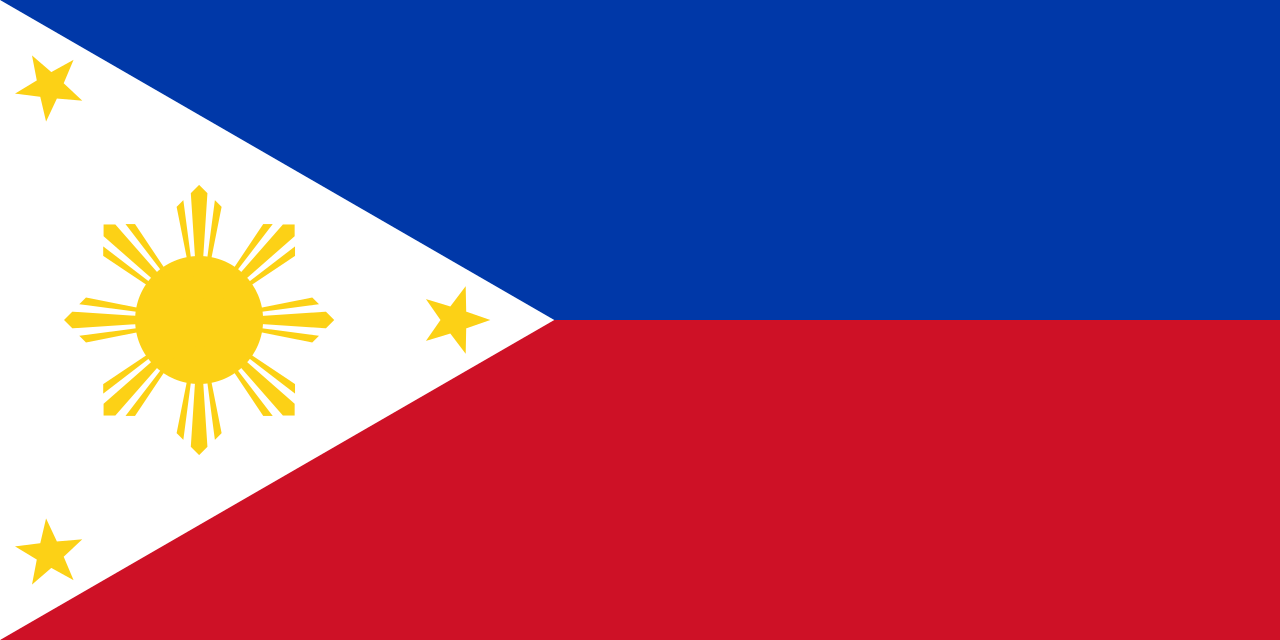
Filipinas
Sign in to saveAlso known as Republic of the Philippines, The Philippines, Philippine Islands, RP
país de Asia
OverviewAI-generated
The Republic of the Philippines is a country in South-Eastern Asia. Its capital is Manila. The nation has a population of 114,123,600 and covers an area of 342,353 square kilometers. The official languages are Filipino, English, and Taglish. The native label for the country is Pilipinas. The motto is Maka-Diyos, Maka-Tao, Makakalikasan at Makabansa. The currency is the Philippine peso.
The legislative body is the Congress of the Philippines. The head of state and head of government holds the office of President of the Philippines. The country replaces the Commonwealth of the Philippines. Ethnic groups include the Tagalog people, Cebuano people, Ilocano, and Visayans. The top-level domain is .ph. The time zone is UTC+08:00. The top-level domain is .ph. The flag is 🇵🇭.
Synthesized by Vinony from 68 facts across 9 sources: Wikidata, Open Meteo, Openweathermap, REST Countries, World Bank, OpenStreetMap, PubMed, Vinony graph, Geo. Generated from structured data (not the Wikipedia text) and checked against those facts — may still contain errors.
Weather now
7-day forecast
via Open-Meteo
Country

- Capital
- Manila
- Population
- 114,123,600
- Region
- Asia · South-Eastern Asia
- Demonym
- Filipino
- Currencies
- PHP (₱)
- Languages
- English, Filipino
- Calling code
- +63
- Drives on
- Right
- Gini
- 42.3 (2018)
- FIFA code
- PHI
- TLD
- .ph
- Timezones
- UTC+08:00
via REST Countries
Indicators · World Bank
- GDP
- $461.6B(2024)
- Population
- 115,843,670(2024)
- Life expectancy
- 69.9 yrs(2024)
- Unemployment
- 2.2 %(2025)
- Urban population
- 55.5 %(2024)
- Internet users
- 67.3 %(2024)
- Forest area
- 24.5 %(2023)
- Renewable energy
- 28 %(2021)
via World Bank Open Data · CC BY 4.0
Wikipedia views (30d)
343,512 totalvia Wikimedia Pageviews API
Key facts
- Country.conventional_long_name
- Republic of the Philippines
- Country.common_name
- the Philippines
- Country.image_flag
- Flag of the Philippines.svg
- Country.flag_size
- 130
- Country.flag_type
- Flag
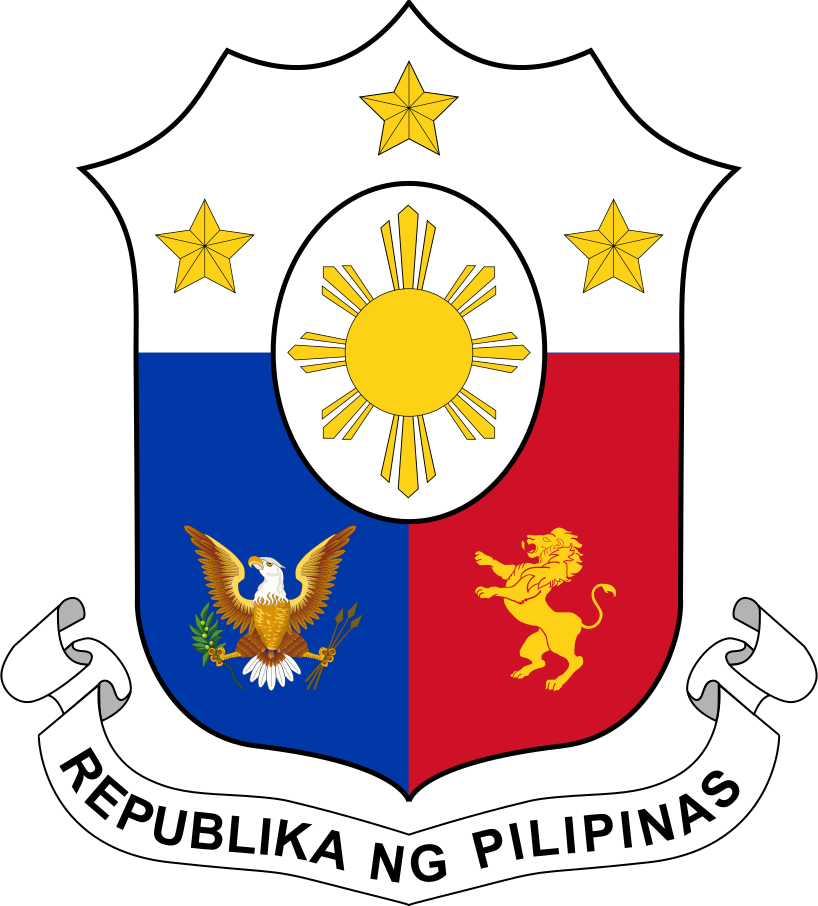
- Country.image_coat
- Coat of arms of the Philippines.svg
- Country.symbol_type
- Coat of arms
- Country.other_symbol_type
- Great Seal:
- Country.other_symbol
- 95px
- Country.capital
- Manila (de jure)Metro Manila (de facto)
- Country.largest_city
- Quezon City
- Country.recognized_national_languages
- Filipino
- Country.recognized_regional_languages
- 19 languages
- Country.languages_type
- National sign language
- Country.languages
- Filipino Sign Language
- Country.languages_sub
- yes
- Country.languages2_type
- Other recognized languages
- Country.languages2
- Spanish and Arabic
via Wikipedia infobox
Research
37,085 papers- Thalassemia in the Philippines.ReviewHemoglobin · 2022Yuson ED, Naranjo MLTDOI: 10.1080/03630269.2021.2023566
- Philippines.Department of State publication. Background notes series · 1983United States. Department of State. Bureau of Public Affairs
- Treatment gaps in Parkinson's disease care in the Philippines.ReviewNeurodegenerative disease management · 2017Jamora RDG, Miyasaki JMDOI: 10.2217/nmt-2017-0014
- Philippine parapsychology.ReviewExplore (New York, N.Y.) · 2024Cervantes CLGDOI: 10.1016/j.explore.2023.10.006
- Philippines Case Study: Government Policies on Nutrition Education.Nestle Nutrition Institute workshop series · 2019Capanzana MV, Aguila DVDOI: 10.1159/000499555
- Mission: Philippines 1992.Journal of post anesthesia nursing · 1993Roberts CM, Wilburn ST
- Intersectionality and the invisibility of transgender health in the Philippines.Global health research and policy · 2022Abesamis LEADOI: 10.1186/s41256-022-00269-9
- Advance Care Planning in the Philippines: A continuing narrative of advocacy.Zeitschrift fur Evidenz, Fortbildung und Qualitat im Gesundheitswesen · 2023Alparaque-Corvera R, Aguirre-Pedro D, Phillip E Francisco E et al.DOI: 10.1016/j.zefq.2023.05.004
via PubMed
Wikidata facts
- Instance of
- island country
- Named after
- Philip II of Spain
- Official name
- Republika ng Pilipinas
- Demonym
- filippino
- Religion
- Christianity
- Country
- Philippines
- Contains
- Negros Island Region
- Continent
- Asia
- Capital
- Manila
- Official language
- Taglish
- Currency
- Philippine peso
- Population
- 112729484
- Area
- 343448
- Time zone
- Philippine Standard Time
- Body of water
- Celebes Sea
- Head of government
- Bongbong Marcos
- Head of state
- Bongbong Marcos
- Form of government
- republic
- Legislature
- Congress of the Philippines
- Anthem
- Lupang Hinirang
- Shares border with
- Taiwan
- Highest point
- Mount Apo
- Official website
- www.gov.ph
- Households
- 26393906
Show 82 more facts
- Life expectancy
- 72
- Nominal GDP
- 404284327312
- Unemployment rate
- 11.2
- Calling code
- +63
- Licence plate code
- RP
- Electrical plug type
- Europlug
- Mains voltage
- 220
- Motto
- Mae'n fwy o hwyl yn y Philipinau
- Coat of arms
- coat of arms of the Philippines
- topic's main Wikimedia portal
- Portal:Philippines
- Unicode character
- 🇵🇭
- category of associated people
- Category:Filipino people
- ethnic group
- Waray people
- geography of topic
- Geography of the Philippines
- office held by head of government
- President of the Philippines
- native label
- Philippines
- diplomatic relation
- Republic of Ireland
- office held by head of state
- President of the Philippines
- Commons gallery
- Pilipinas / Philippines
- trunk prefix
- 0
- number of out-of-school children
- 2855158
- replaces
- Commonwealth of the Philippines
- marriageable age
- 21
- mobile country code
- 515
- total fertility rate
- 2.89
- maritime identification digits
- 548
- topic's main category
- Category:Philippines
- age of majority
- 18
- railway traffic side
- left
- category for films shot at this location
- Category:Films shot in the Philippines
- executive body
- Government of the Philippines
- category for people who died here
- Category:Deaths in the Philippines
- inception
- 1946-07-04
- Commons category
- Philippines
- top-level Internet domain
- .ph
- retirement age
- 60
- category for people born here
- Category:Births in the Philippines
- short name
- RP
- driving side
- right
- lowest point
- Philippine Sea
- IPA transcription
- filɪˈpiːnən
- language used
- Ibanag
- central bank
- Bangko Sentral ng Pilipinas
- GS1 country code
- 480
- history of topic
- history of the Philippines
- VAT rate
- 12
- BTI Status Index
- 5.59
- BTI Governance Index
- 4.31
- studied by
- Filipinology
- economy of topic
- economy of the Philippines
- poverty incidence
- 13.20
- demographics of topic
- demographics of the Philippines
- topic has template
- Template:Administrative divisions of the Philippines
- Democracy Index
- 6.62
- on focus list of Wikimedia project
- Wikipedia:Vital articles/Level/4
- hashtag
- Philippines
- Human Development Index
- 0.699
- P11012
- Peru
- electorate
- 68431965
- Happy Planet Index score
- 57.1
- Gini coefficient
- 42.3
- Inequality-adjusted Human Development Index
- 0.574
- suicide rate
- 2.5
- median income
- 307190
- social media followers
- 1060116
- female population
- 53649400
- male population
- 55017643
- urban population
- 58930729
- rural population
- 50102516
- literacy rate
- 96.3
- P12749
- Trentino-South Tyrol
- name
- Republiken Filippinerna
- highest judicial authority
- Supreme Court of the Philippines
- birth rate
- 21.618
- death rate
- 5.568
- most populous urban area
- Quezon City
- culture
- culture of the Philippines
- located in/on physical feature
- Southeast Asia
Sources (15)
via Wikidata · CC0
Travel guide
Understand
With over 7,100 islands and of territory between the Philippine Sea and the South China Sea (called the "West Philippine Sea" in the Philippines), the Philippines is the world's second largest archipelago country, after nearby Indonesia (Northern Canada has the largest archipelago). The islands are mostly volcanic in origin, covered with tropical rainforest and fertile soil, but much of the rainforest has been cut down. The terrain varies considerably, but many of the coasts have a lot of bays and headlands, and many of the larger islands have mountainous interiors. The coasts also have many coral reefs.
The country has problems like crime, corruption, poverty, and internal conflicts. There is ongoing conflict between the Philippine government and Islamic separatists in Mindanao, and with Communist rebels (New People's Army) elsewhere. Spillovers of hostilities into large cities have occurred. The red tape, bribery, and excessive patronage associated with Philippines' bureaucracy has been reduced, but some locals still distrust government. Crimes and illegal drugs are commonplace, but you are more likely to encounter them if you venture into rough areas. Western nations have discouraged travel to the country because of safety and security concerns.
Despite the first impressions of the Philippines as relatively economically developed, it remains a developing country struggling with income inequality and poverty. Typical monthly income for someone in a low-end job – farmer, f…
Get in
As an island nation separated by thousands of kilometers of seas, the Philippines is mostly reachable only by plane even from within Southeast Asia. There are few passenger ships, and ports may have limited facilities for immigration and customs processing.
Philippine bureaucracy is nowhere as cumbersome and corrupt since the end of the Ferdinand Marcos era, and most visitors can travel visa free or get a visa upon arrival at most ports of entry. Customs are relaxed, but the country is now strictly enforcing restrictions on bringing plants, animals, and food, and the obvious prohibitions on bringing in contraband.
Get around
The country's vast archipelagic nature makes travel by plane and boat very important for most visitors, especially between major cities. The country is quite large, especially when considering the area that is water, and its geography and population patterns mean that seemingly short distances, especially on land, may take more time to travel than you would expect.
Do what Filipinos do, and try to "commute" or take public transportation when possible. That said, travel by car or motorcycle is still an interesting way to discover the Philippines and find places off the beaten track, if you're willing to face the rather shocking situation on Philippine roads.
See
The Philippines can give you the tropical island experience of your life. Its beautiful sandy beaches, warm climate, century old churches, magnificent mountain ranges, dense rain forests, rich culture and smiling people are some of the attractions that you can see and experience on this archipelago composed of 7,107 islands. You can experience the country's rich and unique culture in different ways like touring old Spanish churches, joining colorful fiestas (festivals) and by enjoying exotic and tasty cuisine. But perhaps the greatest way to experience Filipino culture is by riding a jeepney.
Do
thumb|250x250px|Sailing in [[Boracay]] thumbnail|250px|Whitewater rafting in the Cagayan de Oro River thumb|250x250px|Baguio mountains Aerial sports - An annual Hot Air Balloon festival is held in January and February in Clark, Angeles in Pampanga. Hot air balloons are displayed, and there is skydiving and other activities. Basketball is the most popular sport in the Philippines, don't miss the PBA and UAAP basketball tournaments. A more Filipino experience is watching any of the paliga games held in barangays during the hot months, if you can bear the heat; streetball is also quite popular. Bentosa and Hilot are Filipino alternative ways of healing, Bentosa is a method where a cup cover a tea light candle then it flames out and it drains out all the pain on the certain part of the body, Hilot is just the Filipino way of massaging. Board sailing - Waves and winds work together making the country a haven for board sailors. Boracay, Subic Bay and Anilao in Batangas are the main destinations. Casinos: Metro Manila has a wide collection of casinos and entertainment destinations. Explore the Newport World Resorts, the country's first luxurious casino integrated resort, and the newly opened Solaire Resorts and Casino. The Entertainment City is home to four integrated casino resorts, including the Okada Manila. Other towns also have casinos; there is a large one at Cebu Airport. Cock fighting is quite popular in the Philippines; most towns have an arena. Sometimes they are quite bus…
Eat
Filipino cuisine is diverse, and varies by region and ethnic group. Local food varies as you travel between regions, provinces and islands, and ingredients vary by the local culture and economy, but there are broad characteristics that define Filipino food. thumbnail|Filipino cuisine|380px Filipino cuisine has developed from the different cultures that shaped its history; it is Southeast Asian cuisine but with influences from both Asia and the West. Though its cuisine is not as renowned as many of its neighbors, such as that of Thailand and Vietnam, Filipino cooking is nonetheless distinct in that it is possibly the least spicy of all Southeast Asian cuisines. Don't make the mistake of thinking that Filipino food is bland, though. It is just that instead of spices, Filipino food depends more on garlic, onions, ginger and vinegar to add flavor to dishes, and is mostly sweet, sour, and salty. Painstaking preparation and prolonged cooking time is also a characteristic of most Filipino dishes, and when done properly is often what brings out the flavor of the food, as opposed to a healthy dose of spices. As with the rest of Southeast Asia, rice is the staple food of the Philippines, but parts of the country rather have corn instead. Nonetheless, non-Filipinos may be caught off-guard by the tendency for all meat to be cooked well-done.
To experience how the Filipinos eat in a budget way, carinderias (eateries) and turo-turo (literally "point-point", buffet-style restaurants where…
Drink
Due to the tropical climate of the Philippines, chilled drinks are popular. Stands selling chilled drinks and shakes are common especially in shopping malls.
Filipinos (except for observant Muslims) love to drink (and get drunk). Filipinos rarely consume alcohol by itself. They would normally have what is called as pulutan or bar chow alongside their drinks which is like the equivalent of tapas. Beer is perhaps the most common form of alcohol consumed in bars.
Alcohol is cheap in the Philippines, some of the cheapest in the whole of Asia. In a supermarket the excellent local beers are around and bottles of tolerable local rum or brandy start under . In many bars beer is around and mixed drinks .
Sleep
Accommodation options range from luxury five-star hotels/resorts to backpacker inns, but off the beaten track, options are sparse. Rates begin at , or higher depending on location, season and demand. Large cities such as Manila or Cebu have a higher price bracket, so do major tourist destinations.
Homestays ("transient homes") or bed and breakfasts are common in the provinces, especially in tourist towns that do not have much commercial accommodation. Many are just basic homes that provide meals and lodging, but some may be mansions with a swimming pool.
Motels (or "short-time [hotels]") are another cheap option, but they have a reputation for being havens for illicit sex. They tend to be scattered in red-light districts, but many are clustered along major highways. Rates are per hour than per day, and it generally costs for overnight stays (at least 6 to 10 hours), or for short stays (2 to 5 hours).
Hotels and resorts are usually for the higher-end traveler, although rates — even for four-star establishments — are not very high compared to other international destinations. Condotels are furnished condominium units rented out for long or short term stays, while apartelles are set up for both short and long term stays. Pension houses, tourist inns and lodging houses are usually more basic and economical from per night.
Cheaper places often have only fans instead of air conditioning, and no private toilet or shower. Even if you get a private shower, it may not have hot wate…
Stay safe
Since the transition to democracy, the Philippines suffers from crime, corruption, and ongoing insurgencies. While foreign governments and the media exaggerate the threats, the country is, by and large, peaceful except for some regions experiencing low-level insurgencies. Crime levels in major cities are relatively comparable to those in American cities.
The Philippines has among the highest death tolls from natural disasters such as earthquakes, tropical cyclones (typhoons) and floods, as well as tropical diseases.
The Philippines is quite low-income: unskilled jobs generally pay US$100-200 a month and even many good jobs are under US$500. More or less all travelers will be perceived as rich by local standards. This makes you a prime target for thieves, scammers, prostitutes and corrupt officials. Do not make it worse by displaying a Rolex, an iPhone and a Nikon or by pulling out a stack of notes when you pay a restaurant bill.
Respect
Filipinos are hospitable, friendly and polite, but cultural norms differ drastically from much of the West. Much of Filipino etiquette borrows from East Asian and Hispanic culture.
Filipinos are in general indirect communicators, mostly motivated by hiya (hee-YUH', "shame") and delicadeza (propriety), but they tend to be more assertive and upfront than those in neighboring countries. In general, saving face is important in Filipino culture. Filipinos have a relaxed view of time, like Hispanics. Approach "Filipino time" with patience; being "fashionably late" is also not uncommon especially in social events. Buses and ferries often do not observe timetables. This does not extend to business or formal meetings. Filipinos respect their elders, and it is considered rude to challenge someone older than you has said. Use the correct pronouns or term of address when addressing an elderly person or anyone older than you. There are also honorific particles in some of the Philippine languages, such as Tagalog po and Bikol tabi; use them when talking with anyone older. On buses, jeepneys and trains, priority seats are provided for use by the elderly, as well as pregnant women and people with disabilities. It is considered honorable to help an elderly person cross a street. It is generally fine to be asked overly personal questions, which may strike brash and too direct for foreigners, but this is just a way for Filipinos to get to know someone. If you are not fine with such questions, …
Travel guide from Wikivoyage (CC BY-SA 4.0)
Article · Español
Filipinas —oficialmente, la República de Filipinas (en tagalo, Republika ng Pilipinas; en inglés, Republic of the Philippines)— es un país insular (véase archipiélago) situado en el Sudeste Asiático, sobre el océano Pacífico. Su capital es Manila. Al norte se encuentra separado de la isla de Taiwán por el estrecho de Luzón; al oeste se halla el mar de la China Meridional, también conocido como el mar de Filipinas Occidental y Vietnam; al suroeste, la isla de Borneo; al sur, el mar de Célebes lo separa de otras islas de Indonesia, y al este limita con el mar de Filipinas. Su ubicación en el cinturón de fuego del Pacífico y su clima tropical lo convierten en un lugar propenso a terremotos y tifones. El país es rico en recursos naturales y se encuentra en una de las zonas con mayor biodiversidad del mundo. Está formado por 7641 islas que se clasifican geográficamente en tres grupos: la isla de Luzón, el grupo de las Bisayas y la isla de Mindanao. Filipinas tiene una población estimada de 109 millones de habitantes de acuerdo con el censo del 2020; además, es el 12.º país más poblado del mundo sin tener en cuenta a los 12 millones de filipinos que viven en el extranjero. Varias etnias y culturas conviven a lo largo de sus islas. Catalogado como un país recientemente industrializado, su economía continúa el constante crecimiento que inició desde su independencia. Las reformas económicas implementadas a inicios del siglo XXI lograron que el sector servicios desplazara a la agricultura como la principal actividad económica, y ahora este aporta más de la mitad del PIB. Sin embargo, aún enfrenta diversos retos en la infraestructura: la falta de desarrollo en el sector turístico, la educación, la atención a la salud y el desarrollo humano. En tiempos prehistóricos, los negritos fueron algunos de los primeros habitantes del archipiélago, seguidos por oleadas sucesivas de pueblos austronesios que trajeron consigo tradiciones y costumbres de Malasia, India y el mundo islámico, mientras que el comercio introdujo algunos aspectos culturales chinos. Estos establecieron los primeros reinos insulares gobernados por Datus, Rajas o Sultanes. En 1521, la llegada del explorador Fernando de Magallanes —portugués al servicio de España— marcó el comienzo de una era de influencia y posterior dominio español. Miguel López de Legazpi estableció el primer asentamiento español en Filipinas en 1565, con la fundación de Cebú. En 1571 fundó la ciudad de Manila, que se convertiría en el centro administrativo y económico del Imperio español en Asia y puerto de partida del galeón de Manila con destino Acapulco. Filipinas fue gobernada por el Virreinato de Nueva España centrado en México antes de que se decretara el gobierno directo después de la independencia de México. Tres siglos de influencia española dieron lugar a una cultura hispano-asiática, patente en el arte, música, gastronomía y costumbres de Filipinas, en especial su religión católica. También surgió una variante filipina del idioma español, que floreció en la segunda mitad del siglo XIX y primera del XX. A finales del siglo XIX estalló la Revolución filipina, apoyada por Estados Unidos, y posteriormente la guerra hispano-estadounidense que dio lugar a la cesión de las islas por España a EE. UU. en 1898. Las desavenencias entre la nueva República Filipina y EE. UU. desembocaron en la guerra filipino-estadounidense que acabó con la victoria estadounidense en 1903. De esta forma, Estados Unidos reemplazó a España como potencia dominante. A excepción del periodo de ocupación japonesa, los estadounidenses mantuvieron la soberanía sobre las islas hasta el final de la Segunda Guerra Mundial en 1946. Desde la independencia, el país atravesó varias crisis políticas que sirvieron para definir las características de una república constitucional. El legado de los distintos periodos históricos se refleja en la actual cultura del país, que es una combinación de lo indígena prehispánico con elementos chinos y la cultura hispánica, debido a tres siglos de presencia española. Esta cultura mestiza está presente en la gastronomía, en la música, los bailes y el arte filipino. El carácter hispánico es más evidente en su religión católica, en su legado arquitectónico, en especial las iglesias y casas de estilo colonial, en muchos topónimos del país y en nombres y apellidos. Finalmente, la herencia de Estados Unidos perdura en el idioma inglés y en una mayor afinidad con la cultura popular.
Abstract from DBpedia / Wikipedia · CC BY-SA
Gallery (59)
On the map
3 mapped locations
Available in 271 languages
- Español
- Français
- Deutsch
- 中文
- 日本語
- Русский
- Português
- Italiano
- العربية
- हिन्दी
- Abkhazian
- abstract
- Achinese
- Afrikaans
- Albanian
- Albanian
- Amharic
- ami
Show 252 more
- Angika
- Aragonese
- Aramaic
- Armenian
- Arpitan
- Assamese
- Asturian
- Awadhi
- azb
- Azerbaijani
- Bahasa Indonesia
- Balinese
- Bangla
- Banjar
- Bashkir
- Basque
- bat_smg
- Batak Toba
- Bavarian
- be_x_old
- Belarusian
- Betawi
- Bhojpuri
- Bikol
- Bishnupriya
- Bislama
- Bosnian
- Breton
- btm
- Buginese
- Bulgarian
- Buriat
- Burmese
- Catalan
- cbk_zam
- cdo
- Cebuano
- Central Dusun
- Central Kurdish
- Chamorro
- Chechen
- Cherokee
- Chuvash
- Cornish
- Corsican
- Crimean Tatar
- Croatian
- Czech
- dag
- Danish
- Divehi
- dty
- Dzongkha
- Egyptian Arabic
- Esperanto
- Estonian
- Extremaduran
- Faroese
- Fiji Hindi
- Fijian
- Filipino
- Finnish
- fiu_vro
- Fula
- Gagauz
- Galician
- Gan Chinese
- gcr
- Georgian
- Gilaki
- Goan Konkani
- Gorontalo
- Gothic
- Greek
- Guarani
- Gujarati
- Haitian Creole
- Hakka Chinese
- Hausa
- Hawaiian
- Hebrew
- Hungarian
- Iban
- Icelandic
- Ido
- Iloko
- Inari Sami
- Interlingua
- Interlingue
- Inupiaq
- Irish
- Jamaican Creole English
- Javanese
- Kabardian
- Kabyle
- Kannada
- Kanuri
- Kara-Kalpak
- Karachay-Balkar
- Kashmiri
- Kashubian
- Kazakh
- kbp
- kge
- Khmer
- Kikuyu
- Kinyarwanda
- Komi
- Kongo
- Kotava
- Kurdish
- Kyrgyz
- Ladino
- Lao
- Latin
- Latvian
- Lezghian
- Ligurian
- Limburgish
- Lingala
- Lingua Franca Nova
- Lithuanian
- lld
- Lojban
- Lombard
- Low German
- Lower Sorbian
- Luxembourgish
- Macedonian
- Madurese
- Maithili
- Malagasy
- Malay
- Malayalam
- Maltese
- Manipuri
- Manx
- Māori
- map_bms
- Marathi
- Mari
- Mazanderani
- Minangkabau
- Mingrelian
- Mirandese
- Moksha
- Mongolian
- Moroccan Arabic
- Navajo
- nds_nl
- Nederlands
- Nepali
- Newari
- Nias
- Northern Frisian
- Northern Sami
- Norwegian
- Norwegian Nynorsk
- Novial
- Occitan
- Odia
- Old English
- olo
- Oromo
- Ossetic
- Pampanga
- Pangasinan
- Papiamento
- Pashto
- Picard
- Piedmontese
- Polski
- Punjabi
- pwn
- Quechua
- roa_rup
- Romanian
- Rundi
- Rusyn
- Samoan
- Sango
- Sanskrit
- Santali
- Sardinian
- Scots
- Scottish Gaelic
- Serbian
- Serbian (Latin)
- Shan
- Shona
- Sicilian
- Silesian
- simple
- Sindhi
- Sinhala
- Slovak
- Slovenian
- Somali
- Southern Sotho
- Sranan Tongo
- Sundanese
- Svenska
- Swahili
- Swati
- szy
- Tajik
- Talysh
- Tamil
- Taroko
- Tatar
- tay
- Telugu
- Tetum
- Tibetan
- Tiếng Việt
- Tok Pisin
- Toki Pona
- Tongan
- Tumbuka
- Türkçe
- Turkmen
- Tyap
- Udmurt
- Ukrainian
- Upper Sorbian
- Urdu
- Uyghur
- Uzbek
- Venetian
- Veps
- Volapük
- Walloon
- Waray
- Welsh
- West Flemish
- Western Frisian
- Western Mari
- Western Panjabi
- Wolof
- Wu Chinese
- Yakut
- Yiddish
- Yoruba
- Zaza
- Zeelandic
- zh_classical
- zh_min_nan
- zh_yue
- Zhuang
- فارسی
- ไทย
- 한국어
via Wikidata sitelinks · CC0