
File:Jean-Marc_Nattier,_Portrait_de_Pierre-Augustin_Caron_de_Beaumarchais_(1755).jpg · Wikimedia Commons · See Wikimedia Commons
Pierre Beaumarchais
Sign in to saveAlso known as Pierre-Augustin Caron de Beaumarchais, Beaumarchais
French playwright, diplomat and polymath (1732–1799)
Pierre Beaumarchais was a French playwright, diplomat, and multitalented figure who lived from 1732 to 1799 and became famous for his witty comedies during the Enlightenment era. He matters because his plays, which satirized the French aristocracy and social order, influenced both literature and the intellectual currents that led to the French Revolution.
AI-generated from the Wikipedia summary — may contain errors.
Person · Open Library
- Works
- 6
Top works
- Las bodas de Fígaro
- El barbero de Sevilla
- Barber of Seville and the Marriage of Figaro
- Figaro'nun Düğünü veya Çılgın Gün
- Sevilla Berberi Veya Nafile Tedbir
via Open Library + Wikidata
Music · MusicBrainz
- Type
- Person
- Gender
- Male
- Origin
- France
- Active from
- 1732
- Active to
- 1799
via MusicBrainz · CC0
Listeners · Last.fm
- Listeners
- 2
- Total plays
- 34
<a href="https://www.last.fm/music/Pierre+Beaumarchais">Read more on Last.fm</a>
Wikidata facts
- Instance of
- human
- Gender
- male
- Citizenship
- France
- Place of birth
- rue Saint-Denis
- Occupation
- opinion journalist
- Languages spoken
- French
- Native language
- French
- Notable work
- The Guilty Mother
- Field of work
- performing arts
- Movement
- Enlightenment philosophy
- Image
- D'après Jean-Marc Nattier, Portrait de Pierre-Augustin Caron de Beaumarchais (Bibliothèque-musée de la Comédie-Française) -001.jpg
Show 13 more facts
- place of burial
- Père Lachaise Cemetery
- Commons category
- Pierre Augustin Caron de Beaumarchais
- date of birth
- 1732-01-24
- date of death
- 1134-05-19
- Commons Creator page
- Pierre Augustin Caron de Beaumarchais
- topic's main category
- Category:Pierre Beaumarchais
- Commons gallery
- Pierre Augustin Caron de Beaumarchais
- name in native language
- Pierre-Augustin Caron de Beaumarchais
- ethnic group
- French
- place of detention
- Prison de l'Abbaye
- writing language
- French
- archives at
- Bibliothèque nationale de France
- P12674
- Tengwangge Xu
via Wikidata · CC0
Works in European collections
36 objects attributed to Pierre Beaumarchais, held across European museums, libraries & archives · via Europeana

Eugenia, a drama of five acts
Ingenius and virtue or the confused seducer: comedy in five acts

Zelmire. Le comte de Warwik. L'orphelin de la Chine. Eugenie. La feinte par amour
Oeuvres de Beaumarchais précédées d'une notice sur l'auteur, et suivies de lettres inédites
Oeuvres de Beaumarchais précédées d'une notice sur l'auteur, et suivies de lettres inédites
Oeuvres de Beaumarchais précédées d'une notice sur l'auteur, et suivies de lettres inédites
Untitled
Untitled
Untitled
Untitled
Untitled
Untitled
Untitled
Untitled
Untitled

Untitled

Untitled
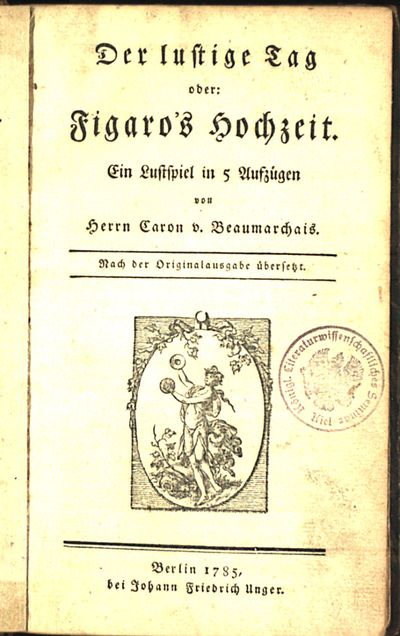
Untitled
Untitled
Untitled
Untitled
Untitled
Untitled
Untitled
Untitled
Untitled
Untitled
Untitled
Untitled
Untitled
Untitled
Untitled
Untitled
Untitled
Untitled
Untitled
~27 min read
Encyclopedic overview
Pierre-Augustin Caron de Beaumarchais ( pronounced [pjɛʁ oɡystɛ̃ kaʁɔ̃ d(ə) bomaʁʃɛ]; né Caron; 24 January 1732 – 18 May 1799) was a French playwright and diplomat of the Age of Enlightenment. Best known for his three Figaro plays, at various times in his life he was also a watchmaker, inventor, musician, spy, publisher, arms dealer, and revolutionary (both French and American).
Born a Parisian watchmaker's son, Beaumarchais rose in French society and became influential in the court of Louis XV as an inventor and music teacher. He made a number of important business and social contacts, played various roles as a diplomat and spy, and had earned a considerable fortune before a series of costly court battles jeopardized his reputation.
Excerpted from Wikipedia’s “Pierre Beaumarchais” article, available under the CC BY-SA 4.0 licence.
Gallery (7)
Available in 60 languages
- Español
- Français
- Deutsch
- 中文
- 日本語
- Русский
- Português
- Italiano
- العربية
- Armenian
- azb
- Azerbaijani
- Bahasa Indonesia
- Bangla
- Basque
- be_x_old
- Belarusian
- Bulgarian
Show 41 more
- Catalan
- Central Kurdish
- Chuvash
- Croatian
- Czech
- Danish
- Egyptian Arabic
- Esperanto
- Estonian
- Finnish
- Galician
- Georgian
- Greek
- Hebrew
- Hungarian
- Ido
- Kyrgyz
- Latvian
- Macedonian
- Mazanderani
- Mongolian
- Nederlands
- Norwegian
- Occitan
- Piedmontese
- Polski
- Romanian
- Serbian
- Serbian (Latin)
- Slovak
- Slovenian
- Svenska
- Tajik
- Tatar
- Tiếng Việt
- Türkçe
- Ukrainian
- Urdu
- Uzbek
- فارسی
- 한국어
via Wikidata sitelinks · CC0