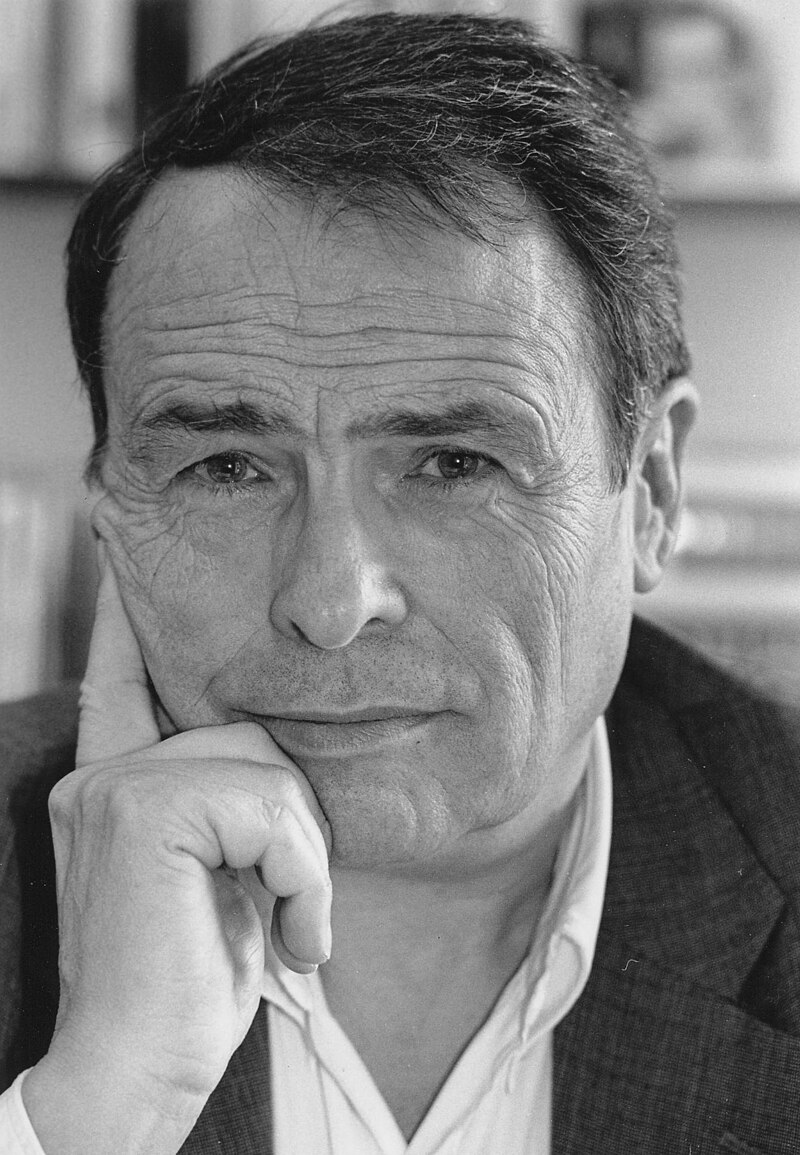
File:Pierre_Bourdieu_(1).jpg · Wikimedia Commons · See Wikimedia Commons
Pierre Bourdieu
Sign in to saveAlso known as Bourdieu, Pér Burdé, P. Burdé, Félix Bourdieu
French sociologist, anthropologist, and philosopher (1930–2002)
Pierre Bourdieu was a French sociologist, anthropologist, and philosopher who developed influential theories about how society works and how inequality is maintained across generations. His ideas matter because they fundamentally changed how scholars understand culture, education, and power, offering tools to explain why some groups in society have advantages over others.
AI-generated from the Wikipedia summary — may contain errors.
Film & TV
Denguin, Pyrénées-Atlantiques, France
Pierre Bourdieu (1 August 1930 – 23 January 2002) was a French sociologist and public intellectual. Bourdieu's contributions to the sociology of education, the theory of sociology, and sociology of aesthetics have achieved wide influence in several related academic fields (e.g. anthropology, media and cultural studies, education, popular culture, and the arts). During his academic career he was…
Known for
- Enfin pris ? — Self2002
- Sociology Is a Martial Art — Self2001
- Le champ journalistique et la télévision — Himself1997
- Arrêt sur images : le traitement par la télévison de la grêve de 1995 — Self1996
- Aujourd'hui la vie — Self1982
- Apostrophes — Self1975
via TMDB
Wikidata facts
- Instance of
- human
- Given name
- Félix
- Gender
- male
- Citizenship
- France
- Place of birth
- Denguin
- Place of death
- Paris
- Occupation
- researcher
- Position held
- director
- Educated at
- Lycée Louis-le-Grand
- Languages spoken
- French
- Native language
- French
- Award
- Goethe Medal
- Doctoral advisor
- Georges Canguilhem
- Doctoral student
- Luc Boltanski
- Field of work
- sociology of culture
- Image
- Pierre Bourdieu (1).jpg
Show 13 more facts
- place of burial
- Père Lachaise Cemetery
- Commons category
- Pierre Bourdieu
- date of death
- 2002-01-23
- date of birth
- 1930-08-01
- topic's main category
- Category:Pierre Bourdieu
- Commons gallery
- Pierre Bourdieu
- name in native language
- Pierre Bourdieu
- cause of death
- cancer
- birth name
- Pierre Félix Bourdieu
- manner of death
- natural causes
- on focus list of Wikimedia project
- Wikipedia:Vital articles/Level/4
- influenced by
- Plato
- political alignment
- far-left politics
Sources (11)
via Wikidata · CC0
~40 min read
Encyclopedic overview
Pierre Bourdieu ( UK: /bʊərˈdjɜː/, US: /bʊərˈd(j)uː/; French: [pjɛʁ buʁdjø]; Gascon: Pèir Bordièu; 1 August 1930 – 23 January 2002) was a French sociologist and public intellectual. Bourdieu's contributions to the sociology of education, the theory of sociology, and sociology of aesthetics have achieved wide influence in several related academic fields (e.g. anthropology, media and cultural studies, education, popular culture, and the arts). During his academic career he was primarily associated with the School for Advanced Studies in the Social Sciences in Paris and the Collège de France.
Bourdieu's work was primarily concerned with the dynamics of power in society, especially the diverse and subtle ways in which power is transferred and social order is maintained within and across generations. In conscious opposition to the idealist tradition of much of Western philosophy, his work often emphasized the corporeal nature of social life and stressed the role of practice and embodiment in social dynamics. Building upon and criticizing the theories of Karl Marx, Sigmund Freud, Max Weber, Émile Durkheim, Claude Lévi-Strauss, Erwin Panofsky and Marcel Mauss among others, his research pioneered novel investigative frameworks and methods, and introduced such influential concepts as the cultural reproduction, the habitus, the field or location, symbolic violence, as well as cultural capital, social capital, and symbolic capital (as distinct from traditionally recognized economic forms of capital). Another notable influence on Bourdieu was Blaise Pascal, after whom Bourdieu titled his Pascalian Meditations.
Excerpted from Wikipedia’s “Pierre Bourdieu” article, available under the CC BY-SA 4.0 licence.
Gallery (2)
Available in 70 languages
- Español
- Français
- Deutsch
- 中文
- 日本語
- Русский
- Português
- Italiano
- العربية
- Afrikaans
- Albanian
- Armenian
- Asturian
- Azerbaijani
- Bahasa Indonesia
- Basque
- Belarusian
- Bulgarian
Show 51 more
- Catalan
- Croatian
- Czech
- Danish
- Egyptian Arabic
- Esperanto
- Estonian
- Finnish
- Galician
- Greek
- Hebrew
- Hungarian
- hyw
- Icelandic
- Ido
- Interlingue
- Irish
- Kazakh
- Latin
- Latvian
- Lithuanian
- Malagasy
- Nederlands
- Norwegian
- Norwegian Nynorsk
- Occitan
- Pashto
- Picard
- Piedmontese
- Polski
- Punjabi
- Romanian
- Sardinian
- Scots
- Serbian
- Slovak
- Slovenian
- Svenska
- Tamil
- Tiếng Việt
- Türkçe
- Ukrainian
- Waray
- Welsh
- Western Mari
- Wu Chinese
- Yoruba
- zh_min_nan
- zh_yue
- فارسی
- 한국어
via Wikidata sitelinks · CC0