Don E. Wilson;Russell A. Mittermeier
Species
Near ThreatenedSPECIES
- KingdomAnimalia
- PhylumChordata
- ClassMammalia
- OrderChiroptera
- FamilyVespertilionidae
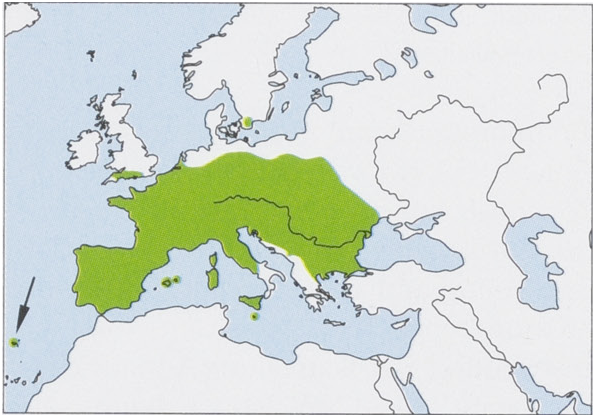
二名法 Plecotus austriacus(Fischer, 1829)[1] 长耳蝠(学名:Plecotus austriacus)为蝙蝠科长耳蝠属的动物。在中国大陆,分布于西藏、青海、新疆、四川等地。该物种的模式产地在奥地利维也纳。[1] 亚种 长耳蝠四川亚种(学名:Plecotus austriacus ariel),Thomas于1911年命名。在中国大陆,分布于青海(东部)、四川等地。该物种的模式产地在四川康定。[2] 长耳蝠青海亚种(学名:Plecotus austriacus kozlovi),Bobrinskii于1926年命名。在中国大陆,分布于青海(柴达木)等地。该物种的模式产地在柴达木东部。[3] 长耳蝠新疆亚种(学名:Plecotus austriacus mordax),Thomas于1926年命名。在中国大陆,分布于新疆(西南部)等地。该物种的模式产地在新疆喀什。[4] 长耳蝠克什米尔亚种(学名:Plecotus austriacus wardi),Thomas于1911年命名。在中国大陆,分布于西藏、新疆(准葛尔)等地。该物种的模式产地在克什米尔拉达克。[5] 参考文献 ^ 1.0 1.1 中国科学院动物研究所. 长耳蝠. 《中国动物物种编目数据库》. 中国科学院微生物研究所. [2009-03-27]. (原始内容存档于2016-03-05). ^ 中国科学院动物研究所. 长耳蝠四川亚种. 《中国动物物种编目数据库》. 中国科学院微生物研究所. [2009-03-27]. (原始内容存档于2016-03-05). ^ 中国科学院动物研究所. 长耳蝠青海亚种. 《中国动物物种编目数据库》. 中国科学院微生物研究所. [2009-03-27]. (原始内容存档于2016-03-05). ^ 中国科学院动物研究所. 长耳蝠新疆亚种. 《中国动物物种编目数据库》. 中国科学院微生物研究所. [2009-03-27]. (原始内容存档于2016-03-05). ^ 中国科学院动物研究所. 长耳蝠克什米尔亚种. 《中国动物物种编目数据库》. 中国科学院微生物研究所. [2009-03-27]. (原始内容存档于2016-03-05). 取自“https://zh.wikipedia.org/w/index.php?title=长耳蝠&oldid=49407151” 分类:长耳蝠属 隐藏分类: TaxoboxLatinName 本地相关图片与维基数据相同 含有拉丁語的條目
via GBIF · IUCN
Bird sounds
- echolocation· Sweden· quality A
- echolocation· France· quality A
- echolocation· Spain· quality B
- echolocation· Spain· quality B
via Xeno-canto
Wikidata facts
- Image
- Plecotus austriacus (cropped).jpg
Show 6 more facts
- taxon name
- Plecotus austriacus
- Commons category
- Plecotus austriacus
- Commons gallery
- Plecotus austriacus
- taxon common name
- esperteyu oreyón gris
- wingspan
- 277.5
- short name
- P. austriacus
Sources (9)
via Wikidata · CC0
~2 min read
Article
The grey long-eared bat (Plecotus austriacus) is a fairly large European bat. It has distinctive ears, long and with a distinctive fold. It hunts above woodland, often by day, and mostly for moths. In captivity, it has also been recorded to eat small lizards. It is extremely similar to the more common brown long-eared bat, and was only distinguished in the 1960s, but has a paler belly.
Biology and ecology