Skejo, Josip;Rebrina, Fran;Szövényi, Gergely;Puskás, Gellért;Tvrtković, Nikola
Poecilimon
Sign in to savethumb|P. bilgeri nymph Poecilimon is a genus of bush crickets in the subfamily Phaneropterinae and tribe Barbitistini. Species can be found in: central and Southeast Europe (including Italy and the Southern Alps, Southern Hungary, Romania, Bulgaria), the south of the European part of the former USSR, Asia Minor, Syria, Palestine, the Caucasus, Persia and extends in Central Asia to the Altai Mountains.
Species
GENUS
- KingdomAnimalia
- PhylumArthropoda
- ClassInsecta
- OrderOrthoptera
- FamilyTettigoniidae
via GBIF
Museum specimens
- Specimen records
- 5
- Family
- Tettigoniidae
- Collections
- UPS, MZLU
- Recorded in
- Bulgaria, Georgia, Serbia
Wikidata facts
- Instance of
- taxon
- Parent taxon
- Tettigoniidae
- Image
- Poecilimon ornatus, male.jpg
Show 4 more facts
- Commons category
- Poecilimon
- taxon rank
- genus
- taxon name
- Poecilimon
- topic's main category
- Category:Poecilimon
Sources (1)
via Wikidata · CC0
~8 min read
Encyclopedic overview
5 sectionsContents
- Description
- Species
- subgenus ''Poecilimon'' <small>Fischer, 1853</small>
- References
- External links
thumb|P. bilgeri nymph Poecilimon is a genus of bush crickets in the subfamily Phaneropterinae and tribe Barbitistini. Species can be found in: central and Southeast Europe (including Italy and the Southern Alps, Southern Hungary, Romania, Bulgaria), the south of the European part of the former USSR, Asia Minor, Syria, Palestine, the Caucasus, Persia and extends in Central Asia to the Altai Mountains.
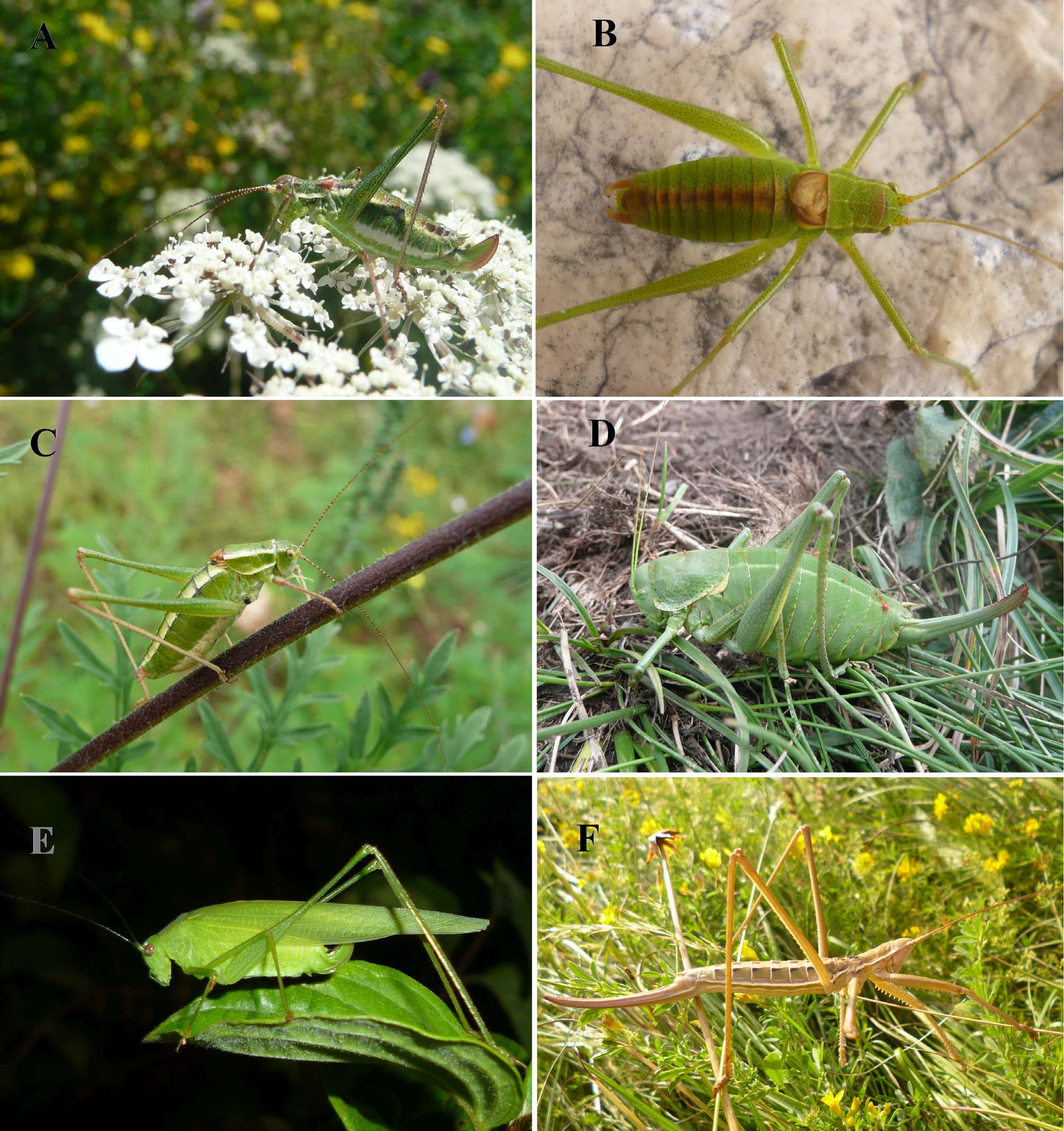
==Description== Because Poecilimon species are often brightly coloured, they may be called "bright bush crickets", although some are mostly green. As with many Orthoptera, colouration can be misleading, with variability within species. Often there is a stripe behind the eyes, dorsally dark and can extend beyond the pronotum. The fastigium is broader to narrower than the scapus. The pronotum is often shiny, smooth, and often rounded dorsally. These insects are often brachypterous and females can be apterous. In the males, the cerci are very different, but are always more or less conical in the females. The ovipositor is always straight and slightly curved upwards and serrated. The antennae are monochrome or ringed and about three times as long as the body.
Excerpted from Wikipedia’s “Poecilimon” article, available under the CC BY-SA 4.0 licence.