File:Brain_bulbar_region.svg · Wikimedia Commons · See Wikimedia Commons
puente troncoencefálico
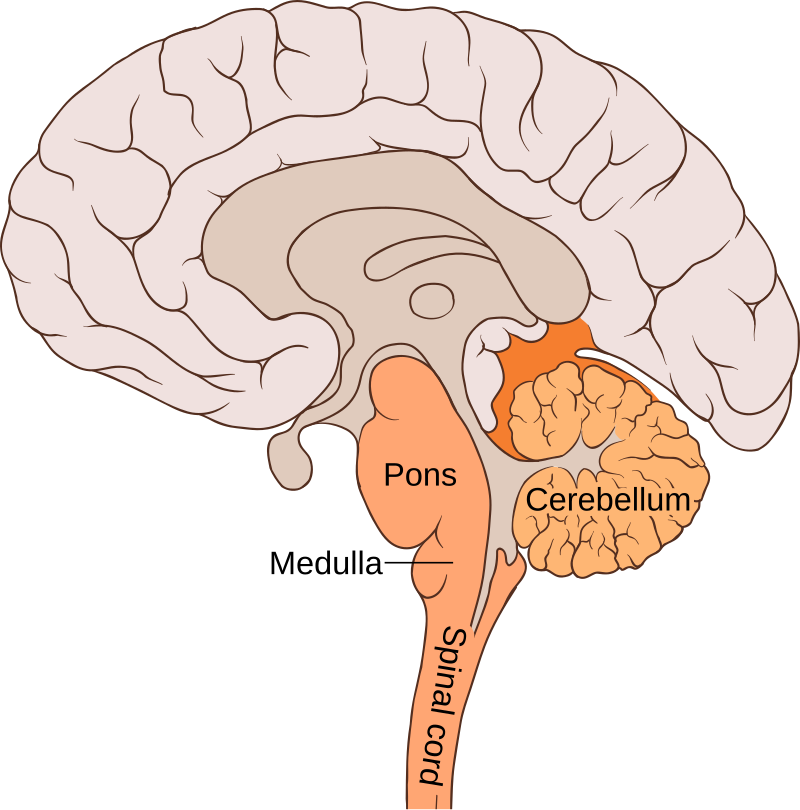
Sign in to saveThe pons (from Latin ) is the part of the brainstem that, in humans and other mammals, lies inferior to the midbrain, superior to the medulla oblongata, and anterior to the cerebellum.
Key facts
- Brain.Name
- Pons
- Brain.Image
- Brain bulbar region.svg
- Brain.Caption
- Pons in the brainstem
- Brain.Image2
- Gray679.png
- Brain.Caption2
- Anteroinferior view of the medulla oblongata and pons
- Brain.IsPartOf
- Brain stem
- Brain.Artery
- Pontine arteries
- Brain.Vein
- Transverse and lateral pontine veins
via Wikipedia infobox
Research
44,188 papers- Tumors of the pons.Neurosurgery clinics of North America · 1993
- The rhombencephalon and breathing: a view from the pons.Respiratory physiology & neurobiology · 2004
- [Brainstem infarction (pons)].Nihon rinsho. Japanese journal of clinical medicine · 2006
- Pons Anteroposterior and Cerebellar Vermis Craniocaudal Diameters in Fetuses With Down Syndrome.Journal of ultrasound in medicine : official journal of the American Institute of Ultrasound in Medicine · 2021
- Sudden deafness.Current opinion in neurology · 2006
via PubMed
Wikidata facts
- Part of
- brain stem
- Image
- Pons.gif
Show 6 more facts
- Commons category
- Pons
- topic's main category
- Category:Pons
- arterial supply
- pontine arteries
- anatomical location
- brain stem
- different from
- Most
- native label
- pons Varolii
via Wikidata · CC0
Article · Español
El puente troncoencefálico, también llamado protuberancia anular o puente de Varolio (Pons, en latín), es la porción del tronco del encéfalo que se ubica entre la médula oblongada y el mesencéfalo. Es el segmento más prominente del tronco del encéfalo, y su superficie anterior es convexa. Su nombre deriva del gran número de fibras transversales en la cara anterior que conectan los dos hemisferios cerebelosos. Además de núcleos sensitivos y motores, contiene una porción de la formación reticular que participa en funciones importantes para la vida como el sentido de la vista, coordinación motora, el sueño y el estado de alerta.
Abstract from DBpedia / Wikipedia · CC BY-SA