
Portugal
Also known as Portuguese Republic, PRT, POR
pays du sud-ouest de l'Europe
AI overview
Portugal is a European country located on the Iberian Peninsula in the southwest, comprising mainland territory plus two autonomous regions in the Atlantic Ocean, with a population of over 10.7 million people. It matters as the westernmost point of continental Europe and serves as a distinct nation that borders Spain while maintaining its own independent identity and governance.
AI-generated from the Wikipedia summary — may contain errors.
Weather now
cached 2h ago22°scattered clouds
42% 0.7 m/s OpenWeatherMap
7-day forecast
via Open-Meteo
Country
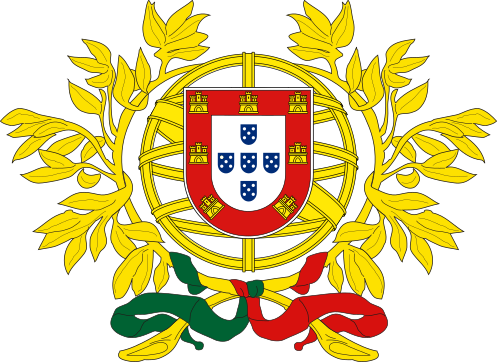

- Capital
- Lisbon
- Population
- 10,749,635
- Region
Travel guide
Understand
Portugal sits on the western edge of the Iberian peninsula, with two archipelagos in the Atlantic Ocean. Despite its small land area, it has many landforms and climates between the Atlantic coast and the mountains.
Get in
In addition, citizens of Andorra may enter and reside in Portugal indefinitely without a visa.
See
thumb|Pena National Palace, in [[Sintra: it's one of the major expressions of 19th-century Romanticism in the world.]] thumb|The luxurious [[Cascais village in the Portuguese Riviera (Estoril Coast).]] thumb|[[Fátima|Sanctuary of Our Lady of Fátima: this is one of the largest pilgrimage sites (Marian shrine) in the world.]]
Eat
Portuguese cuisine evolved from hearty peasant food drawn from the land and abundant seafood found in the country's lengthy coast with the cows, pigs and goats raised on the limited grazing land of its interior. From these humble origins, spices and condiments brought back to the country during the exploration and colonisation of South America, Africa, the East Indies and the Far East, contributed to the development of what become regarded as 'typical' Portuguese cuisine which inherently, also helped shape the cuisine in the regions under Portuguese influence, from Brazil and Cape Verde to Thailand and Japan. Today, traditional Portuguese cuisine is served alongside the latest trendy and fusion cuisine styles. Several establishments have been awarded Michelin stars.
thumb|Caldo verde: the green broth is a very popular soup in Portuguese cuisine. Soup is an essential first course of a Portuguese meal. The most popular is the Minho speciality, caldo verde, made from kale, potatoes and spiced smoked sausage.
thumb|Bacalhau à Brás: salt cod with onions, scrambled eggs and fried potatoes. You will see another Portuguese staple bacalhau (salt cod) everywhere. Locals will tell you that there are as many ways to cook this revered dish as there are days in the year, or even more.
thumb|Sardinhas assadas: grilled sardines with potatoes and salad. The most common of Portugal's delicious fish (peixe) dishes revolve around sole (linguado) and sardines (sardinha) although salmon (salmão…
Drink
thumb|Portuguese drinks: Brandy from [[Douro, and Porto and Madeira wines.]] When travelling in Portugal, the drink of choice is wine. Red wine is the favourite amongst the locals, but white wine is also popular. Northern Portugal has a white wine cultivar variation with a greenish tint known as vinho verde. This wine has a very crisp acidic-sweet flavour and is better served cold, it goes best with seafood or fish dishes and Alvarinho is one of the more famous brands. Drinking wine during a meal or socially is very common in Portugal, after a meal is finished, people will tend to talk and sip wine while the food digests. Port wine (vinho do Porto) can be an apéritif or a dessert. Alentejo wine may not be yet known worldwide like Port, but within Portugal just as famous, Esporão is one of the best brands from the Alentejo region. Portugal has other official demarcated wine regions (regiões vinhateiras) which produce some of the best wines such as, Madeira, Dão, Sado and Douro. The Bairrada region produces some delightful sparkling wines, Raposeira being a well known brand.
Article · Français
Le Portugal, en forme longue la République portugaise, en portugais : República Portuguesa, est un pays d'Europe du Sud, membre de l'Union européenne, situé dans l'Ouest de la péninsule Ibérique. Délimité au nord et à l'est par l'Espagne puis au sud et à l'ouest par l'océan Atlantique, il est le pays le plus occidental de l'Europe continentale. Il comprend également les archipels des Açores et de Madère, deux régions autonomes situées dans le nord de l'océan Atlantique, pour une superficie totale de 92 090 km2. Membre fondateur de l'OTAN, le Portugal est étroitement lié politiquement et militairement avec l'ensemble des autres pays occidentaux. Il est également membre de l’OCDE, de l'ONU, du conseil de l'Europe et de l’espace Schengen et est l'un des pays fondateurs de la zone euro. Le Portugal entretient en outre d'importantes relations avec l'Espagne et la France, l'Allemagne, le Royaume-Uni et l'Italie, qui sont ses cinq plus importants partenaires commerciaux. Fondé au XIIe siècle, le royaume de Portugal devient au XVe siècle l'une des principales puissances d'Europe occidentale, jouant un rôle majeur dans les Grandes découvertes et se constituant un vaste empire colonial en Afrique, en Asie, en Océanie, et en Amérique du Sud. La puissance du pays décline à partir du XVIIe siècle. La monarchie portugaise est renversée en 1910, à l'issue d'un soulèvement militaire qui contraint le roi Manuel II à l'exil. La Première République portugaise (en portugais : Primeira República) est le régime politique en vigueur au Portugal entre la fin de la monarchie constitutionnelle marquée par la révolution du 5 octobre 1910 et le coup d'État militaire du 28 mai 1926. Puis, pendant plus de quarante ans, le pays est soumis au régime autoritaire d'António de Oliveira Salazar, jusqu'à la révolution des Œillets de 1974 qui met fin à la dictature et restaure la démocratie dans le pays. L'économie du Portugal a alors connu un essor important. Il devient à la fin du XXe siècle un pays développé selon les standards européens, économiquement prospère, socialement et politiquement stable. En 2011, la dégradation économique mondiale conduit le Portugal à la récession et provoque une crise socio-économique et politique. Le Portugal doit également relever le défi du renouvellement des générations, le pays a en effet la fécondité la plus faible d'Europe et une des plus faibles au monde avec seulement 1,23 enfant par femme. Durant la dictature de 1926 à 1974 près d'un million et demi de Portugais sont partis travailler en dehors du pays pour fuir la pauvreté de la campagne et les guerres coloniales. Les fortes zones d'émigration portugaise sont le Brésil, les États-Unis, la France, le Luxembourg (14,1 % de la population totale du pays), la Suisse, l'Argentine, le Venezuela, le Canada, ainsi que la principauté d'Andorre. Avec plus de 30 millions de luso-descendants (descendants portugais) dans le monde, la diaspora portugaise est à l'heure actuelle l'une des principales diasporas européennes et mondiales. Le tourisme, principalement balnéaire, est une ressource très importante, notamment en Algarve et dans la région de Lisbonne. Le climat subtropical de Madère et ses paysages singuliers en font une destination touristique appréciée. Le Portugal est l'un des pays les plus visités d'Europe avec 12,7 millions de touristes en 2019. Il est également un grand pays viticole, réputé notamment pour le vin de Porto. Le Portugal est par ailleurs le premier producteur mondial de liège. Le Portugal rayonne enfin grâce aux grands événements qu'il organise. Sa capitale, Lisbonne, a ainsi accueilli l'Exposition universelle sur le thème des océans en 1998. Il s'est également porté candidat, conjointement avec l'Espagne, à l'organisation de la coupe du monde de football 2018 après avoir été l'hôte du championnat d'Europe en 2004.
Gallery (59)
On the map
6 mapped locations
Connections
Categories
Countries and territories where Portuguese is an official languageCountries in EuropeCountries in North AfricaIberian Peninsula countriesMember states of NATOMember states of the Community of Portuguese Language CountriesMember states of the European UnionMember states of the Union for the MediterraneanMember states of the United NationsOECD membersPortugal