
Romania
Sign in to saveAlso known as Roumania, Rumania, România, ro
Romania is a country in Southeast and Central Europe. It lies on the lower course of the Danube, north of the Balkan Peninsula, and on the northwestern shore of the Black Sea. It borders Ukraine to the north and east, Hungary to the west, Serbia to the southwest, Bulgaria to the south, Moldova to the east, and the Black Sea to the southeast. It is the twelfth-largest country in Europe by area, covering , and the sixth-most populous member state of the European Union, with nearly 20 million inhabitants. The capital, largest city and economic centre is Bucharest. Other major cities include Cluj-
OverviewAI-generated
Romania is a country in Southeast Europe with the capital Bucharest. Its native label is România. The nation operates under a semi-presidential system, with the head of government holding the office of Prime Minister of Romania. It has been characterized as a free country. The official currency is the Romanian Leu.
The population is recorded at 23,201,835 in one source, 19,036,031 in another, and 19,051,804 in a third. The land area is 238,391 square units. Forest area comprises 30.1158292767733 percent of the total, while renewable energy accounts for 23.6 percent. The urban population percentage is 52.1674778928768, and internet users make up 91.29048551 percent. Life expectancy is 76.4585365853659 years, and the unemployment rate is 5.992 percent.
Romania is located in the Eastern European Time zone, observing UTC+02:00 and UTC+03:00. Its license plate code is RO, and the top-level domain is .ro. The emergency phone number is 112. Diplomatic relations exist with Canada, Italy, Germany, and Australia. The country's inception date is 1859-01-24.
Synthesized by Vinony from 67 facts across 9 sources: Wikidata, REST Countries, Openweathermap, Open Meteo, World Bank, OpenStreetMap, PubMed, Vinony graph, Geo. Generated from structured data (not the Wikipedia text) and checked against those facts — may still contain errors.
Weather now
cached 212h ago7-day forecast
via Open-Meteo
Country

- Capital
- Bucharest
- Population
- 19,036,031
- Region
- Europe · Southeast Europe
- Demonym
- Romanian
- Currencies
- RON (lei)
- Languages
- Romanian
- Calling code
- +40
- Drives on
- Right
- Gini
- 35.8 (2018)
- FIFA code
- ROU
- TLD
- .ro
- Timezones
- UTC+02:00
- Borders
- BGR, HUN, MDA, SRB, UKR
via REST Countries
Indicators · World Bank
- GDP
- $382.6B(2024)
- Population
- 19,051,804(2024)
- Life expectancy
- 76.5 yrs(2024)
- Unemployment
- 6 %(2025)
- Urban population
- 52.2 %(2024)
- Internet users
- 91.3 %(2024)
- Forest area
- 30.1 %(2023)
- Renewable energy
- 23.6 %(2021)
via World Bank Open Data · CC BY 4.0
Wikipedia views (30d)
200,905 totalvia Wikimedia Pageviews API
Key facts
- Country.coa_size
- 70
- Country.conventional_long_name
- Romania
- Country.image_flag
- Flag of Romania.svg
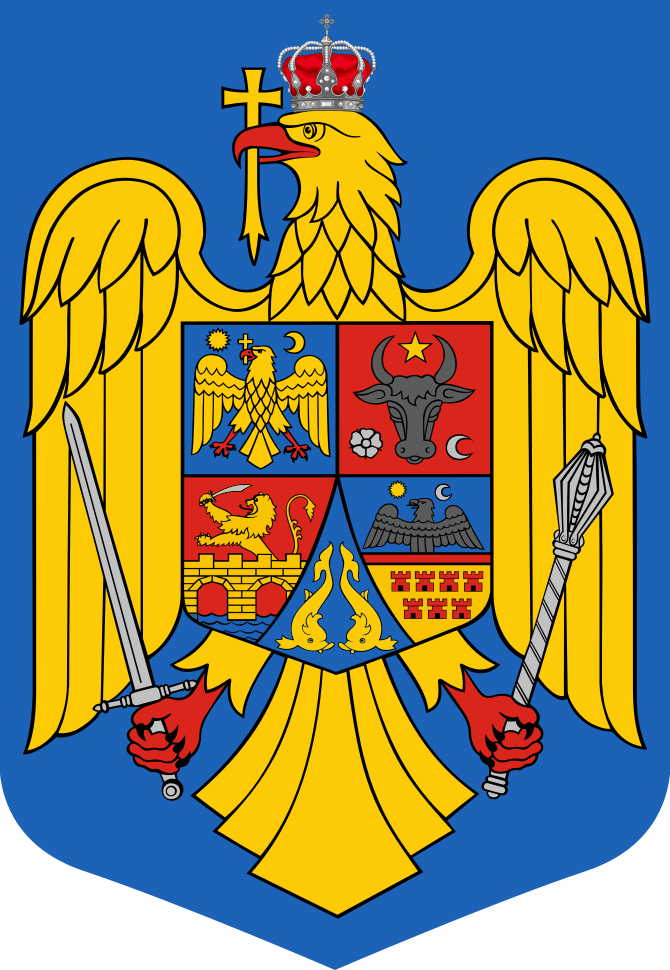
- Country.image_coat
- Coat of arms of Romania.svg
- Country.national_anthem
- "Awaken Thee, Romanian!"File:Desteapta-te, romane!.ogg
- Country.capital
- Bucharest
- Country.largest_city
- capital
- Country.official_languages
- Romanian
- Country.ethnic_groups_year
- 2021
- Country.demonym
- Romanian
- Country.religion_year
- 2021
- Country.government_type
- Unitary semi-presidential republic
- Country.leader_title1
- President
- Country.leader_name1
- Nicușor Dan
- Country.leader_title2
- Prime Minister
- Country.leader_name2
- Ilie Bolojan
- Country.leader_title3
- President of the Senate
- Country.leader_name3
- Mircea Abrudean
via Wikipedia infobox
Research
121,235 papers- Barrett's Esophagus in Romania: what do we know?ReviewRomanian journal of internal medicine = Revue roumaine de medecine interne · 2020Piloiu C, Dumitrascu DLDOI: 10.2478/rjim-2020-0007
- Romania, a Harbour of HIV-1 Subtype F1: Where Are We after 33 Years of HIV-1 Infection?ReviewViruses · 2022Preda M, Manolescu LCSDOI: 10.3390/v14092081
- Blood banking: The situation in ROMANIA.ReviewTransfusion and apheresis science : official journal of the World Apheresis Association : official journal of the European Society for Haemapheresis · 2023Oancea V, Burta O, Dobrota ADOI: 10.1016/j.transci.2023.103801
- The beginnings of orthopaedics in Romania.ReviewInternational orthopaedics · 2018Poenaru DV, Oprea MDDOI: 10.1007/s00264-018-4009-5
- Romania's Forgotten Children: Sensory Deprivation Revisited.Comprehensive child and adolescent nursing · 2020Glasper EADOI: 10.1080/24694193.2020.1735250
- A review of telemedicine in Romania.ReviewJournal of telemedicine and telecare · 2004Panait L, Doarn CR, Saftoiu A et al.DOI: 10.1258/135763304322764103
- Mental health related stigma in Romania: systematic review and narrative synthesis.BMC psychiatry · 2023Manescu EA, Henderson C, Paroiu CR et al.DOI: 10.1186/s12888-023-05147-3
- Romania.Department of State publication. Background notes series · 1983United States. Department of State. Bureau of Public Affairs
via PubMed
Travel guide
Understand
With a Black Sea coast to the east, it is bordered by Bulgaria to the south, Serbia to the southwest, Hungary to the northwest, Moldova to the northeast and Ukraine in both the north and the east. While its southern regions are usually seen as part of Southeastern Europe (Balkans), Transylvania, its largest region, is in Central Europe.
The country is enjoying better standards since the Communist periods, with foreign investment on the rise. It is even considered to be the one of the fastest developing countries in the world due to its rapid GDP growth year by year and infrastructure improvements.
Get in
Getting to Romania is easy from nearly all parts of the world: it is served by an array of transport types and companies.
Romania has borders with the following countries: Ukraine, Bulgaria, Serbia, Moldova, and Hungary.
Get around
thumb|Lake Oașa near [[Sebeș, with Pătru's peak in the background.]] thumb|Colourful tombstones at the Merry Cemetery in [[Săpânța.]] thumb|Rugged landscapes in Prahova County. Getting around Romania is relatively inefficient for the great distances that have to be covered in this country (this is after all, the second-largest country in Central Europe, after Poland). The transport infrastructure has been improving quite significantly, even though roads remain a weak point. There are three operational highways, that connect Bucharest to the seaside and to the cities of Pitești and Ploiești, respectively, and several others under construction. Train travel, however, has improved dramatically. Several upgrade projects are underway for several railway tracks, which makes rail traffic on those lines a bit slow for the time being.
See
thumb|Bran Castle is one of Romania's main landmarks.
Whether you're looking for stunning landscapes, ancient cultural traditions, bustling city life or beautiful historic heritage; no visitor to Romania needs to search for things to see. This country is home to a range of top sights, especially when you'd like to get a feel for the old Europe, the time of monasteries and castles.
Do
thumb|Trekking in the Retezat Mountains thumb|[[Southern Bukovina is home to the remarkable Painted Monasteries]] thumb|Romania has a number of good winter sports destinations Go to church - Romania is one of the most religious countries in Europe, and the Orthodox church is omnipresent. You will certainly want to visit some churches and monasteries for their beauty and history, but why not take the chance to experience an Orthodox mass? The congregation is usually standing and it is perfectly normal to show up only briefly during the mass so you can come and go at your leisure without disturbing anyone. Show up at any church on Sunday morning, stand quietly in the back and observe. Be suitably dressed, see the section "Respect".
You will experience bible readings, prayers and other rituals accompanied by a short sermon explaining the text. You are not likely to understand much, but you can notice the varying levels of involvement among church-goers, visible in how long and where people stay at the mass, and how often they sign themselves with the cross, or even genuflect. Organised congregation singing is not common but is conducted by a choir with each church-goer joining when he feels like. The choir singing can be captivating, the quality usually reflects the importance of the church.
The altar has sections with doors that open and close depending on the church season. You will also see candles sold, they are lit in or by the church in separate trays for the souls of ei…
Eat
thumb|Colivă dishes are used for a church ritual. thumb|Saramura is one of Romania's traditional dishes. Romanian food is distinct yet familiar to most people, being a mixture of Balkan cuisine and Central European cuisine, but it has some unique elements. The local dishes are the delicious sarmale, ardei umpluți (stuffed peppers), mămăligă (pr. muhmuhliguh, polenta), bulz (traditional roasted polenta, filled with at least two kinds of cheeses, bacon and sour cream), friptură (steak), salată de boeuf (finely chopped cooked veggies and meat salad, usually topped with mayo and decorated with tomatoes and parsley), zacuscă (a yummy, rich salsa-like dip produced in the fall) as well as tocană (a kind of stew), tochitură (pr. tokituruh, an assortment of fried meats, and traditional sausages, in a special sauce, served with polenta and fried eggs), mici (pr. michi, with a ch sound like in the word "chat"; a kind of spicy sausage, but only the meat, without the casings, almost always cooked on a barbecue, but may also be cooked with hot water vapours; often served with beer during picnics - mici și bere), roe salad, various mashed beans varieties like iahnie (the h is loud).
Other dishes include a burger bun with a slice of ham, a slice of cheese and a layer of French fries, ciorbă de burtă (white sour tripe soup), ciorbă rădăuțeană (very similar to ciorbă de burtă, but with chicken instead of tripe), ciorbă țărănească (a red sour soup, akin to borș but with the beet root being rep…
Drink
thumb|Palinca for sale at a festival
Sleep
Finding an accommodation in Romania is very easy, for any price. In all the touristy places, as soon as you get to the train station several people will come to you asking whether you need an accommodation, or you can book it in advance. Those people welcoming you at the station often speak English, French and Italian. Moreover, while walking on the street, you will often find cazare written on the houses; that means they will rent you a room in their house. You're best advised to book an accommodation in advance in the big cities (Bucharest, Cluj-Napoca, Brasov and Iasi), since it'll be quite hard to wander around looking for a place to sleep, but you won't have any problem at all anywhere else.
As in most other countries, it is often cheaper to obtain accommodation directly with the hotel (either in person or in advance via the internet) rather than through booking agencies. Even an increasing number of small hotels will accept reservations via the Internet. Search for the local official tourist guide websites which will have a list of hotels and/or bed and breakfasts, then inquire at that site: most have information in English, many have formal reservation webpages. Prices for 4-star hotels are much the same as in the rest of Europe, certainly in Bucharest, whilst 3-star hotels and below can be a little cheaper. A feature of Romanian accommodation prices is that many bed and breakfast establishments (without any hotel star rating) are as expensive as or more expensive tha…
Stay safe
Romania is a very safe country, where random attacks are almost non-existent. While violence against foreign tourists is rare, this does not mean you should leave your common sense at home, if you decide to vacation in Romania. Generally crime is limited to petty thefts and common scams, and not much else that would concern the tourist. Wherever you may be in the country, ask trusted locals about the surroundings, they will gladly give you a few pointers.
Although racial prejudice exists in Romania, especially toward those who look like Roma (“gypsies”), hate crimes are rare. Some homophobic prejudice also remains, for instance an annual gay pride parade in Bucharest has been the scene of violent protests in past years.
Stay healthy
Tap water is generally potable, but most people choose to drink bottled water instead.
Travel guide from Wikivoyage (CC BY-SA 4.0)
~40 min read
Encyclopedic overview
40 sectionsContents
- Etymology
- History
- Prehistory
- Antiquity
- Middle Ages
- Early modern times and national awakening
- Unification and the Kingdom of Romania
- From the Little Union to the Great War
- World War I and the Great Union
- Interwar period
- World War II
- Socialist Romania (1947–1989)
- Romania since 1989
- Geography
- Climate
- Politics
- Government
- Foreign relations
- Military
- Administrative divisions
- Economy
- Infrastructure
- Tourism
- Science and technology
- Demographics
- Languages
- Religion
- Urbanisation
- Education
- Healthcare
- Culture
- Arts and monuments
- Holidays, traditions, and cuisine
- Media
- Sports
- See also
- Notes
- References
- Sources
- External links
Romania is a country in Southeast and Central Europe. It lies on the lower course of the Danube, north of the Balkan Peninsula, and on the northwestern shore of the Black Sea. It borders Ukraine to the north and east, Hungary to the west, Serbia to the southwest, Bulgaria to the south, Moldova to the east, and the Black Sea to the southeast. It is the twelfth-largest country in Europe by area, covering 238,397 km (92,046 mi), and the sixth-most populous member state of the European Union, with 19 million inhabitants. The capital, largest city and economic centre is Bucharest. Other major cities include Cluj-Napoca, Iași, Constanța, Timișoara and Brașov.
Romania was settled during the Lower Paleolithic, later becoming Dacia before Trajan's Dacian Wars and Romanisation. The modern Romanian state was formed in 1859 with the unification of Moldavia and Wallachia under Alexandru Ioan Cuza, becoming the Kingdom of Romania in 1881 under Carol I of Romania. Romania gained independence from the Ottoman Empire in 1877, formalised by the Treaty of Berlin. After World War I, Transylvania, Banat, Bukovina, and Bessarabia joined the Old Kingdom, forming Greater Romania, which reached its largest territorial extent. In 1940, under Axis pressure, Romania lost territories to Hungary, Bulgaria, and the Soviet Union. Following the Act of 23 August, Romania switched sides to join the Allies. After World War II, it regained Northern Transylvania through the Paris Peace Treaties. Under Soviet occupation, King Michael I was forced to abdicate, and Romania became a socialist republic and Warsaw Pact member. After the fall of communism and the Romanian revolution in 1989, Romania transitioned to liberal democracy.
Excerpted from Wikipedia’s “Romania” article, available under the CC BY-SA 4.0 licence.
Gallery (59)
On the map
6 mapped locations
Available in 280 languages
- Español
- Français
- Deutsch
- 中文
- 日本語
- Русский
- Português
- Italiano
- العربية
- हिन्दी
- Abkhazian
- Acehnese
- Adyghe
- Afrikaans
- Akan
- Albanian
- Albanian
- Amharic
Show 261 more
- ami
- Angika
- Aragonese
- Aramaic
- Armenian
- Arpitan
- Asturian
- Awadhi
- Aymara
- azb
- Azerbaijani
- Bahasa Indonesia
- Balinese
- Bangla
- Bashkir
- Basque
- bat_smg
- Bavarian
- be_x_old
- Belarusian
- Betawi
- Bhojpuri
- Bikol
- Bishnupriya
- Bislama
- blk
- Bosnian
- Breton
- Bulgarian
- Buriat
- Burmese
- Catalan
- cbk_zam
- cdo
- Cebuano
- Central Kurdish
- Chamorro
- Chechen
- Cherokee
- Church Slavic
- Chuvash
- Cornish
- Corsican
- Crimean Tatar
- Croatian
- Czech
- Danish
- Divehi
- dty
- Dzongkha
- Egyptian Arabic
- eml
- Erzya
- Esperanto
- Estonian
- Ewe
- Extremaduran
- Faroese
- Fiji Hindi
- Filipino
- Finnish
- fiu_vro
- Friulian
- Fula
- Gagauz
- Galician
- Ganda
- gcr
- Georgian
- Gilaki
- Gothic
- Greek
- Guarani
- Gujarati
- Haitian Creole
- Hakka Chinese
- Hausa
- Hawaiian
- Hebrew
- Hungarian
- hyw
- Icelandic
- Ido
- Igbo
- Iloko
- Inari Sami
- Interlingua
- Interlingue
- Irish
- Jamaican Creole English
- Javanese
- Jju
- Kabardian
- Kabyle
- Kannada
- Kara-Kalpak
- Karachay-Balkar
- Kashmiri
- Kashubian
- Kazakh
- kbp
- kge
- Khmer
- Kinyarwanda
- Komi
- Komi-Permyak
- Kongo
- Konkani
- Kotava
- Kurdish
- Kyrgyz
- Ladino
- Lao
- Latgalian
- Latin
- Latvian
- lbe
- Lezghian
- Ligurian
- Limburgish
- Lingala
- Lingua Franca Nova
- Lithuanian
- lld
- Lojban
- Lombard
- Low German
- Lower Sorbian
- Luxembourgish
- Macedonian
- Madurese
- Maithili
- Malagasy
- Malay
- Malayalam
- Maltese
- Manipuri
- Manx
- Māori
- map_bms
- Marathi
- Mari
- Mazanderani
- Minangkabau
- Mingrelian
- Mirandese
- Moksha
- Mongolian
- Moroccan Arabic
- Navajo
- nds_nl
- Neapolitan
- Nederlands
- Nepali
- Newari
- Northern Frisian
- Northern Sami
- Norwegian
- Norwegian Nynorsk
- Novial
- nrm
- Obolo
- Occitan
- Odia
- Old English
- olo
- Oromo
- Ossetic
- Pampanga
- Pangasinan
- Papiamento
- Pashto
- Pennsylvania German
- Picard
- Piedmontese
- Polski
- Pontic
- Punjabi
- Quechua
- roa_rup
- roa_tara
- Romanian
- Romansh
- Romany
- Rusyn
- Samoan
- Santali
- Sardinian
- Saterland Frisian
- Scots
- Scottish Gaelic
- Serbian
- Serbian (Latin)
- Shan
- Shona
- Sicilian
- Silesian
- simple
- Sindhi
- Sinhala
- Slovak
- Slovenian
- Somali
- Southern Sotho
- Sranan Tongo
- Standard Moroccan Tamazight
- Sundanese
- Svenska
- Swahili
- Swati
- szy
- Tachelhit
- Tajik
- Talysh
- Tamil
- Taroko
- Tatar
- tay
- Telugu
- Tetum
- Tibetan
- Tiếng Việt
- Tigrinya
- Tok Pisin
- Toki Pona
- Tongan
- Tumbuka
- Türkçe
- Turkmen
- Tyap
- Udmurt
- Ukrainian
- Upper Sorbian
- Urdu
- Uyghur
- Uzbek
- Venetian
- Veps
- Volapük
- Walloon
- Waray
- Welsh
- West Flemish
- Western Frisian
- Western Panjabi
- Wolof
- Wu Chinese
- Xhosa
- Yakut
- Yiddish
- Yoruba
- Zaza
- Zeelandic
- zh_classical
- zh_min_nan
- zh_yue
- Zhuang
- Zulu
- فارسی
- ไทย
- 한국어
via Wikidata sitelinks · CC0