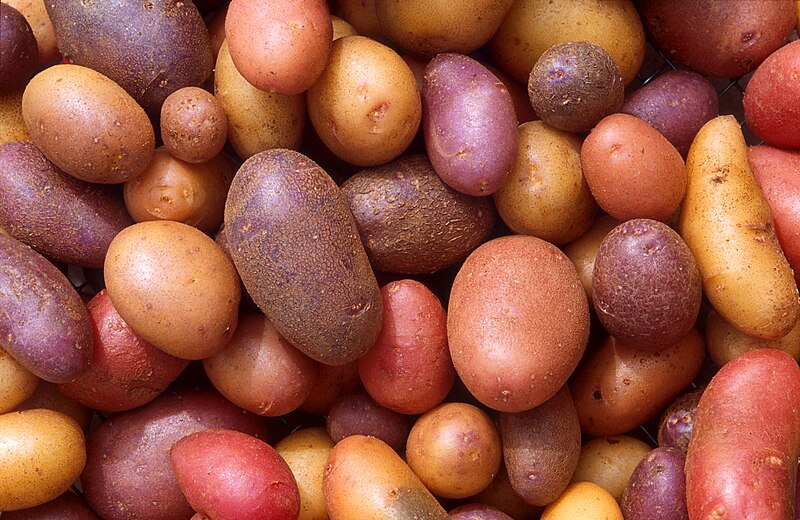
File:Patates.jpg · Wikimedia Commons · See Wikimedia Commons
potato
Sign in to saveAlso known as potato plant, tater, tattie, spud, Solanum tuberosum
The potato () is a starchy tuberous vegetable native to the Americas that is consumed as a staple food in many parts of the world. Potatoes are underground stem tubers of the plant Solanum tuberosum, a perennial in the nightshade family Solanaceae.
OverviewAI-generated
Solanum tuberosum, commonly known as the potato, is a species within the genus Solanum. It belongs to the family Solanaceae and is classified as a perennial, useful, and poisonous plant. The organism produces berries as fruit and serves as a source for potato starch. It functions as a food ingredient, vegetable, fodder, and medicinal plant.
The taxon’s range includes Beijing, China, the Tibet Autonomous Region, and Guangdong. It is described in the Brockhaus and Efron Encyclopedic Dictionary and the Encyclopædia Britannica 11th edition. The potato is referenced by 4,050 other encyclopedia articles and has a PubMed count of 38,342. Its genome is sequenced and available through Ensembl. The Unicode character for the potato is 🥔.
Synthesized by Vinony from 29 facts across 4 sources: Wikidata, PubMed, Plants of the World, Vinony graph. Generated from structured data (not the Wikipedia text) and checked against those facts — may still contain errors.
Species
Solanum tuberosum La Pomme de terre ou patate (dans le registre informel ou bien en français canadien ou belge) est un tubercule comestible produit par l’espèce Solanum tuberosum, appartenant à la famille des solanacées. Le terme désigne également la plante elle-même, plante herbacée, vivace par ses tubercules mais toujours cultivée comme une culture annuelle. La pomme de terre est une plante qui réussit dans la plupart des sols, mais elle préfère les sols légers et légèrement acides. La plante est sujette aux maladies dans des sols calcaires ou manquant d’humus[1]. La pomme de terre est originaire de la cordillère des Andes (Pérou), dans le Sud-Ouest de l’Amérique du Sud où son utilisation remonte à environ 8 000 ans. Introduite en Europe vers la fin du XVIe siècle à la suite de la découverte de l’Amérique par les conquistadors espagnols, elle s’est rapidement diffusée dans le monde et est en 2015 cultivée dans plus de 150 pays sous pratiquement toutes les latitudes habitées. Elle est une source importante de glucides, qui se présentent principalement sous forme de fécule[N 1], et selon son mode de cuisson elle peut apporter des quantités notables de protéines et de vitamines. Ses
via · Kew POWO
Research
38,342 papers- Molecular Mechanisms of Dual Potato Reproduction.ReviewPhysiologia plantarum · 2025Kasprzewska A, Basińska-Barczak ADOI: 10.1111/ppl.70451
- New Frontiers in Potato Breeding: Tinkering with Reproductive Genes and Apomixis.ReviewBiomolecules · 2024Hojsgaard D, Nagel M, Feingold SE et al.DOI: 10.3390/biom14060614
- Phenolic Compounds in the Potato and Its Byproducts: An Overview.ReviewInternational journal of molecular sciences · 2016Akyol H, Riciputi Y, Capanoglu E et al.DOI: 10.3390/ijms17060835
- Potato and sweetpotato breeding at the international potato center: approaches, outcomes and the way forward.ReviewTAG. Theoretical and applied genetics. Theoretische und angewandte Genetik · 2023Lindqvist-Kreuze H, Bonierbale M, Grüneberg WJ et al.DOI: 10.1007/s00122-023-04515-7
- Potato post-dormancy sprouting: a problem during storage and its control by essential oils as alternatives to artifact chemicals - a review.ReviewJournal of the science of food and agriculture · 2025Lohani UC, Goraya RK, Ramalingam S et al.DOI: 10.1002/jsfa.14419
- Physiological and molecular mechanisms associated with potato tuber dormancy.ReviewJournal of experimental botany · 2024Dogramaci M, Dobry EP, Fortini EA et al.DOI: 10.1093/jxb/erae182
- Potato glycoalkaloids and metabolites: roles in the plant and in the diet.ReviewJournal of agricultural and food chemistry · 2006Friedman MDOI: 10.1021/jf061471t
- Health benefits of the potato affected by domestic cooking: A review.ReviewFood chemistry · 2016Tian J, Chen J, Ye X et al.DOI: 10.1016/j.foodchem.2016.01.120
via PubMed
Wikidata facts
- Instance of
- taxon
- Subclass of
- perennial plant
- Parent taxon
- Solanum
- Image
- Dettaglio - Solanaceae Solanum tuberosum Lin. Erbario Frizzi Perugia n. 3916.jpg
- Has use
- human food
- Has parts of class
- food ingredient
Show 16 more facts
- taxon rank
- species
- Commons category
- Solanum tuberosum
- taxon name
- Solanum tuberosum
- Commons gallery
- Solanum tuberosum
- taxon common name
- бульба
- has fruit type
- berry
- this taxon is source of
- potato starch
- different from
- potato
- on focus list of Wikimedia project
- Wikipedia:Vital articles/Level/4
- sequenced genome URL
- plants.ensembl.org/Solanum_tuberosum
- taxon range
- Gabon
- short name
- бульба
- Unicode character
- 🥔
- taxon author citation
- L.
- external data available at URL
- www.gbif.org/dataset/31dc1507-a6e1-4233-a8df-c7a78596a7e4
Sources (12)
via Wikidata · CC0
~38 min read
Encyclopedic overview
31 sectionsContents
- Etymology
- Description
- Phylogeny
- History
- Domestication
- Spread
- Breeding
- Varieties
- Genetic engineering
- Cultivation
- Seed potatoes
- Phases of growth
- Pests and diseases
- Harvest
- Storage
- Production
- Effects of climate change on production
- Changes in pests and diseases
- Adaptation strategies
- Nutrition
- Toxicity
- Uses
- Culinary
- Other uses
- Cultural significance
- In mythology
- In art
- In popular culture
- See also
- References
- Further reading
The potato () is a starchy tuberous vegetable native to the Americas that is consumed as a staple food in many parts of the world. Potatoes are underground stem tubers of the plant Solanum tuberosum, a perennial in the nightshade family Solanaceae.
Wild potato species can be found from the southern United States to southern Chile. Genetic studies show that the cultivated potato has a single origin, in the area of present-day southern Peru and extreme northwestern Bolivia. Potatoes were domesticated there about 7,000–10,000 years ago from a species in the S. brevicaule complex. Many varieties of the potato are cultivated in the Andes region of South America, where the species is indigenous.
Excerpted from Wikipedia’s “potato” article, available under the CC BY-SA 4.0 licence.
Gallery (39)
Available in 188 languages
- Español
- Français
- Deutsch
- 中文
- 日本語
- Русский
- Português
- Italiano
- العربية
- हिन्दी
- Abkhazian
- abstract
- Afrikaans
- Albanian
- Albanian
- Amharic
- Aragonese
- Armenian
Show 169 more
- Assamese
- Asturian
- Atikamekw
- Awadhi
- azb
- Azerbaijani
- Bahasa Indonesia
- Balinese
- Bangla
- Bashkir
- Basque
- bat_smg
- be_x_old
- Belarusian
- Betawi
- Bikol
- Bosnian
- Breton
- Bulgarian
- Buriat
- Burmese
- Catalan
- cdo
- Cebuano
- Central Kurdish
- Chechen
- Cheyenne
- Chuvash
- Cornish
- Corsican
- Crimean Tatar
- Croatian
- Czech
- Danish
- Egyptian Arabic
- eml
- Erzya
- Esperanto
- Estonian
- Fiji Hindi
- Filipino
- Finnish
- Fula
- Galician
- Gan Chinese
- gcr
- Georgian
- Goan Konkani
- Gorontalo
- Greek
- Guarani
- Gujarati
- Haitian Creole
- Hausa
- Hebrew
- Hungarian
- Icelandic
- Ido
- Iloko
- Ingush
- Interlingua
- Irish
- Jamaican Creole English
- Javanese
- Kannada
- Kashmiri
- Kazakh
- kbp
- kge
- Komi
- Komi-Permyak
- Kongo
- Kurdish
- Kyrgyz
- Latin
- Latvian
- Ligurian
- Limburgish
- Lingua Franca Nova
- Lithuanian
- Lombard
- Low German
- Lower Sorbian
- Luxembourgish
- Macedonian
- Madurese
- Malagasy
- Malay
- Malayalam
- Manx
- map_bms
- Mazanderani
- Minangkabau
- Mingrelian
- mnw
- Mongolian
- Moroccan Arabic
- nah
- nds_nl
- Neapolitan
- Nederlands
- Nepali
- Newari
- Northern Frisian
- Northern Sami
- Norwegian
- Norwegian Nynorsk
- Occitan
- Old English
- olo
- Ossetic
- Palatine German
- Pampanga
- Pashto
- Picard
- Piedmontese
- Polski
- Punjabi
- Quechua
- Romanian
- rsk
- Rusyn
- Sanskrit
- Santali
- Sardinian
- Scots
- Scottish Gaelic
- Serbian
- Serbian (Latin)
- Silesian
- simple
- Sindhi
- skr
- Slovak
- Slovenian
- Sundanese
- Svenska
- Swahili
- Tajik
- Tamil
- Tatar
- Telugu
- Tiếng Việt
- Tongan
- Tulu
- Türkçe
- Turkmen
- Tuvinian
- Tyap
- Ukrainian
- Upper Sorbian
- Urdu
- Uyghur
- Uzbek
- Veps
- Waray
- Welsh
- West Flemish
- Western Frisian
- Western Panjabi
- Wu Chinese
- Yakut
- Yiddish
- Yoruba
- zh_min_nan
- zh_yue
- فارسی
- ไทย
- 한국어
via Wikidata sitelinks · CC0