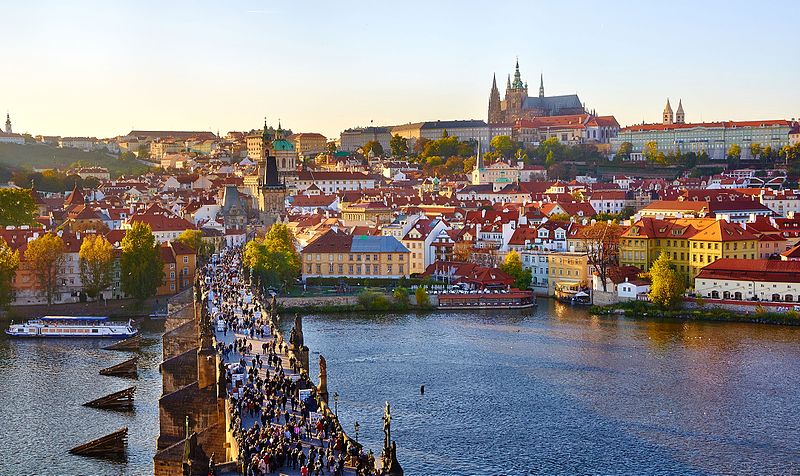
File:Prague_(6365119737).jpg · Wikimedia Commons · See Wikimedia Commons
Prague
Sign in to saveAlso known as Praha, Hlavní město Praha, City of Prague
Prague ( ; ) is the capital and largest city of the Czech Republic and the historical capital of Bohemia. Located on the Vltava River, the city has a population of about 1.4 million, making it the twelfth-largest city in the European Union. Its metropolitan area is home to approximately 2.3 million people.
Prague is the capital and largest city of the Czech Republic, located on the Vltava River with a population of about 1.4 million people, making it the twelfth-largest city in the European Union. As the historical capital of Bohemia and a major European city with a metropolitan area of approximately 2.3 million people, Prague serves as a significant cultural and political center in Central Europe.
AI-generated from the Wikipedia summary — may contain errors.
Key facts
- Settlement.name
- Prague
- Settlement.settlement_type
- Capital city
- Settlement.image_flag
- Flag of Prague.svg
- Settlement.image_blank_emblem
- Logo Praha.svg
- Settlement.blank_emblem_type
- Wordmark
- Settlement.image_shield
- Coat of arms of Prague.svg
- Settlement.nickname
- City of a Hundred Spires
- Settlement.mapsize
- 230px
- Settlement.pushpin_map_caption
- Location within the Czech Republic##Location within Europe
- Settlement.pushpin_map
- Czech Republic#Europe
- Settlement.pushpin_relief
- 1
- Settlement.subdivision_type
- Country
- Settlement.established_title
- Founded
- Settlement.established_date
- 8th century
- Settlement.leader_party
- ODS
- Settlement.leader_title
- Mayor
- Settlement.leader_name
- Bohuslav Svoboda
- Settlement.area_total_km2
- 496.21
via Wikipedia infobox
Research organization · ROR
- Type
- Government
- Founded
- 2000
- Location
- Prague, Czechia
- Also known as
- Capital City of Prague
- Status
- Active
ISNI 0000 0004 0610 2462
~64 min read
Encyclopedic overview
56 sectionsContents
- Etymology and names
- History
- Early history
- Late Middle Ages
- Habsburg era
- 20th century
- First Czechoslovak Republic
- Second World War
- Cold War
- After the Velvet Revolution
- Geography
- Climate
- Administration and politics
- Administrative division
- City government
- National politics
- 2025
- 2021
- Demographics
- 2011 census
- Historical population
- Foreign residents
- Culture
- In popular culture
- Cuisine
- Social media
- Economy
- Tourism
- Main attractions
- Hradčany and Lesser Town (Malá Strana)
- Old Town (Staré Město) and Josefov
- New Town (Nové Město)
- Vinohrady and Žižkov
- Other places
- Tourism statistics
- Education
- Public universities
- Public arts academies
- Private universities
- Largest private colleges
- International institutions
- Science, research and hi-tech centres
- Transport
- Sport
- Teams
- Stadia and arenas
- Events
- International relations
- Twin towns – sister cities
- Namesakes
- See also
- Notes
- References
- Further reading
- Culture and society
- External links
Prague ( ; ) is the capital and largest city of the Czech Republic and the historical capital of Bohemia. Located on the Vltava River, the city has a population of about 1.4 million, making it the twelfth-largest city in the European Union. Its metropolitan area is home to approximately 2.3 million people.
Prague is a historical city with Romanesque, Gothic, Renaissance, and Baroque architecture. It was the capital of the Kingdom of Bohemia and residence of several Holy Roman Emperors, most notably Charles IV (r. 1346–1378) and Rudolf II (r. 1575–1611). It was an important city to the Habsburg monarchy and Austria-Hungary. The city played major roles in the Bohemian and Protestant Reformations, the Thirty Years' War, and in 20th-century history as the capital of Czechoslovakia between the World Wars and the post-war Communist era.
Excerpted from Wikipedia’s “Prague” article, available under the CC BY-SA 4.0 licence.
Gallery (52)
On the map
18 mapped locations
Available in 219 languages
- Español
- Français
- Deutsch
- 中文
- 日本語
- Русский
- Português
- Italiano
- العربية
- हिन्दी
- Adyghe
- Afrikaans
- Albanian
- Albanian
- Amharic
- Aragonese
- Aramaic
- Armenian
Show 200 more
- Assamese
- Asturian
- Avaric
- azb
- Azerbaijani
- Bahasa Indonesia
- Balinese
- Bangla
- Bashkir
- Basque
- bat_smg
- Bavarian
- be_x_old
- Belarusian
- Betawi
- Bikol
- Bislama
- Bosnian
- Breton
- Bulgarian
- Burmese
- Catalan
- cdo
- Cebuano
- Central Kurdish
- Chamorro
- Chechen
- Church Slavic
- Chuvash
- Cornish
- Corsican
- Crimean Tatar
- Croatian
- Czech
- Danish
- Egyptian Arabic
- eml
- Erzya
- Esperanto
- Estonian
- Ewe
- Extremaduran
- Faroese
- Fiji Hindi
- Filipino
- Finnish
- fiu_vro
- Fula
- Gagauz
- Galician
- gcr
- Georgian
- Gilaki
- Gothic
- Greek
- Guarani
- Haitian Creole
- Hakka Chinese
- Hausa
- Hebrew
- Hungarian
- hyw
- Iban
- Icelandic
- Ido
- Iloko
- Interlingua
- Interlingue
- Irish
- Javanese
- Kabyle
- Kannada
- Kara-Kalpak
- Karachay-Balkar
- Kashubian
- Kazakh
- kbp
- Khmer
- Kikuyu
- Kinyarwanda
- Komi
- Kongo
- Kotava
- Kurdish
- Kyrgyz
- Ladino
- Lao
- Latgalian
- Latin
- Latvian
- Lezghian
- Ligurian
- Limburgish
- Lingala
- Lingua Franca Nova
- Lithuanian
- lld
- Lojban
- Lombard
- Low German
- Lower Sorbian
- Luxembourgish
- Macedonian
- Malagasy
- Malay
- Malayalam
- Maltese
- Manx
- Māori
- Marathi
- Mari
- Mazanderani
- Minangkabau
- Mingrelian
- Moksha
- Mongolian
- Moroccan Arabic
- Navajo
- nds_nl
- Neapolitan
- Nederlands
- Nepali
- Newari
- Northern Frisian
- Northern Sami
- Norwegian
- Norwegian Nynorsk
- Novial
- nrm
- Occitan
- Old English
- olo
- Ossetic
- Pampanga
- Papiamento
- Pashto
- Pennsylvania German
- Picard
- Piedmontese
- Polski
- Punjabi
- Quechua
- roa_tara
- Romanian
- Romansh
- Romany
- Rusyn
- Sardinian
- Saterland Frisian
- Scots
- Scottish Gaelic
- Serbian
- Serbian (Latin)
- Shona
- Sicilian
- Silesian
- simple
- Sindhi
- Slovak
- Slovenian
- Svenska
- Swahili
- szy
- Tajik
- Talysh
- Tamil
- Tatar
- Telugu
- Tibetan
- Tiếng Việt
- Toki Pona
- Türkçe
- Tyap
- Udmurt
- Ukrainian
- Upper Sorbian
- Urdu
- Uyghur
- Uzbek
- Venetian
- Veps
- Volapük
- Waray
- Welsh
- West Flemish
- Western Frisian
- Western Panjabi
- Wolof
- Wu Chinese
- Yakut
- Yiddish
- Yoruba
- Zaza
- zh_classical
- zh_min_nan
- zh_yue
- Zulu
- فارسی
- ไทย
- 한국어
via Wikidata sitelinks · CC0