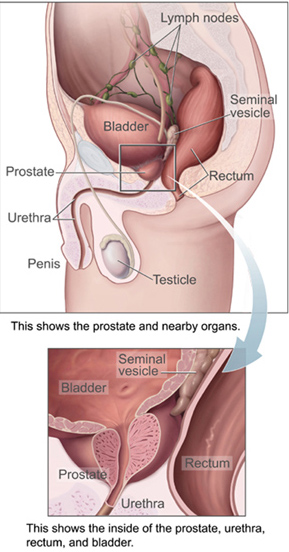
File:Prostatelead.jpg · Wikimedia Commons · See Wikimedia Commons
próstata
Sign in to saveAlso known as prostate gland
The prostate is an accessory gland of the male reproductive system and a muscle-driven mechanical switch between urination and ejaculation. It is found in all male mammals. It differs between species anatomically, chemically, and physiologically. Anatomically, the prostate is found below the bladder, with the urethra passing through it. It is described in gross anatomy as consisting of lobes and in microanatomy by zone. It is surrounded by an elastic, fibromuscular capsule and contains glandular and connective tissue.
The prostate is a gland in the male reproductive system located below the bladder that acts as a mechanical switch controlling whether urine or ejaculate passes through the urethra. It's made up of glandular and connective tissue surrounded by a fibrous capsule, and its structure varies across different male mammal species.
AI-generated from the Wikipedia summary — may contain errors.
Key facts
- Anatomy.Name
- Prostate
- Anatomy.Latin
- prostata
- Anatomy.Greek
- προστάτης
- Anatomy.Image
- Prostatelead.jpg
- Anatomy.Precursor
- Endodermic evaginations of the urethra, urogenital sinus
- Anatomy.System
- Male reproductive system
- Anatomy.Artery
- Internal pudendal artery, inferior vesical artery, and middle rectal artery
- Anatomy.Vein
- Prostatic venous plexus, pudendal plexus, vesical plexus, internal iliac vein
- Anatomy.Nerve
- Inferior hypogastric plexus
- Anatomy.Lymph
- Internal iliac lymph nodes
via Wikipedia infobox
Research
306,945 papers- The role of the prostate in male fertility, health and disease.ReviewNature reviews. Urology · 2016Verze P, Cai T, Lorenzetti SDOI: 10.1038/nrurol.2016.89
- Nutritional and surgical aspects in prostate disorders.ReviewCritical reviews in food science and nutrition · 2023Gasmi A, Bjørklund G, Noor S et al.DOI: 10.1080/10408398.2021.2013158
- Implications of prostate inflammation on male fertility.ReviewAndrologia · 2018Motrich RD, Salazar FC, Breser ML et al.DOI: 10.1111/and.13093
- Prostate ultrasonography.ReviewSeminars in roentgenology · 1993Hamper UM, Sheth SDOI: 10.1016/s0037-198x(05)80113-0
- The microbiome in prostate inflammation and prostate cancer.ReviewProstate cancer and prostatic diseases · 2018Porter CM, Shrestha E, Peiffer LB et al.DOI: 10.1038/s41391-018-0041-1
- Influence of microbiome in intraprostatic inflammation and prostate cancer.ReviewThe Prostate · 2024Prakash P, Verma S, Gupta SDOI: 10.1002/pros.24756
- Chronic inflammation in benign prostatic hyperplasia: Pathophysiology and treatment options.ReviewInternational journal of urology : official journal of the Japanese Urological Association · 2024Inamura S, Terada NDOI: 10.1111/iju.15518
- Prostate growth and inflammation.ReviewThe Journal of steroid biochemistry and molecular biology · 2008Sciarra A, Mariotti G, Salciccia S et al.DOI: 10.1016/j.jsbmb.2007.09.013
via PubMed
Wikidata facts
- Part of
- male reproductive system
- Image
- Prostate - Gray1153.png
Show 7 more facts
- venous drainage
- prostatic venous plexus
- Commons category
- Prostate
- topic's main category
- Category:Prostate
- arterial supply
- internal pudendal artery
- anatomical location
- pelvic cavity
- sexually homologous with
- Skene's gland
- NCI Thesaurus ID
- C12410
Sources (9)
via Wikidata · CC0
Article · Português
A próstata é uma glândula exócrina do sistema reprodutor masculino encontrada apenas em alguns mamíferos. Ela difere entre as espécies anatomicamente, quimicamente e fisiologicamente. Anatomicamente, a próstata encontra-se abaixo da bexiga, com a uretra passando por ela. É descrito na anatomia geral como consistindo de lóbulos e na microanatomia por zona. É circundado por uma cápsula fibromuscular e contém tecido glandular, bem como tecido conjuntivo. As glândulas da próstata produzem e contêm fluido que faz parte do sêmen, a substância que é emitida durante a ejaculação como parte da resposta sexual masculina. Este fluido prostático é ligeiramente alcalino, leitoso ou de aparência branca. A alcalinidade do sêmen ajuda a neutralizar a acidez do trato vaginal, prolongando a vida útil do esperma. O fluido prostático é expelido na primeira parte da ejaculação, junto com a maior parte do esperma, por causa da ação do tecido músculo liso dentro da próstata. Em comparação com os poucos espermatozóides expelidos juntamente com o fluido vesicular seminal principalmente, aqueles no fluido prostático têm melhor motilidade, sobrevida mais longa e melhor proteção do material genético. Transtornos da próstata incluem alargamento, inflamação, infecção, e câncer. A palavra próstata vem do grego antigo προστάτης, prostátēs, significando "aquele que está diante de", "protetor", "guardião", com o termo originalmente usado para descrever as vesículas seminais.
Abstract from DBpedia / Wikipedia · CC BY-SA
Gallery (16)
Available in 88 languages
- Español
- Français
- Deutsch
- 中文
- 日本語
- Русский
- Português
- Italiano
- العربية
- हिन्दी
- Afrikaans
- Albanian
- Aragonese
- Armenian
- Asturian
- Azerbaijani
- Bahasa Indonesia
- Bangla
Show 69 more
- Basque
- be_x_old
- Belarusian
- Bikol
- Bosnian
- Bulgarian
- Catalan
- Central Kurdish
- Croatian
- Czech
- Danish
- Divehi
- Egyptian Arabic
- Esperanto
- Estonian
- Filipino
- Finnish
- Galician
- Georgian
- Greek
- Hebrew
- Hungarian
- Icelandic
- Ido
- Interlingue
- Irish
- Javanese
- Kashmiri
- Kazakh
- Kurdish
- Kyrgyz
- Latin
- Latvian
- Limburgish
- Lithuanian
- Luxembourgish
- Macedonian
- Malay
- Malayalam
- Mongolian
- Nederlands
- Nepali
- Newari
- Norwegian
- Norwegian Nynorsk
- Papiamento
- Polski
- Romanian
- Serbian
- Serbian (Latin)
- simple
- Slovak
- Slovenian
- Svenska
- Tamil
- Tatar
- Telugu
- Tiếng Việt
- Türkçe
- Ukrainian
- Urdu
- Uzbek
- Waray
- Welsh
- Wu Chinese
- zh_yue
- فارسی
- ไทย
- 한국어
via Wikidata sitelinks · CC0