File:Prostatelead.jpg · Wikimedia Commons · See Wikimedia Commons
gruczoł krokowy
Sign in to saveAlso known as prostate gland
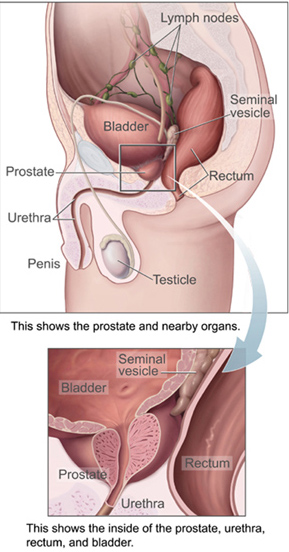
The prostate is an accessory gland of the male reproductive system and a muscle-driven mechanical switch between urination and ejaculation. It is found in all male mammals. It differs between species anatomically, chemically, and physiologically. Anatomically, the prostate is found below the bladder, with the urethra passing through it. It is described in gross anatomy as consisting of lobes and in microanatomy by zone. It is surrounded by an elastic, fibromuscular capsule and contains glandular and connective tissue.
The prostate is a gland in the male reproductive system located below the bladder that acts as a mechanical switch controlling whether urine or ejaculate passes through the urethra. It's made up of glandular and connective tissue surrounded by a fibrous capsule, and its structure varies across different male mammal species.
AI-generated from the Wikipedia summary — may contain errors.
In the Vinony graph
Within Vinony's link graph, gruczoł krokowy is referenced by 912 other articles, and connects out to epithelium, ejaculation and seminal vesicula.
It sits within the topics Exocrine system, Glands and Human male reproductive system.
Its subject is documented across 88 Wikipedia language editions.
Key facts
- Anatomy.Name
- Prostate
- Anatomy.Latin
- prostata
- Anatomy.Greek
- προστάτης
- Anatomy.Image
- Prostatelead.jpg
- Anatomy.Precursor
- Endodermic evaginations of the urethra, urogenital sinus
- Anatomy.System
- Male reproductive system
- Anatomy.Artery
- Internal pudendal artery, inferior vesical artery, and middle rectal artery
- Anatomy.Vein
- Prostatic venous plexus, pudendal plexus, vesical plexus, internal iliac vein
- Anatomy.Nerve
- Inferior hypogastric plexus
- Anatomy.Lymph
- Internal iliac lymph nodes
via Wikipedia infobox
Research
306,945 papers- The role of the prostate in male fertility, health and disease.ReviewNature reviews. Urology · 2016Verze P, Cai T, Lorenzetti SDOI: 10.1038/nrurol.2016.89
- Nutritional and surgical aspects in prostate disorders.ReviewCritical reviews in food science and nutrition · 2023Gasmi A, Bjørklund G, Noor S et al.DOI: 10.1080/10408398.2021.2013158
- Implications of prostate inflammation on male fertility.ReviewAndrologia · 2018Motrich RD, Salazar FC, Breser ML et al.DOI: 10.1111/and.13093
- Prostate ultrasonography.ReviewSeminars in roentgenology · 1993Hamper UM, Sheth SDOI: 10.1016/s0037-198x(05)80113-0
- The microbiome in prostate inflammation and prostate cancer.ReviewProstate cancer and prostatic diseases · 2018Porter CM, Shrestha E, Peiffer LB et al.DOI: 10.1038/s41391-018-0041-1
- Influence of microbiome in intraprostatic inflammation and prostate cancer.ReviewThe Prostate · 2024Prakash P, Verma S, Gupta SDOI: 10.1002/pros.24756
- Chronic inflammation in benign prostatic hyperplasia: Pathophysiology and treatment options.ReviewInternational journal of urology : official journal of the Japanese Urological Association · 2024Inamura S, Terada NDOI: 10.1111/iju.15518
- Prostate growth and inflammation.ReviewThe Journal of steroid biochemistry and molecular biology · 2008Sciarra A, Mariotti G, Salciccia S et al.DOI: 10.1016/j.jsbmb.2007.09.013
via PubMed
Wikidata facts
- Part of
- male reproductive system
- Image
- Prostate - Gray1153.png
Show 7 more facts
- venous drainage
- prostatic venous plexus
- Commons category
- Prostate
- topic's main category
- Category:Prostate
- arterial supply
- internal pudendal artery
- anatomical location
- pelvic cavity
- sexually homologous with
- Skene's gland
- NCI Thesaurus ID
- C12410
Sources (9)
via Wikidata · CC0
Article · Polski
Gruczoł krokowy, stercz, prostata (łac. prostata, od starogreckiego προστάτης prostátēs, strażnik) – nieparzysty narząd mięśniowo-gruczołowy będący częścią męskiego układu płciowego. Wydzielina prostaty to mętna, biaława ciecz o charakterystycznym zapachu (to ona nadaje zapach spermie), stanowiąca nośnik plemników. Odczyn wydzieliny jest, w zależności od badań, podawany jako lekko kwasowy (pH 6.1- 6.5) albo lekko zasadowy (pH 7.31). Składa się z dwóch płatów: lewego i prawego, połączonych węziną. Niestale występuje płat środkowy. Kształt prostaty jest porównywany do kształtu kasztana jadalnego (spłaszczony stożek). Gruczoł ten jest otoczony mocną torebką z mięśni gładkich, które kurczą się podczas ejakulacji. Stercz znajduje się poniżej pęcherza moczowego w miednicy mniejszej. Przez jego miąższ przebiega część sterczowa cewki moczowej, dlatego gdy dochodzi do jego rozrostu, wskutek mechanicznego ucisku cewki moczowej pojawiają się problemy z oddawaniem moczu oraz inkontynencja. Tylna część stercza przylega bezpośrednio do odbytnicy. Silny ucisk w tej okolicy wywołuje gwałtowne uczucie parcia na mocz oraz niekiedy pieczenie w okolicy żołędzi. Masaż prostaty wykonywany zarówno ze względów lekarskich (badanie per rectum), jak i erotycznych, prowadzi do czasowego podwyższenia stężenia swoistego antygenu sterczowego (PSA), co może skutkować oznaczeniem nieprawidłowego poziomu w badaniu laboratoryjnym.
Abstract from DBpedia / Wikipedia · CC BY-SA
Gallery (16)
Available in 88 languages
- Español
- Français
- Deutsch
- 中文
- 日本語
- Русский
- Português
- Italiano
- العربية
- हिन्दी
- Afrikaans
- Albanian
- Aragonese
- Armenian
- Asturian
- Azerbaijani
- Bahasa Indonesia
- Bangla
Show 69 more
- Basque
- be_x_old
- Belarusian
- Bikol
- Bosnian
- Bulgarian
- Catalan
- Central Kurdish
- Croatian
- Czech
- Danish
- Divehi
- Egyptian Arabic
- Esperanto
- Estonian
- Filipino
- Finnish
- Galician
- Georgian
- Greek
- Hebrew
- Hungarian
- Icelandic
- Ido
- Interlingue
- Irish
- Javanese
- Kashmiri
- Kazakh
- Kurdish
- Kyrgyz
- Latin
- Latvian
- Limburgish
- Lithuanian
- Luxembourgish
- Macedonian
- Malay
- Malayalam
- Mongolian
- Nederlands
- Nepali
- Newari
- Norwegian
- Norwegian Nynorsk
- Papiamento
- Polski
- Romanian
- Serbian
- Serbian (Latin)
- simple
- Slovak
- Slovenian
- Svenska
- Tamil
- Tatar
- Telugu
- Tiếng Việt
- Türkçe
- Ukrainian
- Urdu
- Uzbek
- Waray
- Welsh
- Wu Chinese
- zh_yue
- فارسی
- ไทย
- 한국어
via Wikidata sitelinks · CC0