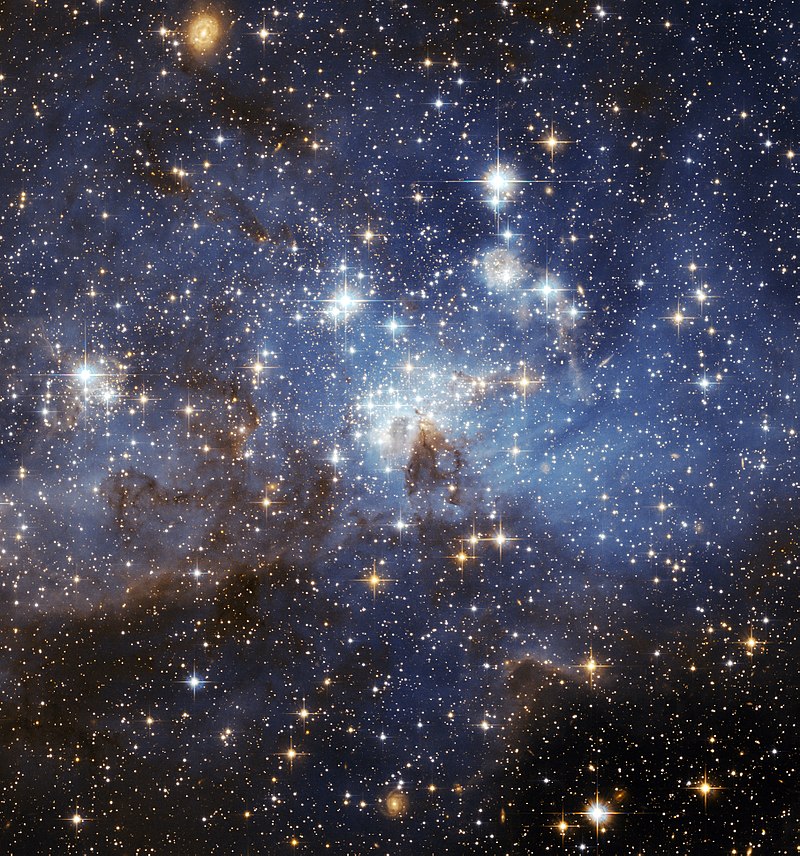
File:LH_95.jpg · Wikimedia Commons · See Wikimedia Commons
protostar
Sign in to saveAlso known as baby star
A protostar is a very young star that is still gathering mass from its parent molecular cloud. It is the earliest phase in the process of stellar evolution. For a low-mass star (i.e. that of the Sun or lower), it lasts about 500,000 years. The phase begins when a molecular cloud fragment first collapses under the force of self-gravity and an opaque, pressure-supported core forms inside the collapsing fragment. It ends when the infalling gas is depleted, leaving a pre-main-sequence star, which contracts to later become a main-sequence star at the onset of hydrogen fusion producing helium.
A protostar is a newly forming star that is still pulling in material from the gas cloud around it, representing the earliest stage of star development. Protostars matter because studying them helps us understand how stars like our Sun form and evolve, starting from the collapse of a gas cloud and continuing until nuclear fusion begins.
AI-generated from the Wikipedia summary — may contain errors.
Wikidata facts
- Subclass of
- young stellar object
- Part of
- star formation
- Image
- A diamond in the dust.jpg
Show 4 more facts
- Stack Exchange tag
- astronomy.stackexchange.com/tags/protostar
- Commons category
- Protostars
- topic's main category
- Category:Protostars
- on focus list of Wikimedia project
- Wikipedia:Vital articles/Level/4
via Wikidata · CC0
~6 min read
Encyclopedic overview
7 sectionsContents
- History
- Protostellar evolution
- Observed classes of young stars
- Gallery
- See also
- References
- External links
A protostar is a very young star that is still gathering mass from its parent molecular cloud. It is the earliest phase in the process of stellar evolution. For a low-mass star (i.e. that of the Sun or lower), it lasts about 500,000 years. The phase begins when a molecular cloud fragment first collapses under the force of self-gravity and an opaque, pressure-supported core forms inside the collapsing fragment. It ends when the infalling gas is depleted, leaving a pre-main-sequence star, which contracts to later become a main-sequence star at the onset of hydrogen fusion producing helium.
==History== The modern picture of protostars, summarized above, was first suggested by Chushiro Hayashi in 1966. In the first models, the size of protostars was greatly overestimated. Subsequent numerical calculations clarified the issue, and showed that protostars are only modestly larger than main-sequence stars of the same mass. This basic theoretical result has been confirmed by observations, which find that the largest pre-main-sequence stars are also of modest size.
Excerpted from Wikipedia’s “protostar” article, available under the CC BY-SA 4.0 licence.
Gallery (15)
Available in 62 languages
- Español
- Français
- Deutsch
- 中文
- 日本語
- Русский
- Português
- Italiano
- العربية
- हिन्दी
- Afrikaans
- Aragonese
- Asturian
- Azerbaijani
- Bahasa Indonesia
- Bangla
- Basque
- Belarusian
Show 43 more
- Bosnian
- Bulgarian
- Burmese
- Catalan
- Chuvash
- Croatian
- Czech
- Esperanto
- Estonian
- Finnish
- Galician
- Georgian
- Greek
- Hebrew
- Hungarian
- Irish
- Javanese
- Kazakh
- Lithuanian
- Macedonian
- Malay
- Marathi
- Nederlands
- Norwegian
- Norwegian Nynorsk
- Polski
- Romanian
- Serbian
- Serbian (Latin)
- simple
- Slovak
- Svenska
- Tamil
- Tatar
- Tiếng Việt
- Türkçe
- Ukrainian
- Uzbek
- Wu Chinese
- zh_yue
- فارسی
- ไทย
- 한국어
via Wikidata sitelinks · CC0