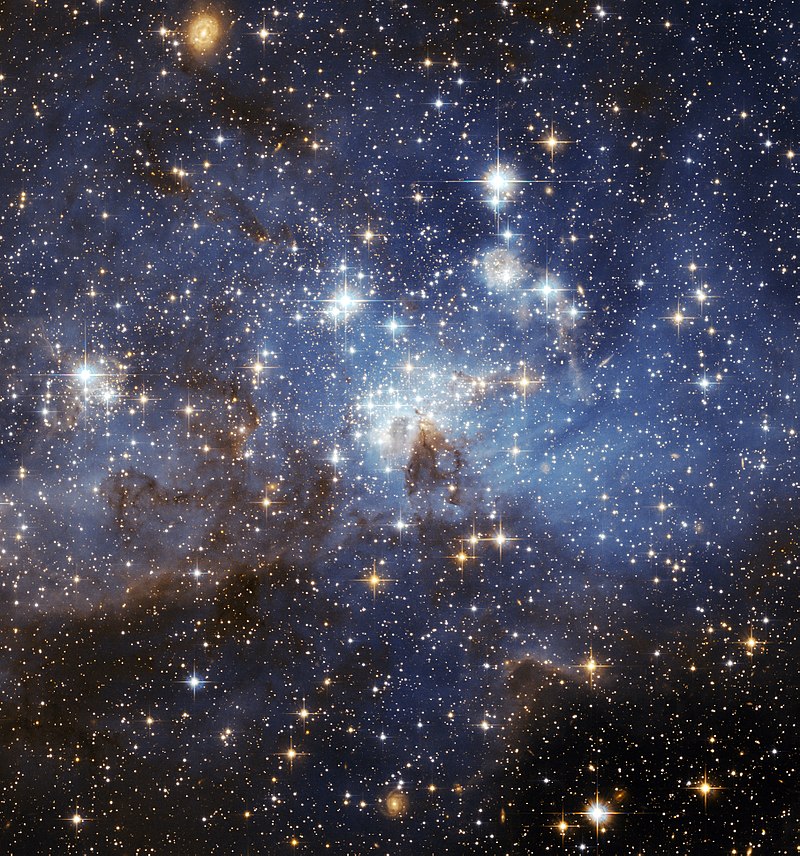
File:LH_95.jpg · Wikimedia Commons · See Wikimedia Commons
protoestrela
Sign in to saveAlso known as baby star
A protostar is a very young star that is still gathering mass from its parent molecular cloud. It is the earliest phase in the process of stellar evolution. For a low-mass star (i.e. that of the Sun or lower), it lasts about 500,000 years. The phase begins when a molecular cloud fragment first collapses under the force of self-gravity and an opaque, pressure-supported core forms inside the collapsing fragment. It ends when the infalling gas is depleted, leaving a pre-main-sequence star, which contracts to later become a main-sequence star at the onset of hydrogen fusion producing helium.
A protostar is a newly forming star that is still pulling in material from the gas cloud around it, representing the earliest stage of star development. Protostars matter because studying them helps us understand how stars like our Sun form and evolve, starting from the collapse of a gas cloud and continuing until nuclear fusion begins.
AI-generated from the Wikipedia summary — may contain errors.
Wikidata facts
- Subclass of
- young stellar object
- Part of
- star formation
- Image
- A diamond in the dust.jpg
Show 4 more facts
- Stack Exchange tag
- astronomy.stackexchange.com/tags/protostar
- Commons category
- Protostars
- topic's main category
- Category:Protostars
- on focus list of Wikimedia project
- Wikipedia:Vital articles/Level/4
via Wikidata · CC0
Article · Português
Uma Protoestrela é um protótipo de estrela, ou seja, um objeto candidato que se tornará estrela caso sua massa seja grande o suficiente. Em virtude de alguma turbulência em uma nuvem molecular decorrente de algum evento exterior à mesma, ocorre uma ruptura no estado de equilíbrio da nuvem onde certas regiões ficam mais densas que outras. Nessas regiões formam-se glóbulos de onde, eventualmente, formam-se estrelas. Esses glóbulos começam a colapsar por conta de seu próprio peso e, à medida que isso acontece, sua temperatura aumenta. Concomitantemente, a matéria ao redor do glóbulo forma um disco em queda sobre este e, por causa disso, jatos de matéria são expelidos pelos polos, são os objetos HH. Quando termina de acrescentar matéria em si mesma, ou seja, cessa a queda do material daquela região da nuvem sobre a protoestrela, temos uma estrela pré-sequência principal.
Abstract from DBpedia / Wikipedia · CC BY-SA
Gallery (15)
Available in 62 languages
- Español
- Français
- Deutsch
- 中文
- 日本語
- Русский
- Português
- Italiano
- العربية
- हिन्दी
- Afrikaans
- Aragonese
- Asturian
- Azerbaijani
- Bahasa Indonesia
- Bangla
- Basque
- Belarusian
Show 43 more
- Bosnian
- Bulgarian
- Burmese
- Catalan
- Chuvash
- Croatian
- Czech
- Esperanto
- Estonian
- Finnish
- Galician
- Georgian
- Greek
- Hebrew
- Hungarian
- Irish
- Javanese
- Kazakh
- Lithuanian
- Macedonian
- Malay
- Marathi
- Nederlands
- Norwegian
- Norwegian Nynorsk
- Polski
- Romanian
- Serbian
- Serbian (Latin)
- simple
- Slovak
- Svenska
- Tamil
- Tatar
- Tiếng Việt
- Türkçe
- Ukrainian
- Uzbek
- Wu Chinese
- zh_yue
- فارسی
- ไทย
- 한국어
via Wikidata sitelinks · CC0