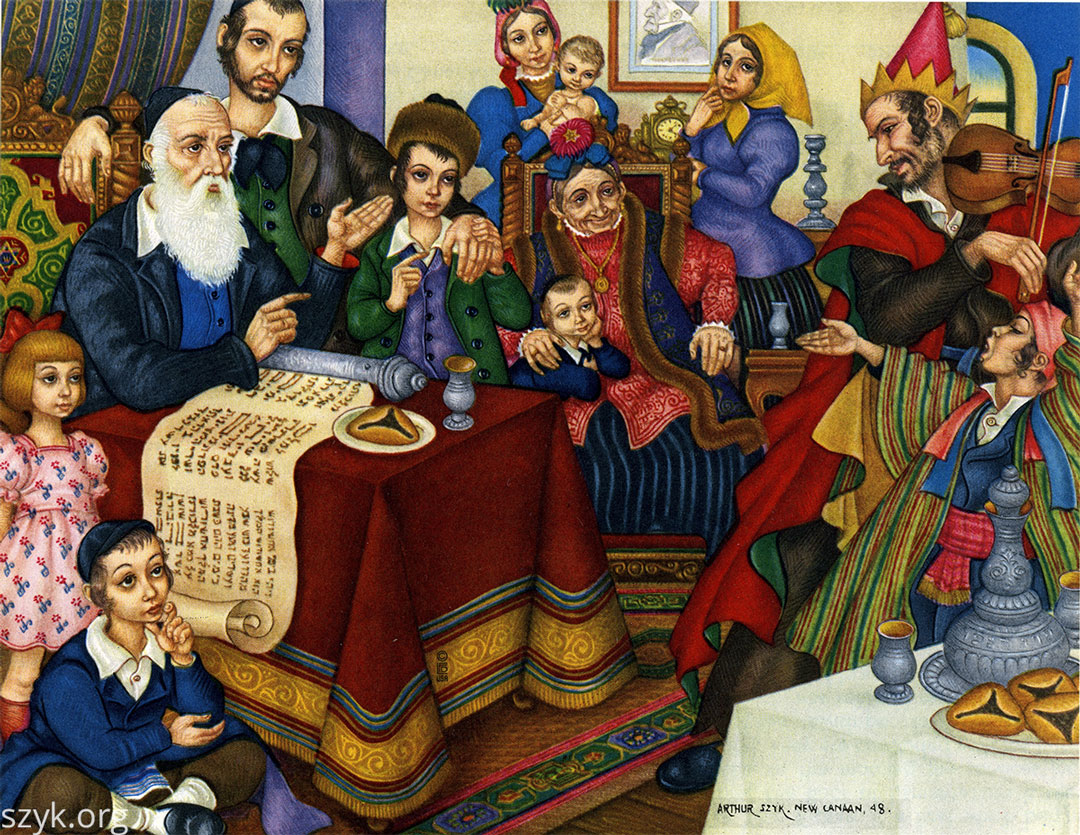
Purim
Sign in to saveAlso known as Feast of Esther, Feast of Purim, Jewish Feast of Purim, Feast of Lots
Purim ( , ) is a Jewish holiday that commemorates the saving of the Jewish people by Queen Esther from annihilation at the hands of an official of the Achaemenid Empire named Haman, as it is recounted in the Book of Esther.
Purim is a Jewish holiday that celebrates how Queen Esther saved the Jewish people from being killed by Haman, a powerful official in the ancient Achaemenid Empire, according to the biblical Book of Esther. The holiday commemorates this deliverance from what would have been the destruction of the Jewish people.
AI-generated from the Wikipedia summary — may contain errors.
Wikipedia views (30d)
22,250 totalvia Wikimedia Pageviews API
Key facts
- Holiday.holiday_name
- Purim
- Holiday.image
- Purim by Arthur Szyk.jpg
- Holiday.caption
- Purim by Arthur Szyk
- Holiday.date
- 14th day of Adar (in Jerusalem and all ancient walled cities, 15th of Adar)
- Holiday.type
- Jewish
- Holiday.significance
- Celebration of Jewish deliverance as told in the Book of Esther ()
- Holiday.relatedto
- Hanukkah, Day of Salvation and Liberation, as a rabbinically decreed Jewish holiday
- Holiday.startedby
- Esther and Mordechai
- Holiday.frequency
- Annual
via Wikipedia infobox
Described at

Purim - Levande kulturarv
Purim är en judisk högtid och tradition som firas på den fjortonde dagen i månaden Adar som brukar infalla i mars.
levandekulturarv.se →Purim är en judisk högtid och tradition som firas på den fjortonde dagen i månaden Adar som brukar infalla i mars. Purim är en judisk högtid och tradition som firas på den fjortonde dagen i månaden Adar som brukar infalla i mars månad. Den firas till minne av när drottning Ester, som var judinna, räddade judarna i Persien. Historien återberättas i Esters bok i bibeln. Ordet Purim betyder ’lott’ och kommer av att kungens storvisir Haman tänkte dra lott om vilken dag judarnas utrotning från Persien skulle ske. Dagen före Purim fastar man och läser ur Esters bok i synagogan på kvällen och morgonen. När Hamans namn läses skakar man i skallror och för oväsen så man inte hör hans namn nämnas. (Det är ett religiöst påbud att utplåna den onde Hamans namn genom att dränka det i oväsen.) Under Purim klär man ut sig (ofta till någon av gestalterna i Esters bok), man utbyter gåvor av mat och dryck, ger pengar till de fattiga och äter en gemensam festmåltid. Till måltiden serveras även starka drycker. (Enligt Talmud ska man dricka så mycket att man inte ”ser skillnad på den onde Haman och den gode Mordechaj”.) Kunskapsöverföring sker främst genom att delta under högtiden, men också genom undervisning i judiska traditioner och genom internationella webbplatser. De svenska judiska församlingarna informerar om judiska högtider och medlemmar inbjuds till aktuella festligheter. Det finns även flera mindre föreningar runt om i landet som är öppna även för andra som inte är medlemmar i en församling. Purim firas till minne av när drottningen Ester, som var judinna, räddade judarna i Persien från att bli mördade av den onde Haman. Enligt bibeln (Ester 3:13) hade han planer på att ”förgöra, döda och utrota alla judar, unga och gamla, spädbarn och kvinnor, under loppet av en enda dag”, som utspelade sig det judiska året 3405, år 356 före vår tideräkning. Historien återberättas i Esters bok. Det hela började med att Ahasverus (Xerxes I), kung av Persien, gifte sig med Ester som dolde sitt judiska ursprung inför Ahasverus. När hennes farbror Mordechai vägrade att knäböja inför Haman, kungens storvisir, blev Haman mycket arg, inte bara på Mordechai utan på hela det folk som han tillhörde. Haman bestämde sig för att försöka utrota alla judar i Persien. På Mordechais uppmaning förrådde drottning Ester Hamans planer inför kung Ahasverus. Haman hängdes, men Hamans påbud om att judar fick dödas kunde inte stoppas. Ahasverus utfärdade då ett nytt påbud som tillät judarna att lyfta vapen mot sina fiender, vilket de också gjorde. Enligt Esters bok dödades 75 000 perser. Kunskapsöverföring sker främst genom att delta under högtiden, men också genom undervisning i judiska traditioner och inte minst genom internationella webbplatser. På de svenska judiska församlingarnas hemsidor informeras om judiska högtider och medlemmar inbjuds till aktuella festligheter, som Purim. Det finns även flera mindre föreningar runt om i landet som är öppna för studenter och andra som inte är medlemmar i en församling. Många har också privata purimfester och en del även uppläsningar av Esters bok som inte är organiserade av en institution. Adriansen, Inge & Bregenhøj, Carsten (2014): Maske og forklædning i Danmark . Redaktion Århus: Århus Universitetsforlag. 2005: Världens fest i Sverige . Projektledare Thomas Schiöler, redaktör Leif Åberg, illustrationer Pontus Wahlström. UR i samarbete med Världskulturmuseet. Stockholm: Sveriges utbildningsradio (UR).
Excerpt from a page describing this subject · 5,817 chars · not written by Vinony
Wikidata facts
- Instance of
- holiday
- Subclass of
- Jewish holiday
- Religion
- Judaism
- Image
- Homemade hamantaschen.jpg
Show 6 more facts
- Commons category
- Purim
- topic's main category
- Category:Purim
- described by source
- New International Encyclopedia
- topic has template
- Template:Purim footer
- native label
- פּוּרִים
- described at URL
- levandekulturarv.se/in-english/the-inventory/submissions/purim
via Wikidata · CC0
~49 min read
Encyclopedic overview
39 sectionsContents
- Name
- Purim narrative
- Scriptural and rabbinical sources
- Historical views
- Traditional historians
- Modern scholarship views
- Observances
- Reading of the Megillah
- Blessings before Megillah reading
- Blessing and recitations after Megillah reading
- Women and Megillah reading
- Blotting out Haman's name{{anchor|grager}}
- Megillah reading campaign
- Food gifts and charity
- Purim meal {{transliteration|he|(se'udah)}} and festive drinking
- Fasts
- Customs
- Greetings
- Masquerading
- Burning of Haman's effigy
- Purim spiel
- Songs
- Traditional foods
- Torah learning
- In Jerusalem
- Shushan Purim
- Purim Meshulash
- Other Purims
- Purim Katan
- Communal and familial Purims
- In modern history
- In the media
- Gallery
- See also
- Extensions of Jewish festivals which are similar to Shushan Purim and Purim Katan
- Persian(ate) Jewry
- Notes
- References
- External links
Purim ( , ) is a Jewish holiday that commemorates the saving of the Jewish people by Queen Esther from annihilation at the hands of an official of the Achaemenid Empire named Haman, as it is recounted in the Book of Esther.
According to the Book of Esther, Haman was the royal vizier to the Persian king Ahasuerus (likely Xerxes I or Artaxerxes I; and in Old Persian, respectively). His plans were foiled by Mordecai of the tribe of Benjamin, who previously warned the king about an assassination attempt, and Esther, Mordecai's cousin and adopted daughter who had become queen of Persia after her marriage to Ahasuerus. The day of deliverance became a day of feasting and rejoicing among Jews. Although the Book of Esther is traditionally viewed as a historical document, modern scholarship generally regards it as a historical novel with legendary elements, not a reliable account of Purim’s origins.
Excerpted from Wikipedia’s “Purim” article, available under the CC BY-SA 4.0 licence.
Gallery (41)
Available in 65 languages
- Español
- Français
- Deutsch
- 中文
- 日本語
- Русский
- Português
- Italiano
- العربية
- हिन्दी
- Afrikaans
- Albanian
- Armenian
- azb
- Bahasa Indonesia
- Bashkir
- Basque
- Belarusian
Show 46 more
- Breton
- Bulgarian
- Catalan
- Cebuano
- Croatian
- Czech
- Danish
- Egyptian Arabic
- Esperanto
- Filipino
- Finnish
- Galician
- Georgian
- Hebrew
- Hungarian
- Interlingua
- Irish
- Khmer
- Ladino
- Latin
- Latvian
- Lithuanian
- Malagasy
- Nederlands
- Norwegian
- Norwegian Nynorsk
- Polski
- Romanian
- Scots
- Serbian
- Serbian (Latin)
- simple
- Slovak
- Svenska
- Swahili
- Tajik
- Tamil
- Tiếng Việt
- Türkçe
- Ukrainian
- Urdu
- Waray
- Wu Chinese
- Yiddish
- فارسی
- 한국어
via Wikidata sitelinks · CC0