English
Encyclopedia of Life · EOL (see source)
Chaetomiaceae
Sign in to saveThe Chaetomiaceae are a family of fungi in the Ascomycota, order Sordariales, class Sordariomycetes. Chaetomiaceae are usually saprobic or parasitic. Cheatomiaceae are a great source of enzymes with diverse biotechnological and industrial applications such as PMO (polysaccharide monooxygenase), L-methioninase, β-1,3-glucanase, laccase, dextranase, lipolytic, pectinolytic, amylolytic, chitinolytic, and proteolytic enzymes. The production of such compounds can be taken into account as candidates for the development of effective and novel lead compounds for medicine, biological control and produc
Species
ケダマカビ科
Family
- PhylumAscomycota
- ClassSordariomycetes
- OrderSordariales
- FamilyChaetomiaceae
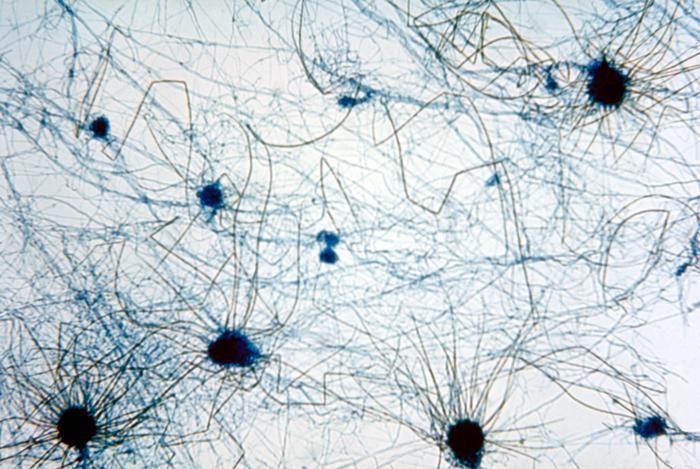
Die Chaetomiaceae sind eine Familie aus der Ordnung der Sordariales. Unter ihnen befinden sich ökonomisch wichtige Lebensmittelzerstörer und Schimmelpilze. Inhaltsverzeichnis 1 Merkmale 2 Ökologie und Verbreitung 3 Taxonomie 4 Quellen 4.1 Literatur 4.2 Einzelnachweise 5 Weblinks Merkmale Sie bilden als Fruchtkörper dünnwandige, häutige Perithecien aus, die blass oder dunkel sein können. Manchmal können diese schildförmig angeordnete Zellen besitzen, oft haben sie typische, komplex aufgebaute Haare. Ein Ostiolum, eine Öffnung an dessen Oberseite, ist nicht immer vorhanden. Die Schläuche sind keulen- bis sackförmig, sehr dünnwandig und besitzen keinen apikalen Ring. Sie zerfließen bei Reife. Die Ascosporen sind normalerweise klein, einporig, blass bis braun, dünnwandig, unseptiert und glatt. Sie werden bei Reife in Wolken abgeworfen. Ein Stroma ist nicht vorhanden. Meist ist keine Nebenfruchtform vorhanden. Falls doch, so ist diese hyphomycetisch ausgebildet. Die Konidien sind dann dickwandig, manchmal auch ornamentiert und entspringen aus undifferenzierten Hyphen. Einige wenige Arten bilden kleine hyaline Spermatien aus einfach phialidischen konidiogenen Zellen. Ökologie und Verbrei
via
Wikidata facts
- Instance of
- taxon
- Parent taxon
- Sordariales
- Image
- Chaetonium (Acremonium) perithecium 40X.png
Show 4 more facts
- taxon name
- Chaetomiaceae
- taxon rank
- family
- Commons category
- Chaetomiaceae
- topic's main category
- Category:Chaetomiaceae
Sources (1)
via Wikidata · CC0
~1 min read
Encyclopedic overview
3 sectionsContents
- Genera
- References
- External links
The Chaetomiaceae are a family of fungi in the Ascomycota, order Sordariales, class Sordariomycetes. Chaetomiaceae are usually saprobic or parasitic. Cheatomiaceae are a great source of enzymes with diverse biotechnological and industrial applications such as PMO (polysaccharide monooxygenase), L-methioninase, β-1,3-glucanase, laccase, dextranase, lipolytic, pectinolytic, amylolytic, chitinolytic, and proteolytic enzymes. The production of such compounds can be taken into account as candidates for the development of effective and novel lead compounds for medicine, biological control and production of bioactive secondary metabolites. Chaetomiaceae furthermore contains some of the most well known thermophilic fungi, an interesting feature carrying many biological applications, but that is found only in few fungal genera.
== Genera == Achaetomium Bommerella Boothiella Botryotrichum Chaetomidium Chaetomiopsis Chaetomium Collariella Corynascella Corynascus Emilmuelleria Erythrocarpon Farrowia Guanomyces Setiferotheca Subramaniula Thielavia Trichocladium
Excerpted from Wikipedia’s “Chaetomiaceae” article, available under the CC BY-SA 4.0 licence.