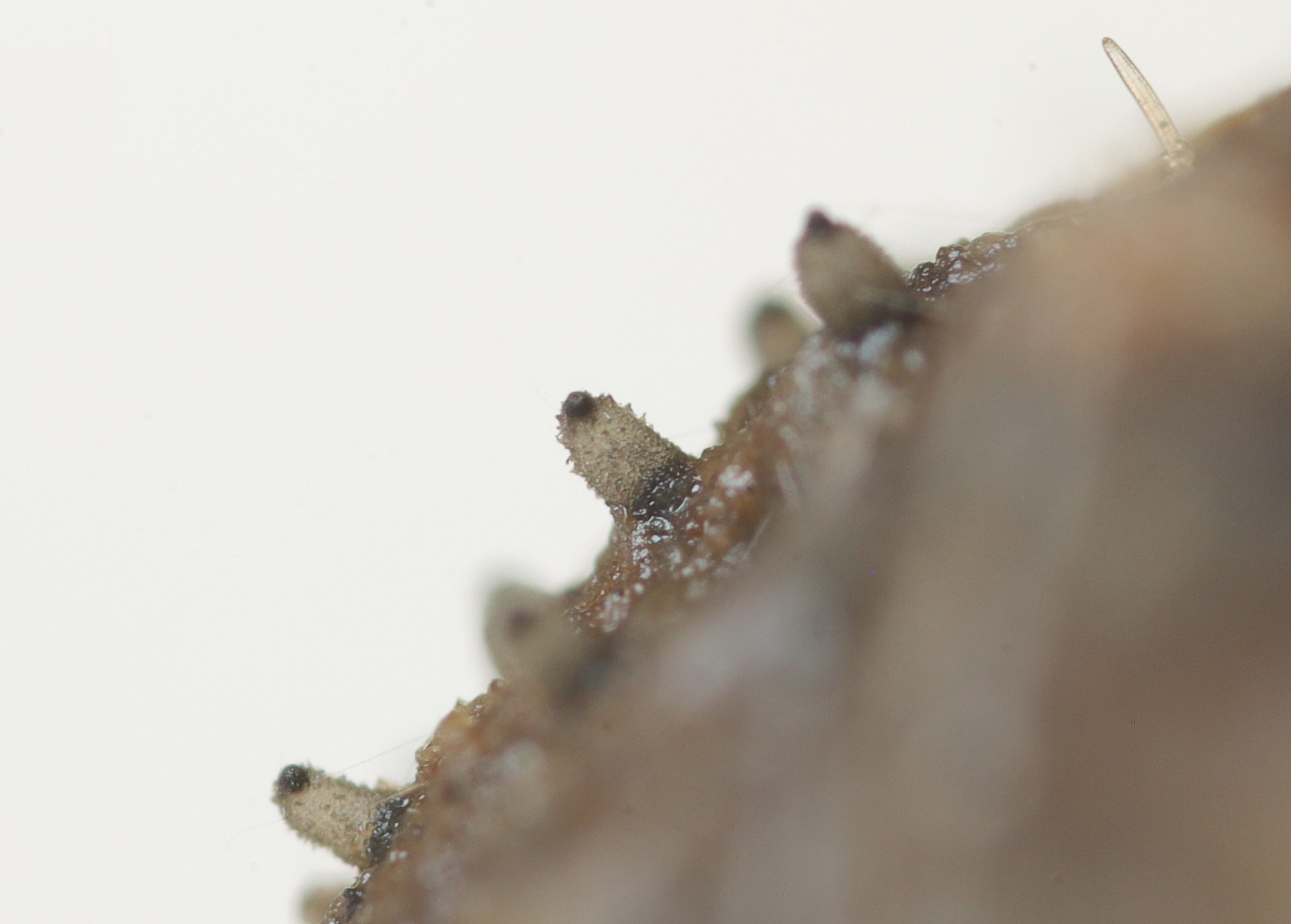
Bo Valeur · https://creativecommons.org/licenses/by-nc/4.0/
Sordariales
Sign in to saveThe order Sordariales is one of the most diverse taxonomic groups within the Sordariomycetes (subdivision Pezizomycotina, division Ascomycota).
Species
フンタマカビ目
ORDER
- KingdomFungi
- PhylumAscomycota
- ClassSordariomycetes
- OrderSordariales
Die Sordariales sind eine Ordnung der Schlauchpilze. Der Großteil der Arten besiedelt Holz und Dung. Inhaltsverzeichnis 1 Merkmale 2 Systematik 3 Belege 3.1 Einzelnachweise 3.2 Literatur 4 Weblinks Merkmale Die Fruchtkörper sind relativ groß, sie entstehen an der oder durchdringen die Oberfläche des Substrates. Die Fruchtkörperwand besteht aus großen Zellen. Bei manchen Arten kommen Paraphysen vor, ebenso subapikale Globuli in den Asci. Die Ascosporen sind vielgestaltig und reichen von zylindrischen, hyalinen Sporen bis zu ellipsoidischen, braunen Sporen, häufig mit Anhängen oder Scheiden. Bei vielen Arten fehlen Anamorphe, wo sie auftreten, sind es leicht pigmentierte, phialidische, Phialophora-ähnliche Anamorphe. Bei manchen Arten keimen die Ascosporen direkt zu Phialiden aus. Systematik Zhang et al. konnten 2006 erstmals zeigen, dass die Sordariales wohl eine monophyletische Gruppe sind. Zur Ordnung werden folgende Familien gezählt (mit ausgewählten Gattungen und Arten):[1] Chaetomiaceae mit 15 Gattungen Lasiosphaeriaceae mit 27 Gattungen Podospora und Cercophora sind beide polyphyletisch. Sordariaceae mit 10 Gattungen, sind monophyletisch Copromyces Neurospora Neurospora crassa
via GBIF
Research
9,687 papers- Genome-scale phylogeny and comparative genomics of the fungal order Sordariales.Molecular phylogenetics and evolution · 2023
- Comparative analysis of the cellulolytic enzymatic ability of strains belonging to the genus Cladorrhinum (Podosporaceae, Sordariales, Ascomycota) and preliminary data for Cladorrhinum samala INTA-AR 59.Fungal biology · 2025
- A re-evaluation of the genus Myceliophthora (Sordariales, Ascomycota): its segregation into four genera and description of Corynascus fumimontanus sp. nov.Mycologia · 2015
- Thermothelomyces thermophila human infections.Clinical microbiology and infection : the official publication of the European Society of Clinical Microbiology and Infectious Diseases · 2017
- Sordaria macrospora carbonic anhydrases.The Enzymes · 2025
via PubMed
Wikidata facts
- Instance of
- taxon
- Parent taxon
- Sordariomycetidae
- Image
- Chaetonium (Acremonium) ascospores 160X (2).png
Show 5 more facts
- topic's main category
- Category:Sordariales
- Commons category
- Sordariales
- taxon rank
- order
- taxon name
- Sordariales
- taxon author citation
- Chadef. ex D.Hawksw. & O.E.Erikss. (1986)
via Wikidata · CC0
~3 min read
Encyclopedic overview
3 sectionsContents
- Families in the order Sordariales
- Genera ''incertae sedis''
- References
The order Sordariales is one of the most diverse taxonomic groups within the Sordariomycetes (subdivision Pezizomycotina, division Ascomycota).
Species in the order Sordariales have a broad range of ecological diversity, containing lignicolous, herbicolous and coprophilous taxa. Most Sordariales are saprobic, producing solitary perithecial ascomata. They are commonly found on dung or decaying plant matter. The order contains a number of ecologically important species, including the model filamentous fungal genera Podospora and Neurospora, as well as potentially industrial-relevant fungi, such as members of the Chaetomiaceae family, which often produce biologically active secondary metabolites. The order Sordariales furthermore contains the highest diversity of thermophilic fungal species, with isolates present in seven different genera.
Excerpted from Wikipedia’s “Sordariales” article, available under the CC BY-SA 4.0 licence.