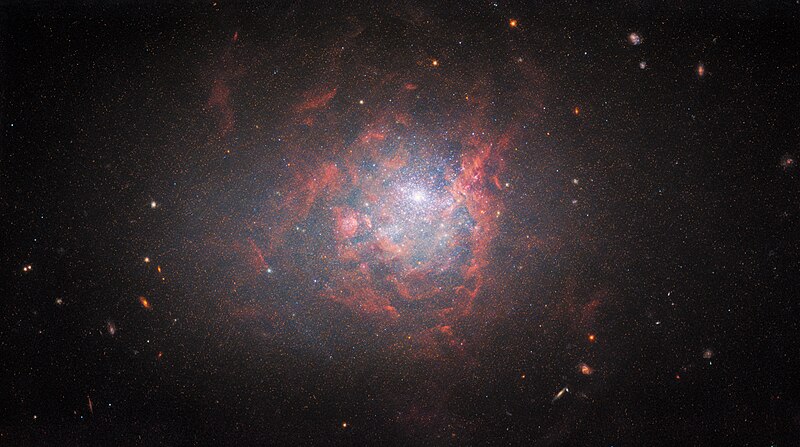
File:NGC1705_-_HST_-_Potw2205a.jpg · Wikimedia Commons · See Wikimedia Commons
NGC 1705
Sign in to savepeculiar galaxy in the constellation Pictor
Key facts
- Constellation
- Pictor
- Right ascension
- 04 54 13.500
- Declination
- −53 ° 21 ′ 39.82 ″
- Redshift
- 633 ± 6 km/ s
- Distance
- 16.6 ± 2.0 Mly (5.1 ± 0.6 Mpc )
- Group or cluster
- Dorado Group
- Apparent magnitude v
- 12.56 ± 0.03
- Type
- SA0 pec or BCD
- Apparent size v
- 1′.86 × 1′.45
via Wikipedia infobox
Wikidata facts
- Constellation
- Pictor
- Distance from Earth
- 5.1
- Image
- NGC1705 - HST - Potw2205a.jpg
Show 11 more facts
- Commons category
- NGC 1705
- catalog code
- [VDD93] 42
- discoverer or inventor
- John Frederick William Herschel
- time of discovery or invention
- 1834-12-05
- apparent magnitude
- 10.525
- galaxy morphological type
- BCD
- right ascension
- 73.5562500
- declination
- -53.3610611
- redshift
- 0.002095
- radial velocity
- 640
- epoch
- J2000.0
Sources (1)
via Wikidata · CC0
~2 min read
Encyclopedic overview
NGC 1705 is a peculiar lenticular galaxy and a blue compact dwarf galaxy (BCD) in the southern constellation of Pictor, positioned less than a degree to the east of Iota Pictoris, and is undergoing a starburst. With an apparent visual magnitude of 12.6 it requires a telescope to observe. It is estimated to be approximately 17 million light-years from the Earth, and is a member of the Dorado Group.
This is a relatively isolated galaxy, with its nearest neighbors being more than 500 kpc distant. However, its neutral hydrogen disk shows a significant amount of warp, suggesting that the outer gas is still settling into place. The mass models of the galaxy suggest the dominant source of mass is a dark matter halo. It has a super star cluster located near the galactic center, and shows strong galactic winds. Designated NGC1750–1, this cluster has a maximum radius of 2.85±0.50 pc and is 12±6 Myr old.
Excerpted from Wikipedia’s “NGC 1705” article, available under the CC BY-SA 4.0 licence.