
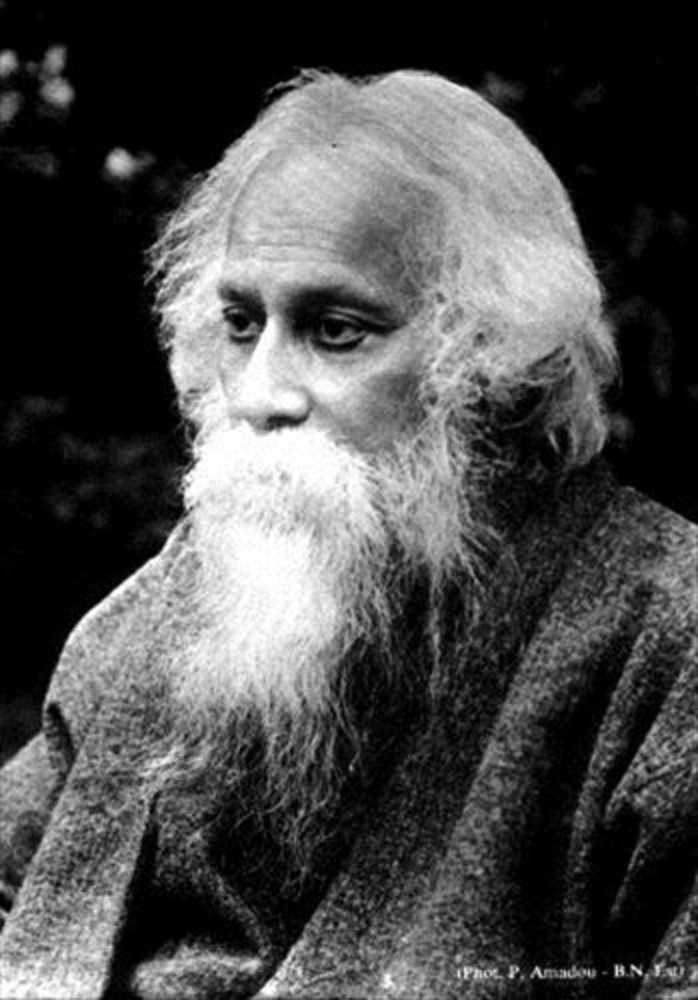
File:1926_Rabindrath_Tagore.jpg · Wikimedia Commons · See Wikimedia Commons
Rabindranath Tagore
Sign in to saveAlso known as Rabīndranātha Thākur, Kabiguru, Tagore, Bishwakabi, R. Tagore, Rabindranat Tagor, Bhanu Singha Thakur, Gurudev
Bengali poet, philosopher and polymath (1861–1941)
OverviewAI-generated
Rabindranath Tagore (1861–1941) was a male poet, painter, composer, and playwright born in Kolkata, British India. He was educated at University College London and held British Raj citizenship. Tagore wrote in English and Bangla, the latter being his native language. He was a Hindu of Bengali Brahmin ethnicity. His notable works include *Gitanjali*, *Ghare-Bhaire*, *Valmikipratibha*, and *Jogajog*. He also used the pseudonym ভানুসিংহ.
Tagore received the Nobel Prize in Literature and was appointed an Officer of the Order of the British Empire and a Knight Bachelor. He was nominated for the Nobel Prize in Literature. His family included his father Debendranath Tagore, his spouse Mrinalini Devi, and siblings Swarnakumari Devi, Hemendranath Tagore, Jyotirindranath Tagore, and Dwijendranath Tagore. He had students Lakshmiswar Sinha and Mukul Dey. Tagore died in Kolkata.
Synthesized by Vinony from 50 facts across 9 sources: Wikidata, Last.fm, Europeana Sparql, TMDb, Open Library, VIAF, MusicBrainz, Nobel Prize, Vinony collections. Generated from structured data (not the Wikipedia text) and checked against those facts — may still contain errors.
Person · Open Library
- Born
- 7 May 1861
- Died
- 7 August 1941
- Works
- 2000
Top works
- Sānāi
- Gītabitāna
- Mirari ; Ustulare ; Movere ; Retinere ; Revelare ; Sublimare ; Unire ; Paradis
- The post office
- Chitrath
via Open Library + Wikidata
Film & TV
Calcutta, British India
Rabindranath Tagore was a Bengali polymath — poet, writer, playwright, composer, philosopher, social reformer, and painter. He reshaped Bengali literature and music as well as Indian art in the late 19th and early 20th centuries. Author of the Gitanjali (Song Offerings), he became in 1913 the first non-European to win the Nobel Prize in Literature. Tagore's poetic songs were viewed as spiritual…
Known for
- Rabindranath Tagore — Self (Archive footage)1961
- Natir Puja1932
via TMDB
Music · MusicBrainz
- Type
- Person
- Gender
- Male
- Country
- India
- Active from
- 1861
- Active to
- 1941
Discography
via MusicBrainz · CC0
Listeners · Last.fm
- Listeners
- 5,733
- Total plays
- 33,510
Tags
Similar artists
Rabindranath Tagore (Bangla: রবীন্দ্রনাথ ঠাকুর; 7 May 1861 – 7 August 1941), also known by the sobriquet Gurudev, was a Bengali poet, Brahmo Samaj philosopher, visual artist, playwright, novelist, and composer whose works reshaped Bengali literature and music in the late 19th and early 20th centuries. A cultural icon of Bengal and India, he became Asia's first Nobel laureate when he won the 1913 Nobel Prize in Literature. <a href="https://www.last.fm/music/Rabindranath+Tagore">Read more on Last.fm</a>
Authority record · VIAF
- Lifespan
- 1861–1941
- Nationality
- IN
- Role / Field
- Poets, Poet, Philosophers, Painter, Escritores, Literatura
- Language
- ben, eng, hin
- Gender
- Male
Recorded by 44 libraries
via VIAF · OCLC
Nobel Prize
- The Nobel Prize in Literature1913
“because of his profoundly sensitive, fresh and beautiful verse, by which, with consummate skill, he has made his poetic thought, expressed in his own English words, a part of the literature of the West”
Wikidata facts
- Instance of
- human
- Gender
- male
- Citizenship
- British Raj
- Place of birth
- Kolkata
- Place of death
- Kolkata
- Spouse
- Mrinalini Devi
- Child
- Rathindranath Tagore
- Father
- Debendranath Tagore
- Occupation
- travel writer
- Languages spoken
- Bangla
- Native language
- Bangla
- Award
- Knight Bachelor
- Field of work
- painting
- Hair colour
- white hair
- Genre
- novella
- Movement
- Bengali Renaissance
- Instrument
- voice
- Image
- Rabindranath Tagore in 1909.jpg
Show 16 more facts
- Commons category
- Rabindranath Tagore
- date of birth
- 1861-05-06
- date of death
- 1941-08-07
- topic's main category
- Category:Rabindranath Tagore
- Commons gallery
- Rabindranath Tagore
- Commons Creator page
- Rabindranath Tagore
- ethnic group
- Brahmin
- nominated for
- Nobel Prize in Literature
- name in native language
- রবীন্দ্রনাথ
- on focus list of Wikimedia project
- Wikipedia:Vital articles/Level/4
- student
- Mukul Dey
- pseudonym
- ভানুসিংহ
- has works in the collection
- Shanghai Museum
- writing language
- English language
- P8168
- apple corer
- P12749
- Turtmann
Sources (15)
via Wikidata · CC0
Works in European collections
24 objects attributed to Rabindranath Tagore, held across European museums, libraries & archives · via Europeana
Głodne kamienie
Kapłanka Wisznu
Babu from Najandżor
Był sobie król
His royal power - a child
Kabuliwala
Discussion
Radża i rani
Return
Elderly sister
Głodne kamienie
Death of Kadambini
Odwet
Night of the Debris
Maszi
Skeleton
Heritage site
Moja piękna sąsiadka
Kuma
Koronujemy cię na króla
Victory
Rescued
Sadhana or the spiritual life; followed by Kabir’s poems.
The crescent moon
~40 min read
Encyclopedic overview
Rabindranath Thakur FRAS ( Bengali: [roˈbindɾonatʰ ˈʈʰakuɾ]; anglicised as Rabindranath Tagore /rəˈbɪndrənɑːt təˈɡɔːr/ ; 7 May 1861 – 7 August 1941), also known by his pseudonym Bhanusimha (Sun Lion) was a Bengali polymath (poet, writer, playwright, composer, philosopher, social reformer, and painter) of the Bengal Renaissance period. In 1913, Tagore became the first Asian to win a Nobel Prize in any category, and also the first lyricist and non-European to win the Nobel Prize in Literature. A significant moulder of culture within the Indian subcontinent, he wrote and composed the national anthems of India and Bangladesh.
He reshaped Bengali literature and music as well as Indian art with Contextual Modernism in the late 19th and early 20th centuries. He was the author of the "profoundly sensitive, fresh and beautiful" poetry of Gitanjali. Tagore's poetic songs were viewed as spiritual and mercurial; his elegant prose and magical poetry were widely popular in the Indian subcontinent. He was a fellow of the Royal Asiatic Society. Referred to as "the Bard of Bengal", Tagore was known by the sobriquets Gurudev, Kobiguru, and Biswokobi.
Excerpted from Wikipedia’s “Rabindranath Tagore” article, available under the CC BY-SA 4.0 licence.
Gallery (14)
Available in 166 languages
- Español
- Français
- Deutsch
- 中文
- 日本語
- Русский
- Português
- Italiano
- العربية
- हिन्दी
- Afrikaans
- Albanian
- Albanian
- Amharic
- Aragonese
- Armenian
- Assamese
- Asturian
Show 147 more
- Awadhi
- azb
- Azerbaijani
- Bahasa Indonesia
- Balinese
- Bangla
- Bashkir
- Basque
- bat_smg
- Bavarian
- be_x_old
- Belarusian
- Bhojpuri
- Bikol
- Bishnupriya
- Bislama
- Bosnian
- Breton
- btm
- Bulgarian
- Buriat
- Burmese
- Catalan
- cdo
- Cebuano
- Central Kurdish
- Chechen
- Cornish
- Crimean Tatar
- Croatian
- Czech
- Danish
- Divehi
- dty
- Egyptian Arabic
- Erzya
- Esperanto
- Estonian
- Faroese
- Fiji Hindi
- Filipino
- Finnish
- Galician
- Georgian
- Goan Konkani
- Greek
- Guarani
- Gujarati
- Hakka Chinese
- Hebrew
- Hungarian
- hyw
- Icelandic
- Ido
- Iloko
- Interlingua
- Irish
- Javanese
- Jju
- Kabardian
- Kannada
- Kanuri
- Kara-Kalpak
- Kashmiri
- Kazakh
- kbp
- Kotava
- Kurdish
- Kyrgyz
- Latin
- Latvian
- Limburgish
- Lingua Franca Nova
- Lithuanian
- Lombard
- Low German
- Luxembourgish
- Macedonian
- Madurese
- Maithili
- Malagasy
- Malay
- Malayalam
- Marathi
- Mazanderani
- Minangkabau
- Mingrelian
- Mongolian
- Moroccan Arabic
- Nederlands
- Nepali
- Newari
- Northern Frisian
- Norwegian
- Norwegian Nynorsk
- Occitan
- Odia
- Ossetic
- Pampanga
- Pashto
- Piedmontese
- Polski
- Punjabi
- Quechua
- roa_tara
- Romanian
- Rusyn
- Sanskrit
- Santali
- Sardinian
- Scots
- Scottish Gaelic
- Serbian
- Serbian (Latin)
- simple
- Sindhi
- Sinhala
- Slovak
- Slovenian
- Sundanese
- Svenska
- Swahili
- syl
- Tajik
- Tamil
- Tatar
- Telugu
- Tiếng Việt
- Türkçe
- Ukrainian
- Urdu
- Uzbek
- Veps
- Volapük
- Waray
- Welsh
- Western Panjabi
- Wu Chinese
- Yakut
- Yiddish
- Yoruba
- zh_min_nan
- zh_yue
- Zhuang
- فارسی
- ไทย
- 한국어
via Wikidata sitelinks · CC0