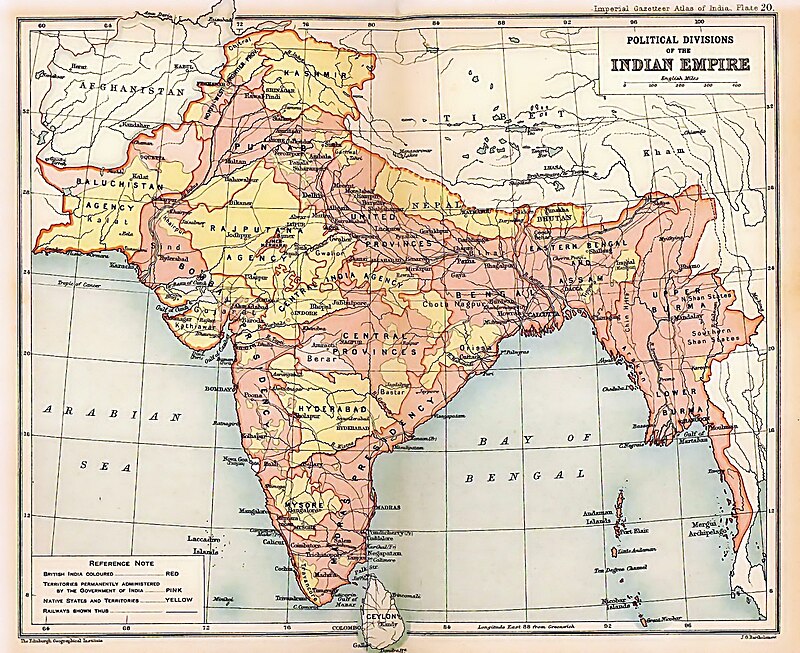
File:British_Indian_Empire_1909_Imperial_Gazetteer_of_India.jpg · Wikimedia Commons · See Wikimedia Commons
British Raj
Sign in to saveAlso known as Indian Empire, Crown rule in India, Direct rule in India, British India, British Indian Empire, the Raj, Hindustan, Hindoostan
British colonial rule on the Indian subcontinent (1858–1947)
The British Raj was the period of direct British colonial rule over India and surrounding regions, lasting from 1858 to 1947. It matters because it was one of history's largest and longest imperial projects, fundamentally reshaping Indian society, economy, and politics during nearly a century of foreign governance.
AI-generated from the Wikipedia summary — may contain errors.
Wikidata facts
- Instance of
- crown colony
- Part of
- British Empire
- Participant in
- Second Boer War
- Country
- British Empire
- Continent
- Asia
- Capital
- New Delhi
- Official language
- English language
- Currency
- Indian rupee
- Population
- 318942000
- Area
- 4238773
- Form of government
- constitutional monarchy
- Legislature
- Central Legislative Assembly
- Anthem
- God Save the King
- Image
- British Indian Empire 1909 Imperial Gazetteer of India.jpg
- Flag
- Star of India
- Coat of arms
- Order of the Star of India
- Said to be same as
- British India
Show 10 more facts
- Commons category
- British Raj
- inception
- 1858-01-01
- dissolved, abolished or demolished date
- 1947-08-15
- replaced by
- India
- native label
- British Raj
- language used
- English language
- official religion
- Christianity
- on focus list of Wikimedia project
- Wikipedia:Vital articles/Level/4
- category for people born here
- Q32654848
- P12749
- Gratiola
via Wikidata · CC0
~40 min read
Encyclopedic overview
The British Raj (/ˈrɑːdʒ/ RAHJ; from Hindustani rāj, 'reign', 'rule' or 'government') was the period of rule by the British Crown over present day India, Pakistan, Bangladesh, and Myanmar, lasting from 1858 to 1947. It is also called Crown rule in India, or direct rule in India. The region under British control was commonly called India in contemporaneous usage and included areas directly administered by the United Kingdom, which were collectively called British India, and areas ruled by indigenous rulers, but under British paramountcy, called the princely states. The region was sometimes called the Indian Empire, though not officially. As India, it was a founding member of the League of Nations and a founding member of the United Nations in San Francisco in 1945. India was a participating state in the Summer Olympics in 1900, 1920, 1928, 1932, and 1936.
This system of governance was instituted on 28 June 1858, when, after the Indian Rebellion of 1857, the rule of the East India Company was transferred to the Crown in the person of Queen Victoria (who, in 1876, was proclaimed Empress of India). It lasted until 1947 when the British Raj was partitioned into two sovereign dominion states: the Union of India (later the Republic of India) and Dominion of Pakistan (later the Islamic Republic of Pakistan and People's Republic of Bangladesh in the 1971 Proclamation of Bangladeshi Independence). At the inception of the Raj in 1858, Lower Burma was already a part of British India; Upper Burma was added in 1886, and the resulting union, Burma, was administered as an autonomous province until 1937, when it became a separate British colony, gaining its independence in 1948. It was renamed Myanmar in 1989. The Chief Commissioner's Province of Aden was also part of British India at the inception of the British Raj and became a separate colony known as Aden Colony in 1937 as well.
Excerpted from Wikipedia’s “British Raj” article, available under the CC BY-SA 4.0 licence.
Gallery (12)
Available in 102 languages
- Español
- Français
- Deutsch
- 中文
- 日本語
- Русский
- Português
- Italiano
- العربية
- हिन्दी
- Afrikaans
- Albanian
- Angika
- Armenian
- Assamese
- Asturian
- azb
- Azerbaijani
Show 83 more
- Bahasa Indonesia
- Bangla
- Bashkir
- Basque
- be_x_old
- Belarusian
- Bhojpuri
- Breton
- Bulgarian
- Burmese
- Catalan
- cdo
- Central Kurdish
- Croatian
- Czech
- Danish
- Egyptian Arabic
- Esperanto
- Estonian
- Filipino
- Finnish
- fiu_vro
- Galician
- Georgian
- Greek
- Hakka Chinese
- Hebrew
- Hungarian
- Icelandic
- Irish
- Kara-Kalpak
- Kashmiri
- Lao
- Latvian
- Lithuanian
- Macedonian
- Maithili
- Malagasy
- Malay
- Malayalam
- Marathi
- Nederlands
- Nepali
- Norwegian
- Norwegian Nynorsk
- Occitan
- Old English
- Pashto
- Polski
- Punjabi
- Romanian
- Rusyn
- Santali
- Scots
- Serbian
- Serbian (Latin)
- simple
- Sindhi
- skr
- Slovak
- Slovenian
- Svenska
- Swahili
- Tajik
- Tamil
- Tatar
- Telugu
- Tiếng Việt
- Türkçe
- Ukrainian
- Urdu
- Uzbek
- Venetian
- Welsh
- Western Frisian
- Western Panjabi
- Wu Chinese
- Zaza
- zh_min_nan
- zh_yue
- فارسی
- ไทย
- 한국어
via Wikidata sitelinks · CC0