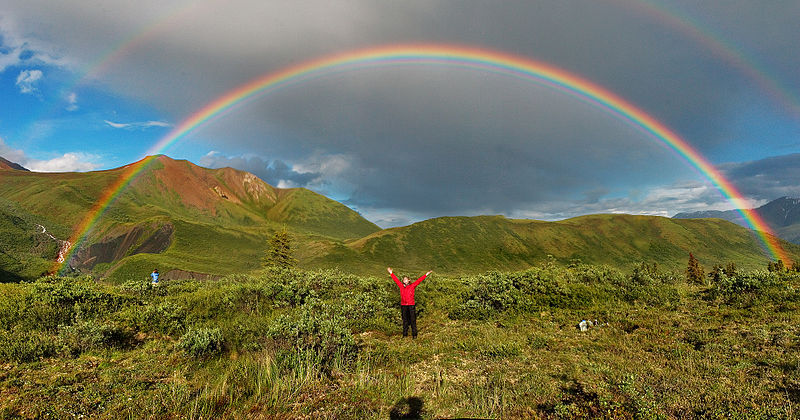
File:Double-alaskan-rainbow.jpg · Wikimedia Commons · See Wikimedia Commons
arco iris
Sign in to savefenómeno meteorológico que aparece como un arco multicolor cuando la luz del sol se refleja en gotas de agua
A rainbow is an optical phenomenon consisting of a spectrum of light that appears in the sky when sunlight and rain occur simultaneously, with the observer positioned between the sun and the rain. Rainbows matter because they are striking natural displays that have fascinated people throughout history and provide visible evidence of how light behaves when it interacts with water droplets.
AI-generated from the Wikipedia summary — may contain errors.
Wikidata facts
- Instance of
- phenomenon
- Subclass of
- photometeor
- Image
- WhereRainbowRises.jpg
Show 7 more facts
- Unicode character
- 🌈
- Commons category
- Rainbows
- topic's main category
- Category:Rainbow
- Commons gallery
- Rainbow
- color
- red
- on focus list of Wikimedia project
- Wikipedia:Vital articles/Level/4
Sources (9)
via Wikidata · CC0
Article · Español
Un arcoíris o arco iris es un fenómeno óptico y meteorológico que causa la aparición en la atmósfera terrestre de un arco multicolor, a veces, doble, por la descomposición de la luz solar en el espectro visible. Se produce por refracción, cuando la luz atraviesa gotas de agua. Está formado por arcos concéntricos de colores, sin solución de continuidad entre ellos, con el rojo hacia la parte exterior y el violeta hacia el interior. A altitud suficiente, por ejemplo cuando se viaja en avión, el arcoíris se puede observar en forma de círculo completo. Cuando se observa un arcoíris doble, el arco secundario rodea al primario. Su intensidad es más tenue y el orden de los colores está invertido. Para los colores vistos por el ojo humano, la secuencia más comúnmente citada y recordada es la de Isaac Newton, definida por siete colores fundamentales: rojo, naranja, amarillo, verde, azul, índigo y violeta. Una lectura cuidadosa del trabajo de Newton indica que el color que llamó azul es lo que actualmente llamaríamos cian.
Abstract from DBpedia / Wikipedia · CC BY-SA
Gallery (29)
Available in 179 languages
- Español
- Français
- Deutsch
- 中文
- 日本語
- Русский
- Português
- Italiano
- العربية
- हिन्दी
- Afrikaans
- Albanian
- Amharic
- ami
- Aragonese
- Aramaic
- Armenian
- Assamese
Show 160 more
- Asturian
- Aymara
- Azerbaijani
- Bahasa Indonesia
- Balinese
- Bangla
- Banjar
- Bashkir
- Basque
- bat_smg
- bdr
- be_x_old
- Belarusian
- Betawi
- Bikol
- Bosnian
- Breton
- Bulgarian
- Burmese
- Catalan
- cdo
- Central Kurdish
- Chechen
- Cherokee
- Chuvash
- Croatian
- Czech
- Danish
- Erzya
- Esperanto
- Estonian
- Fijian
- Filipino
- Finnish
- fiu_vro
- Friulian
- Galician
- Georgian
- Gorontalo
- Greek
- Guarani
- Gujarati
- Haitian Creole
- Hakka Chinese
- Hausa
- Hebrew
- Hungarian
- Iban
- Icelandic
- Ido
- Ingush
- Interlingua
- Inupiaq
- Irish
- Javanese
- Kabyle
- Kannada
- Kara-Kalpak
- Kashmiri
- Kazakh
- kbp
- kge
- Khmer
- Komi
- Komi-Permyak
- Kurdish
- Kyrgyz
- Lao
- Latin
- Latvian
- Ligurian
- Limburgish
- Lithuanian
- lld
- Lombard
- Lower Sorbian
- Macedonian
- Maithili
- Malagasy
- Malay
- Malayalam
- Manx
- Māori
- Marathi
- Mari
- mnw
- Mongolian
- Moroccan Arabic
- nah
- Nederlands
- Nepali
- Newari
- Norwegian
- Norwegian Nynorsk
- Occitan
- Oromo
- Pampanga
- Pashto
- Pennsylvania German
- Polski
- ppl
- Punjabi
- pwn
- Quechua
- roa_rup
- Romanian
- Santali
- Saterland Frisian
- Scottish Gaelic
- Serbian
- Serbian (Latin)
- Shona
- Sicilian
- Silesian
- simple
- Sindhi
- Sinhala
- Slovak
- Slovenian
- Somali
- Sundanese
- Svenska
- Swahili
- szy
- Tachelhit
- Tajik
- Tamil
- Taroko
- Tatar
- tay
- Telugu
- Tibetan
- Tiếng Việt
- Tsonga
- Tulu
- Türkçe
- Ukrainian
- Upper Sorbian
- Urdu
- Uzbek
- Venetian
- Veps
- Walloon
- Waray
- Wayuu
- Welsh
- Western Frisian
- Western Mari
- Western Panjabi
- Wu Chinese
- Yakut
- Yiddish
- Zaza
- zh_classical
- zh_min_nan
- zh_yue
- Zhuang
- فارسی
- ไทย
- 한국어
via Wikidata sitelinks · CC0