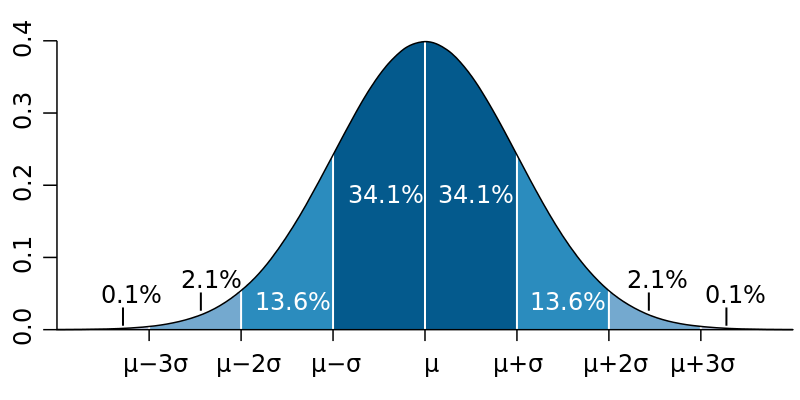
File:Standard_deviation_diagram_micro.svg · Wikimedia Commons · See Wikimedia Commons
losowość
Sign in to savethumb|alt=|A Pseudorandom Number Generator|pseudorandomly generated [[bitmap]] In common usage, randomness is the apparent or actual lack of definite patterns or predictability in information. A random sequence of events, symbols or steps often has no order and does not follow an intelligible pattern or combination. Individual random events are, by definition, unpredictable, but if there is a known probability distribution, the frequency of different outcomes over repeated events (or "trials") is predictable. For example, when throwing two dice, the outcome of any particular roll is unpredicta
Randomness describes when events or information appear to have no predictable pattern or order, even though individual outcomes cannot be foreseen. While we cannot predict what will happen in any single random event, we can predict how often different outcomes will occur over many repeated events if we know the underlying probabilities—like how rolling two dice will average certain results over time.
AI-generated from the Wikipedia summary — may contain errors.
Wikidata facts
- Subclass of
- uncertainty
- Image
- Roulette wheel.jpg
Show 8 more facts
- Commons category
- Randomness
- topic's main category
- Category:Randomness
- described by source
- Encyclopædia Britannica 11th edition
- Stack Exchange tag
- stackoverflow.com/tags/random
- Unicode character
- 🔀
- has effect
- excitement
- history of topic
- history of randomness
- hashtag
- random
Sources (6)
via Wikidata · CC0
Article · Polski
Losowość – brak celu, przyczyny, porządku lub przewidywalnego zachowania. Losowy proces to proces, którego wyniki nie dają się dokładnie przewidzieć, a jedynie można opisać ich rozkład. W matematyce i statystyce termin ten można formalnie zdefiniować jako zachowanie dokładnie opisywane pojęciem zmiennej losowej, pozbawione korelacji i innych przewidywalnych cech. Jednakże samo istnienie idealnego: chaosu, nieporządku, całkowitej nieprzewidywalności podważa np. Teoria Ramseya, naukowcy od lat badają „przypadkowe regularności”, które muszą się pojawić w dużych strukturach niezależnie od ich losowości.Profesor Theodore Motzkin zauważył że „jeśli nieporządek jest w ogólności bardziej prawdopodobny, to całkowity nieporządek jest niemożliwy”.
Abstract from DBpedia / Wikipedia · CC BY-SA
Gallery (10)
Available in 48 languages
- Español
- Français
- Deutsch
- 中文
- 日本語
- Русский
- Português
- Italiano
- العربية
- हिन्दी
- Afrikaans
- Albanian
- Azerbaijani
- Bahasa Indonesia
- Basque
- Belarusian
- Bulgarian
- Central Kurdish
Show 29 more
via Wikidata sitelinks · CC0