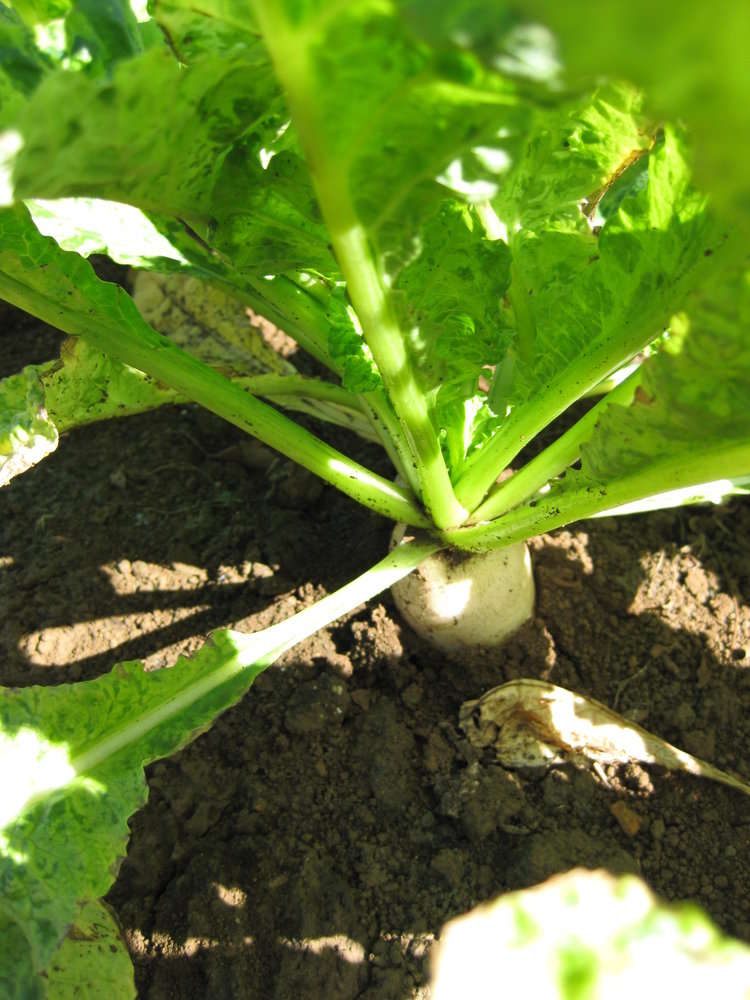
Encyclopedia of Life · EOL (see source)
Raphanus
Sign in to saveRaphanus (Ancient Greek for "radish") is a genus within the flowering plant family Brassicaceae.
OverviewAI-generated
Raphanus is a genus of plants within the family Brassicaceae, belonging to the order Brassicales and the class Magnoliopsida. The taxon, which has the accepted status in WoRMS, is classified under the phylum Tracheophyta and kingdom Plantae. Its parent taxon is Brassiceae, and the type species is Raphanus sativus. Common names for the genus include radish, turnip radish, Radijs, rzodkiew, and 萝卜属. The genus produces fruit of the silique type.
The native range of Raphanus includes Afghanistan, Albania, Algeria, Altay, Austria, the Azores, Baleares, the Baltic States, Belarus, Belgium, Bulgaria, and the Canary Islands. Records from iDigBio indicate the presence of the genus in Mexico, Canada, Spain, the United States, and Peru, with specimens held by institutions such as INECOL, GH, University of Alberta Museums, NY, and IBUNAM. The genus has 277,358 occurrence records in GBIF and 2,665 associated PubMed entries.
Synthesized by Vinony from 39 facts across 8 sources: Wikidata, GBIF, PubMed, Gbif Occ, Plants of the World, WoRMS, iDigBio, Vinony graph. Generated from structured data (not the Wikipedia text) and checked against those facts — may still contain errors.
Species
GENUS
- KingdomPlantae
- PhylumTracheophyta
- ClassMagnoliopsida
- OrderBrassicales
- FamilyBrassicaceae
Raphanus est un genre végétal de la famille des Brassicaceae. C'est notamment le genre des radis. Botte de radis rouges (Raphanus sativus subsp. sativus) Liste des espèces Espèces acceptées[1] Raphanus raphanistrum L. - radis sauvage Raphanus sativus L. - radis cultivé Raphanus caudatus L. Raphanus confusus Al-Shehbaz & Warwick Raphanus indicus Sinskaya Le génome de Raphanus raphanistrum (radis sauvage)[2] et celui de Raphanus sativus (radis cultivé) ont été séquencés. Notes et références ↑ The plant List Brassicaceae -Raphanus ↑ Gaurav D. Moghe, David E. Hufnagel, Haibao Tang, Yongli Xiao, Ian Dworkin, Christopher D. Town,c Jeffrey K. Conner et Shin-Han Shiu Consequences of Whole-Genome Triplication as Revealed by Comparative Genomic Analyses of the Wild Radish Raphanus raphanistrum and Three Other Brassicaceae Species Plant Cell. 2014 May; 26(5): 1925–1937.
via GBIF · Kew POWO
Museum specimens
- Specimen records
- 342
- With media
- 225
- Family
- Brassicaceae
- Collections
- INECOL, GH, UNIVERSITY OF ALBERTA MUSEUMS, NY, IBUNAM, MPM
- Recorded in
- Mexico, Canada, Spain, United States, Peru, United Kingdom, Netherlands, Uruguay
Research
2,665 papers- Radish (Raphanus sativus) and Diabetes.Nutrients · 2017
- Bioactivity of Raphanus Species against Agricultural Phytopathogens and its Role in Soil Remediation: A Review.Combinatorial chemistry & high throughput screening · 2024
- Bioactive compounds in Raphanus sativus: mechanisms of apoptosis, anti-angiogenesis, cell cycle arrest and beyond in cancer prevention and treatment.Medical oncology (Northwood, London, England) · 2025
- Raphanus sativus L. var niger as a source of phytochemicals for the prevention of cholesterol gallstones.Phytotherapy research : PTR · 2014
- Raphanus sativus (Radish): their chemistry and biology.TheScientificWorldJournal · 2004
via PubMed
Wikidata facts
- Instance of
- taxon
- Parent taxon
- Brassiceae
- Image
- Daikon.Japan.jpg
Show 8 more facts
- taxon rank
- genus
- taxon name
- Raphanus
- Commons category
- Raphanus
- topic's main category
- Category:Raphanus
- taxon common name
- redkev
- has fruit type
- silique
- taxonomic type
- Raphanus sativus
via Wikidata · CC0
~1 min read
Encyclopedic overview
2 sectionsContents
- References
- External links
Raphanus (Ancient Greek for "radish") is a genus within the flowering plant family Brassicaceae.
Carl Linnaeus described three species within the genus: the cultivated radish (Raphanus sativus), the wild radish or jointed charlock (Raphanus raphanistrum), and the rat-tail radish (Raphanus caudatus). Various other species have been proposed (particularly related to the East Asian daikon varieties) and the rat-tail radish is sometimes considered a variety of R. sativus, but no clear consensus has emerged.
Excerpted from Wikipedia’s “Raphanus” article, available under the CC BY-SA 4.0 licence.