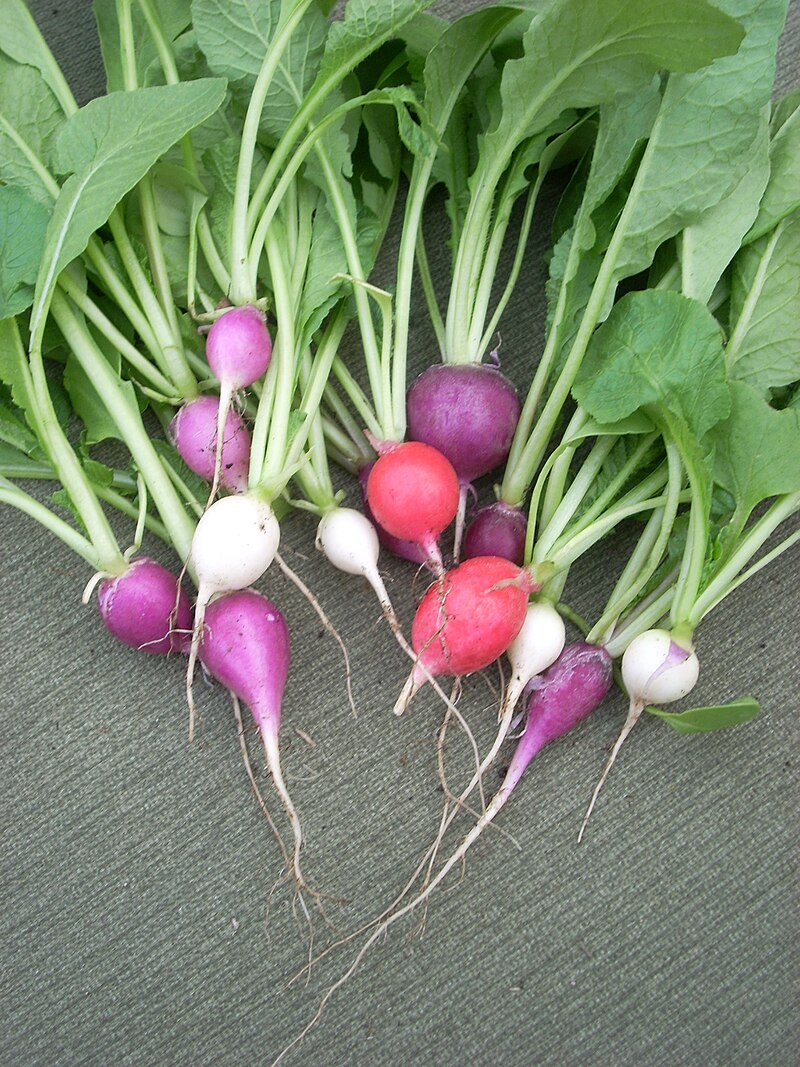
File:Radish_3371103037_4ab07db0bf_o.jpg · Wikimedia Commons · See Wikimedia Commons
Raphanus sativus
Sign in to saveAlso known as radish
The radish (Raphanus sativus or '''Raphanus raphanistrum subsp. sativus') is a flowering plant in the mustard family, Brassicaceae. Its large taproot is commonly used as a root vegetable, although the entire plant is edible and its leaves are sometimes used as a leaf vegetable. Originally domesticated in Asia, radishes are now grown and consumed globally. The radish is sometimes considered to form a species complex with the wild radish and instead treated as the subspecies Raphanus raphanistrum subsp. sativus''.
OverviewAI-generated
Raphanus sativus, commonly known as cultivated radish or white radish, is a species within the genus Raphanus. It belongs to the family Brassicaceae and the order Brassicales. The taxon is classified as a useful plant and has been described in sources such as the Gujin Tushu Jicheng and the Encyclopædia Britannica 11th edition. It is also referred to by the short name R. sativus.
The organism is used as a vegetable, fodder, and medicinal plant. Nutritional data indicates it contains 17 kcal of energy, 3.5 grams of carbohydrates, and 0.9 grams of protein per serving. Its range includes Beijing, China, the Tibet Autonomous Region, and Guangdong. Occurrences have been recorded in Mexico.
Scientific records show an occurrence count of 49684. Media and specimen records are held by institutions including FCN-UAQ, IBUNAM, ECOSUR, IB-CUCBA-UDG, and FC-UABC. The subject is referenced by 800 other encyclopedia articles and appears on the Wikipedia:Vital articles/Level/4 focus list.
Synthesized by Vinony from 56 facts across 8 sources: Wikidata, GBIF, Gbif Occ, Plants of the World, Openfoodfacts, WoRMS, iDigBio, Vinony graph. Generated from structured data (not the Wikipedia text) and checked against those facts — may still contain errors.
Species
Raphanus sativus
SPECIES
- KingdomPlantae
- PhylumTracheophyta
- ClassMagnoliopsida
- OrderBrassicales
- FamilyBrassicaceae
Common Name: long black Spanish radish
via GBIF · Kew POWO
Museum specimens
- Specimen records
- 4,354
- With media
- 3,160
- Family
- Brassicaceae
- Collections
- FCN-UAQ, IBUNAM, ECOSUR, IB-CUCBA-UDG, FC-UABC, FB-UMSNH
- Recorded in
- Mexico
Nutrition · Open Food Facts
Typical values per 100 g · averaged across 14 products
- Energy
- 17 kcal
- Fat
- 0.1 g
- — of which saturates
- 0 g
- Carbohydrates
- 3.5 g
- — of which sugars
- 2.1 g
- Fibre
- 1.4 g
- Protein
- 0.9 g
- Salt
- 0.1 g
via Open Food Facts · ODbL
Wikidata facts
- Instance of
- taxon
- Subclass of
- useful plant
- Parent taxon
- Raphanus
- Image
- Raphanus sativus leaf.JPG
- Has use
- vegetable
Show 12 more facts
- taxon common name
- redkvica
- Commons category
- Raphanus sativus
- taxon rank
- species
- taxon name
- Raphanus sativus
- Commons gallery
- Raphanus sativus
- topic's main category
- Category:Radishes
- described by source
- Encyclopædia Britannica 11th edition
- taxon range
- Guangdong
- on focus list of Wikimedia project
- Wikipedia:Vital articles/Level/4
- short name
- R. sativus
- taxon author citation
- L.
Sources (7)
via Wikidata · CC0
~17 min read
Encyclopedic overview
20 sectionsContents
- Description
- Varieties
- Origins
- Cultivation
- Companion plant
- Pests
- Varieties and cultivars
- Spring or summer radishes
- Winter varieties
- Seed pod varieties
- Production
- Uses
- Nutrition
- Culinary
- Other uses
- In culture
- Gallery
- See also
- References
- External links
The radish (Raphanus sativus or '''Raphanus raphanistrum subsp. sativus') is a flowering plant in the mustard family, Brassicaceae. Its large taproot is commonly used as a root vegetable, although the entire plant is edible and its leaves are sometimes used as a leaf vegetable. Originally domesticated in Asia, radishes are now grown and consumed globally. The radish is sometimes considered to form a species complex with the wild radish and instead treated as the subspecies Raphanus raphanistrum subsp. sativus.
Radishes are often used raw as a crunchy salad vegetable with a pungent, slightly spicy flavor, varying in intensity depending on its growing environment. There are numerous varieties varying in size, flavor, color, and length of time they take to mature. Radishes owe their sharp flavor to the various chemical compounds produced by the plants, including glucosinolate, myrosinase, and isothiocyanate. They are sometimes grown as companion plants and suffer from few pests and diseases. They germinate quickly and grow rapidly, common smaller varieties being ready for consumption within a month, while larger daikon varieties take several weeks. Being relatively easy to grow and quick to harvest, radishes are often planted by novice gardeners. Another use of radish is as a cover or catch crop in winter, or as a forage crop. Some radishes are grown for their seeds; others, such as daikon, may be grown for oil production. Others are used for sprouting.
Excerpted from Wikipedia’s “Raphanus sativus” article, available under the CC BY-SA 4.0 licence.
Gallery (45)
Available in 125 languages
- Español
- Français
- Deutsch
- 中文
- 日本語
- Русский
- Português
- Italiano
- العربية
- हिन्दी
- Achinese
- Albanian
- Amharic
- Aragonese
- Asturian
- Awadhi
- azb
- Azerbaijani
Show 106 more
- Bahasa Indonesia
- Bangla
- Bashkir
- Basque
- bat_smg
- Bhojpuri
- Bikol
- Breton
- Bulgarian
- Catalan
- cdo
- Cebuano
- Central Kurdish
- Chuvash
- Corsican
- Croatian
- Czech
- Danish
- eml
- Erzya
- Esperanto
- Estonian
- Filipino
- Finnish
- Galician
- Georgian
- Goan Konkani
- Greek
- Haitian Creole
- Hakka Chinese
- Hebrew
- Hungarian
- Icelandic
- Iloko
- Irish
- Javanese
- Kabardian
- Kannada
- Kara-Kalpak
- Kashmiri
- Kashubian
- Kazakh
- Kinyarwanda
- Komi
- Kurdish
- Latin
- Latvian
- Ligurian
- Lithuanian
- Macedonian
- Malayalam
- Marathi
- Mazanderani
- Minangkabau
- Mongolian
- nah
- Navajo
- Nederlands
- Norwegian
- Norwegian Nynorsk
- Occitan
- Ossetic
- Pampanga
- Pashto
- Polski
- Punjabi
- Quechua
- Romanian
- Sanskrit
- Sardinian
- Scots
- Serbian
- Serbian (Latin)
- Sicilian
- Silesian
- simple
- Sindhi
- Slovak
- Slovenian
- Sundanese
- Svenska
- Tajik
- Tamil
- Tatar
- Telugu
- Tibetan
- Tiếng Việt
- Tongan
- Türkçe
- Tuvinian
- Ukrainian
- Upper Sorbian
- Urdu
- Uzbek
- Veps
- Walloon
- Waray
- Western Panjabi
- Wu Chinese
- Yiddish
- zh_min_nan
- zh_yue
- Zhuang
- فارسی
- ไทย
- 한국어
via Wikidata sitelinks · CC0