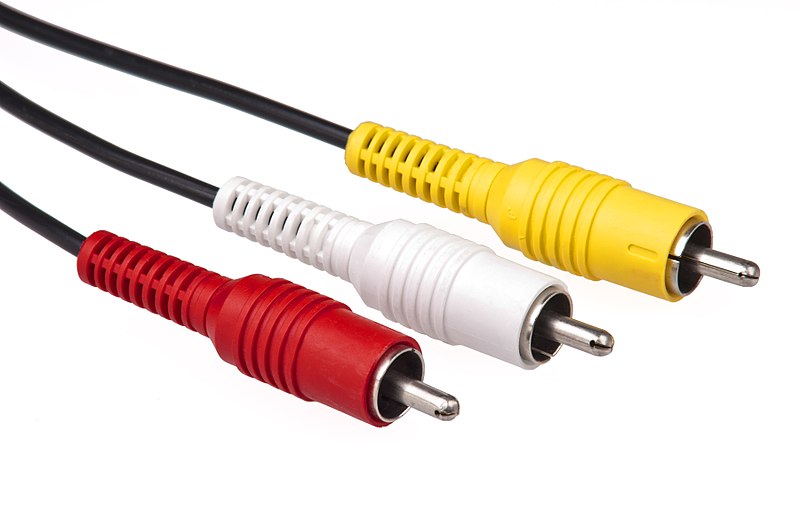
File:Composite-cables.jpg · Wikimedia Commons · See Wikimedia Commons
RCA connector
Sign in to saveAlso known as phono connector, RCA, Cinch connector, Radio Corporation of America connector
electrical connector with one signal channel mainly used for analog stereo audio (in pairs), analog component or composite video and rarely for digital audio
In the Vinony graph
Within Vinony's link graph, RCA connector is referenced by 301 other articles, and connects out to electrical connector, video game console and phonograph.
It is catalogued under topics including Audiovisual connectors, Electrical connectors and RF connectors.
Its subject is documented across 37 Wikipedia language editions.
Key facts
- Type
- RF coaxial connector
- Designer
- Radio Corporation of America
- Designed
- 1930s
- Diameter
- 0.327 in (8.3 mm), 0.126 in (3.2 mm) contact dia.
- Cable
- Coaxial
- Passband
- Typically 0–100 MHz
via Wikipedia infobox
Wikidata facts
- Instance of
- audio/video connector
- Named after
- RCA Corporation
- Diameter
- 0.9
- Image
- RCA plugs (male) for left channel (black) and right channel (red) plugged into output RCA jacks (female) of a CD player.jpg
- Connects with
- coaxial cable
Show 5 more facts
- used by
- S/PDIF
- Commons category
- RCA connectors
- Commons gallery
- RCA connectors
- throughput
- 100
- different from
- telephone connector
Sources (1)
via Wikidata · CC0
~11 min read
Encyclopedic overview
The RCA connector is a type of electrical connector commonly used to carry analog audio and video signals. The name refers to the popular name of Radio Corporation of America, which introduced the design in the 1930s. Typically, the output is a plug type connector and the input a jack type connector. These are referred to as RCA plug and RCA jack respectively.
It is also called a phono connector, referring to its early use to connect a phonograph turntable to an AM radio receiver. As home audio systems became more complex, RCA cables became a standard way to connect components such as radio receivers, amplifiers, turntables, tape decks, and CD players. Their ubiquity led to them also being used for video: connecting AV receivers, analog televisions, videocassette recorders, DVD players, and game consoles. They remain in use as a simple, widely supported means of connection. In some European countries such as France and Germany, the name cinch is still used as an antonomasia of the Chicago-based manufacturer Cinch, for such a connector and socket.
Excerpted from Wikipedia’s “RCA connector” article, available under the CC BY-SA 4.0 licence.