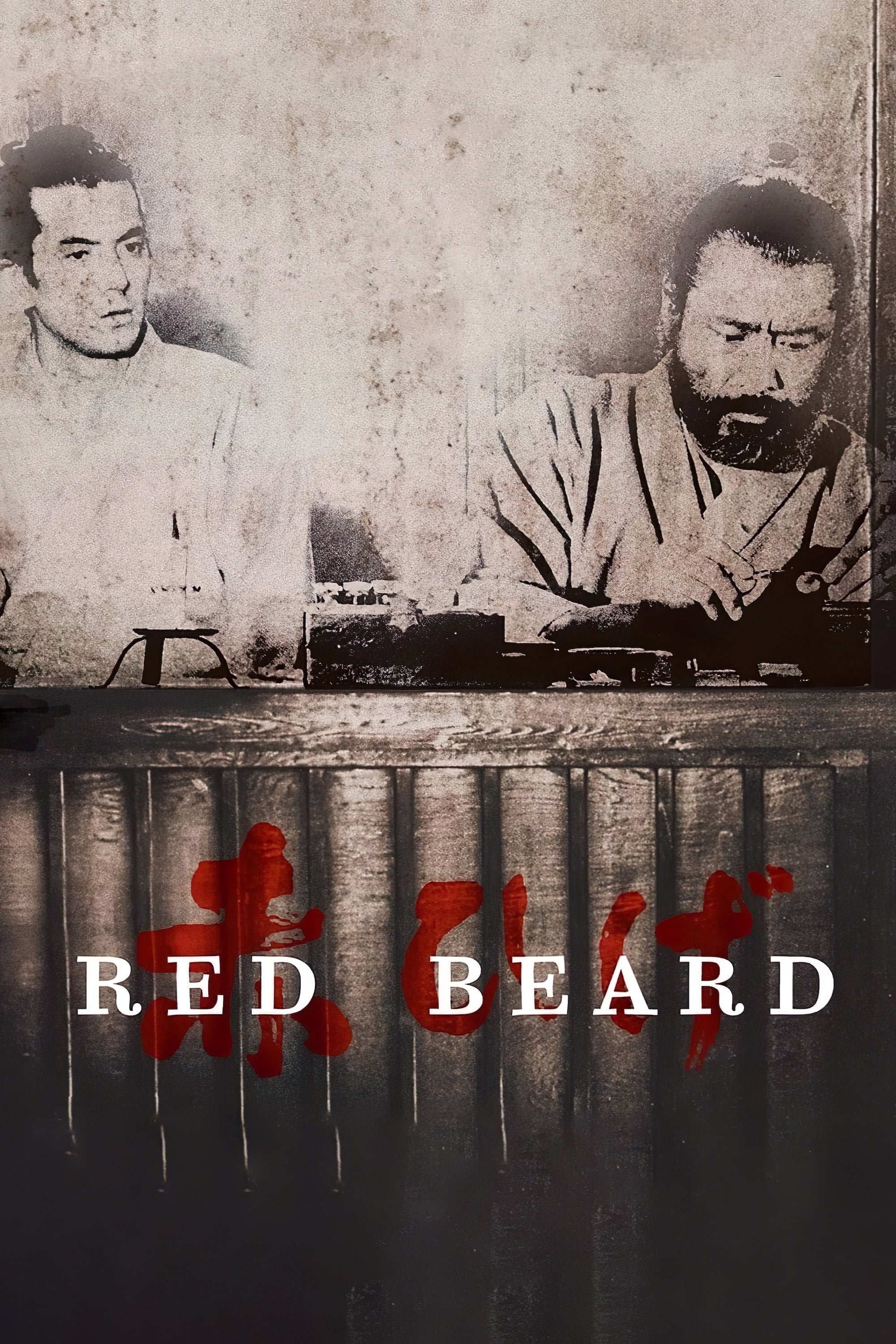
Poster from TMDB
OverviewAI-generated
Red Beard is a 1965 Japanese black-and-white drama film directed by Akira Kurosawa. The screenplay was written by Kurosawa, Hideo Oguni, Ryūzō Kikushima, and Masato Ide, with production by Ryūzō Kikushima and Tomoyuki Tanaka. The cast includes Toshirō Mifune, Kinuyo Tanaka, Chishū Ryū, and Yūzō Kayama. The film was produced by Toho and Kurosawa Production, with music composed by Masaru Sato.
The narrative is set in Edo and focuses on health care and physicians. It is based on a work by Shūgorō Yamamoto and falls under the Jidaigeki genre. The runtime is 185 minutes. The film has received various review scores, including 7.5/10, 75%, 90/100, 8.3/10, and an IMDb rating of 8.3. It has been distributed by Toho and Netflix, and is available via video on demand through providers such as HBO Max and the Criterion Channel.
Synthesized by Vinony from 44 facts across 4 sources: Wikidata, TMDb, OMDb, IMDb. Generated from structured data (not the Wikipedia text) and checked against those facts — may still contain errors.
Film · TMDB
8.1Aspiring to an easy job as personal physician to a wealthy family, Noboru Yasumoto is disappointed when his first post after medical school takes him to a small country clinic under the gruff doctor Red Beard. Yasumoto rebels in numerous ways, but Red Beard proves a wise and patient teacher. He gradually introduces his student to the unglamorous side of the profession, ultimately assigning him to care for a prostitute rescued from a local brothel.
Cast
- Toshirō Mifune as Dr. Kyojio Niide ("Red Beard")
- Yūzō Kayama as Dr. Noboru Yasumoto
- Tsutomu Yamazaki as Sahachi
- Reiko Dan as Osugi
- Miyuki Kuwano as Onaka
- Kyōko Kagawa as Madwoman ("The Mantis")
Themes
- uniform
- career
- small town
- japan
- brothel
- heal
- lunatic asylum
- rural area
- clinic
- doctor
This product uses the TMDB API but is not endorsed or certified by TMDB.
Ratings
IMDb
8.3/10
22,731 votes
Rotten Tomatoes
73%
Metacritic
90/100
- Year
- 1965
- Runtime
- 185 min
- Genres
- Drama
- Rated
- Not Rated
- Awards
- 11 wins & 2 nominations total
via OMDb · IMDb
Key facts
- Directed by
- Akira Kurosawa
- Screenplay by
- Masato Ide Hideo Oguni Ryūzō Kikushima Akira Kurosawa
- Based on
- Akahige Shinryōtan , by Shūgorō Yamamoto
- Produced by
- Tomoyuki Tanaka Ryūzō Kikushima
- Starring
- Toshiro Mifune Yūzō Kayama Reiko Dan Kyōko Kagawa Akemi Negishi Miyuki Kuwano Tsutomu Yamazaki Takashi Shimura
- Cinematography
- Asakazu Nakai Takao Saito
- Edited by
- Akira Kurosawa
- Music by
- Masaru Sato
- Production companies
- Kurosawa Productions Toho
- Distributed by
- Toho
- Release dates
- April 3, 1965 ( 1965-04-03 ) ( roadshow ) April 24, 1965 ( 1965-04-24 ) (Japan)
- Running time
- 185 minutes
- Country
- Japan
- Language
- Japanese
- Budget
- ¥200–300 million
- Box office
- ¥400 million , (Japan)
via Wikipedia infobox
Wikidata facts
- Instance of
- film
- Genre
- Jidaigeki
- Country of origin
- Japan
- Original language
- Japanese
- Main subject
- physician
- Director
- Akira Kurosawa
- Screenwriter
- Hideo Oguni
- Cast member
- Kin Sugai
- Composer
- Masaru Sato
- Producer
- Tomoyuki Tanaka
- Production company
- Toho
- Cinematographer
- Asakazu Nakai
- Narrative location
- Edo
- Filming location
- Japan
- Duration
- 185
- FilmAffinity ID
- 418007
- Distribution format
- video on demand
- Image
- Red-Beard-1.jpg
Show 11 more facts
- publication date
- 1968-12-19
- title
- 赤ひげ
- color
- black-and-white
- distributed by
- Netflix
- after a work by
- Shūgorō Yamamoto
- film editor
- Akira Kurosawa
- review score
- 8.3/10
- capital cost
- 300000000
- assessment
- Bechdel test
- Commons category
- Red Beard
- has characteristic
- film adaptation
Sources (11)
via Wikidata · CC0
~13 min read
Encyclopedic overview
Red Beard (Japanese: 赤ひげ, Hepburn: Akahige) is a 1965 Japanese period drama film co-written, edited, and directed by Akira Kurosawa, in his last collaboration with actor Toshiro Mifune. Based on Shūgorō Yamamoto's 1959 short story collection, Akahige Shinryōtan, the film takes place in Koishikawa, a district of Edo, towards the end of the Tokugawa period (i.e. early or mid-19th century), and is about the relationship between a town doctor and his new trainee. Fyodor Dostoevsky's novel Humiliated and Insulted provided the source for a subplot about a young girl, Otoyo (Terumi Niki), who is rescued from a brothel.
The film looks at the problem of social injustice and explores two of Kurosawa's favorite topics: humanism and existentialism. A few critics have noted the film to be reminiscent in some ways of Ikiru. It is Kurosawa's last black-and-white film. The film was a major box office success in Japan but is known for having caused a rift between Mifune and Kurosawa, with this being the final collaboration between them after working on 16 films together. The film was screened in competition at the 26th Venice International Film Festival. Toshiro Mifune won a Volpi Cup for Best Actor for his performance in the film. It was also nominated for a Golden Globe for Best Foreign Language Film.
Excerpted from Wikipedia’s “Red Beard” article, available under the CC BY-SA 4.0 licence.