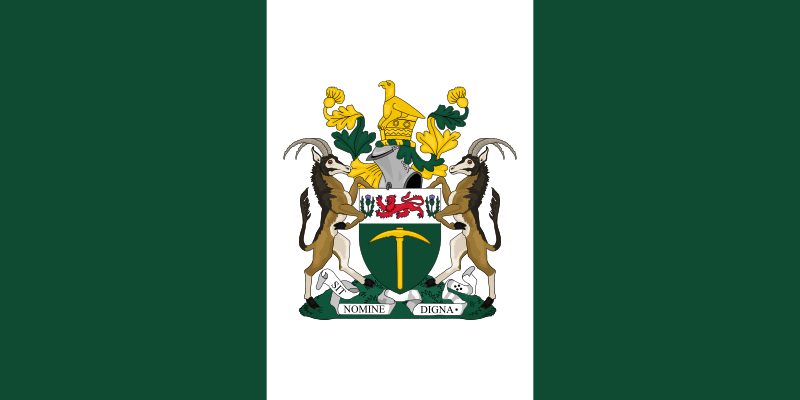
File:Flag_of_Rhodesia_(1968–1979).svg · Wikimedia Commons · See Wikimedia Commons
Rhodesia
Sign in to saveAlso known as Republic of Rhodesia
Rhodesia ( , ; ), officially the Republic of Rhodesia from 1970, was a country in Southern Africa that existed from 1965 to 1979. Rhodesia served as the de facto successor state to the British dominion of Southern Rhodesia following a unilateral declaration of independence issued by the ruling government. Throughout this fourteen-year period, Rhodesia faced internal conflict and political unrest. Following the Lancaster House Agreement in 1979, the territory returned to British political control and then subsequently gained internationally recognised independence as Zimbabwe in 1980.
Rhodesia was a Southern African country that existed from 1965 to 1979 after its government unilaterally declared independence from Britain, succeeding the British dominion of Southern Rhodesia. It matters historically because it experienced significant internal conflict during its fourteen-year existence and eventually returned to British control before becoming the independent nation of Zimbabwe in 1980.
AI-generated from the Wikipedia summary — may contain errors.
In the Vinony graph
Vinony's link graph records 3,714 inbound references to Rhodesia, and connects out to history of Rhodesia, António de Oliveira Salazar and bicameral legislature.
The entry is geolocated on the map in country, across 3 mapped points.
It sits within the topics 1965 establishments in Africa, 1979 disestablishments in Africa and Former monarchies of Africa.
Vinony links it to 77 Wikipedia language editions.
Key facts
- Country.conventional_long_name
- Rhodesia (1965–1970)Republic of Rhodesia (1970–1979)
- Country.common_name
- Rhodesia
- Country.status
- Unrecognised state
- Country.image_flag
- Flag of Rhodesia (1968–1979).svg
- Country.flag_alt
- Flag of Rhodesia from 19681979
- Country.flag_type
- Flag (19681979)
- Country.image_coat
- Coat of arms of Southern Rhodesia (1924–1980).svg
- Country.coa_size
- 80px
- Country.symbol_type
- Coat of arms
- Country.englishmotto
- May she be worthy of the name
- Country.national_anthem
- "God Save the Queen"(19651970)"Rise, O Voices of Rhodesia"(19741979)
- Country.image_map
- Rhodesia.png
- Country.capital
- Salisbury
- Country.largest_city
- capital
- Country.official_languages
- English (de facto)
- Country.languages_type
- Other languages
- Country.ethnic_groups_year
- 1969
- Country.demonym
- Rhodesian
via Wikipedia infobox
Wikidata facts
- Instance of
- state with limited recognition
- Demonym
- Rhodesian
- Country
- Rhodesia
- Continent
- Africa
- Capital
- Harare
- Official language
- English language
- Currency
- Rhodesian dollar
- Population
- 6930000
- Area
- 390580
- Form of government
- parliamentary republic
- Flag
- flag of Rhodesia
Show 10 more facts
- dissolved, abolished or demolished date
- 1979-06-01
- Commons category
- Rhodesia
- topic's main category
- Category:Rhodesia
- inception
- 1965-11-11
- replaced by
- Zimbabwe Rhodesia
- native label
- Rhodesia
- category for people born here
- Category:Rhodesian people
- language used
- English language
- described by source
- The Nuttall Encyclopædia
- P12749
- Walter Steinbeck
Sources (3)
via Wikidata · CC0
~88 min read
Encyclopedic overview
38 sectionsContents
- Etymology
- History
- Background
- Impact of UDI
- Bush War
- Early militant activity
- Military and political escalation (1972–1976)
- End of the Bush War
- Late 1970s
- Intensification of the Bush War
- End of UDI (1979)
- Republic of Zimbabwe (1980)
- Geography
- Climate
- Biodiversity
- Government and politics
- Administrative divisions
- Military
- Biological and chemical warfare
- Economy
- Demographics
- Population
- Language
- Religion
- Foreign relations
- United Kingdom
- Sanctions
- International perspective
- Diplomatic relations
- Results
- Culture
- Media
- Sports
- Legacy
- References
- Further reading
- External links
- Audio and video
Rhodesia ( , ; ), officially the Republic of Rhodesia from 1970, was a country in Southern Africa that existed from 1965 to 1979. Rhodesia served as the de facto successor state to the British dominion of Southern Rhodesia following a unilateral declaration of independence issued by the ruling government. Throughout this fourteen-year period, Rhodesia faced internal conflict and political unrest. Following the Lancaster House Agreement in 1979, the territory returned to British political control and then subsequently gained internationally recognised independence as Zimbabwe in 1980.
The rapid decolonisation of Africa in the late 1950s and early 1960s alarmed a significant proportion of Southern Rhodesia's white population. In an effort to delay the transition to black majority rule, the predominantly white Southern Rhodesian government issued its own Unilateral Declaration of Independence (UDI) from the United Kingdom on 11 November 1965. The new nation, identified simply as Rhodesia, initially sought recognition as an autonomous realm within the Commonwealth of Nations, but reconstituted itself as a republic in 1970. Following the declaration of independence in 1965, the United Nations Security Council passed a resolution that called upon all states not to grant recognition to Rhodesia. Two African nationalist parties, the Zimbabwe African People's Union (ZAPU) and Zimbabwe African National Union (ZANU), launched an armed insurgency against the government upon UDI, sparking the Rhodesian Bush War. Growing war weariness, diplomatic pressure, and an extensive trade embargo imposed by the United Nations prompted Rhodesian prime minister Ian Smith to concede to majority rule in 1978. However, elections and a multiracial provisional government, with Smith succeeded by moderate Abel Muzorewa, failed to appease international critics or halt the war. By December 1979, Muzorewa had secured an agreement with ZAPU and ZANU, allowing Rhodesia to briefly revert to colonial status pending new elections under British supervision. ZANU secured an electoral victory in 1980, and the country achieved internationally recognised independence in April 1980, as Zimbabwe.
Excerpted from Wikipedia’s “Rhodesia” article, available under the CC BY-SA 4.0 licence.
Gallery (28)
On the map
3 mapped locations
Available in 77 languages
- Español
- Français
- Deutsch
- 中文
- 日本語
- Русский
- Português
- Italiano
- العربية
- Afrikaans
- Albanian
- Asturian
- azb
- Azerbaijani
- Bahasa Indonesia
- Bangla
- Basque
- be_x_old
Show 58 more
- Belarusian
- Bulgarian
- Catalan
- Croatian
- Czech
- Danish
- Esperanto
- Estonian
- Faroese
- Finnish
- Galician
- Georgian
- Greek
- Hausa
- Hebrew
- Hungarian
- Icelandic
- Ido
- Irish
- Ladino
- Latvian
- Ligurian
- Lithuanian
- Lombard
- Macedonian
- Malay
- Marathi
- Mazanderani
- Nederlands
- Norwegian
- Nyanja
- Pashto
- Polski
- Punjabi
- Romanian
- Scots
- Serbian
- Serbian (Latin)
- Shona
- simple
- Slovenian
- Svenska
- Tamil
- Telugu
- Tiếng Việt
- Türkçe
- Ukrainian
- Urdu
- Uzbek
- Venetian
- Waray
- Welsh
- Western Frisian
- Wu Chinese
- zh_yue
- فارسی
- ไทย
- 한국어
via Wikidata sitelinks · CC0