
Zimbabwe
Sign in to saveAlso known as Republic of Zimbabwe, Southern Rhodesia, Rhodesia, Zimbabwe Rhodesia
Zimbabwe, officially the Republic of Zimbabwe, is a landlocked country in Southeast Africa, between the Zambezi and Limpopo River, bordered by South Africa to the south, Botswana to the southwest, Zambia to the north, and Mozambique to the east. The capital and largest city is Harare, and the second largest is Bulawayo.
OverviewAI-generated
Zimbabwe, officially the Republic of Zimbabwe, is a landlocked country in Southern Africa. Its capital is Harare. The nation shares borders with Zambia, Mozambique, South Africa, and Botswana. It contains administrative entities including Manicaland Province, Mashonaland Central Province, Mashonaland East Province, and Mashonaland West Province. The highest point in the country is Mount Nyangani.
English, Shona, Northern Ndebele, and Chewa are official languages. The currency includes the United States dollar, Zimbabwe ZiG, pound sterling, and Australian dollar. Zimbabwe is a member of the United Nations, African Union, World Trade Organization, and International Bank for Reconstruction and Development. Its top-level Internet domain is .zw, and its telephone country code is 263. The country operates in the UTC+02:00 time zone.
Population figures vary across sources, listing 15178979, 17073087, and 16634373. The area is 390757. Forest area comprises 44.7366421093447 percent of the land, with 82.4 percent renewable energy. Life expectancy is 63.064 years, and the unemployment rate is 9.293 percent. Urban population is 39.8933716820696 percent, while internet users account for 41.64279938 percent.
Synthesized by Vinony from 67 facts across 9 sources: Wikidata, REST Countries, Open Meteo, Openweathermap, World Bank, OpenStreetMap, PubMed, Vinony graph, Geo. Generated from structured data (not the Wikipedia text) and checked against those facts — may still contain errors.
In the Vinony graph
Vinony catalogs Zimbabwe in its Countries collection (215 entries).
Vinony's link graph records 22,688 inbound references to Zimbabwe, and connects out to African Union, Northern Ndebele and 2008 Zimbabwean presidential election.
The entry is geolocated on the map in city_region, across 6 mapped points.
Vinony files it under 1980 establishments in Zimbabwe, Countries and territories where English is an official language and Countries in Africa.
Weather now
cached 10h ago7-day forecast
via Open-Meteo
Country

- Capital
- Harare
- Population
- 17,073,087
- Region
- Africa · Southern Africa
- Demonym
- Zimbabwean
- Currencies
- ZWL ($)
- Languages
- Chibarwe, English, Kalanga, Khoisan, Ndau, Northern Ndebele, Chewa, Shona, Sotho, Tonga, Tswana, Tsonga, Venda, Xhosa, Zimbabwean Sign Language
- Calling code
- +263
- Drives on
- Left
- Gini
- 50.3 (2019)
- FIFA code
- ZIM
- TLD
- .zw
- Timezones
- UTC+02:00
- Borders
- BWA, MOZ, ZAF, ZMB
via REST Countries
Indicators · World Bank
- GDP
- $41.5B(2024)
- Population
- 16,634,373(2024)
- Life expectancy
- 63.1 yrs(2024)
- Unemployment
- 9.3 %(2025)
- Urban population
- 39.9 %(2024)
- Internet users
- 41.6 %(2024)
- Forest area
- 44.7 %(2023)
- Renewable energy
- 82.4 %(2021)
via World Bank Open Data · CC BY 4.0
Wikipedia views (30d)
131,867 totalvia Wikimedia Pageviews API
Key facts
- Country.conventional_long_name
- Republic of Zimbabwe
- Country.common_name
- Zimbabwe
- Country.image_flag
- Flag of Zimbabwe.svg
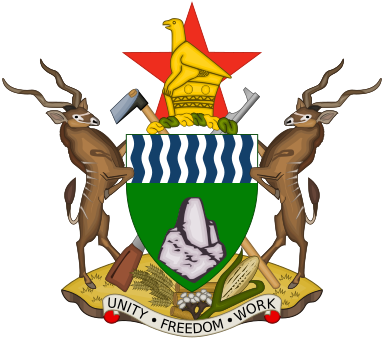
- Country.image_coat
- Coat of arms of Zimbabwe.svg
- Country.coa_size
- 105
- Country.national_motto
- "Unity, Freedom, Work"
- Country.national_anthem
- "Blessed Be the Land of Zimbabwe" File:National_Anthem_of_Zimbabwe,_performed_by_the_Royal_Australian_Navy_Band.ogg
- Country.capital
- Harare
- Country.largest_city
- Harare
- Country.official_languages
- 16 languages:
- Country.ethnic_groups_year
- 2022 census
- Country.religion_year
- 2017
- Country.government_type
- Unitary presidential republic
- Country.leader_title1
- President
- Country.leader_name1
- Emmerson Mnangagwa
- Country.leader_title2
- First Vice-President
- Country.leader_name2
- Constantino Chiwenga
- Country.leader_title3
- Second Vice-President
via Wikipedia infobox
Research
17,231 papers- Zimbabwe's national AIDS levy: A case study.ReviewSAHARA J : journal of Social Aspects of HIV/AIDS Research Alliance · 2016Bhat N, Kilmarx PH, Dube F et al.DOI: 10.1080/17290376.2015.1123646
- An overview of cybersecurity in Zimbabwe's financial services sector.ReviewF1000Research · 2023Maphosa VDOI: 10.12688/f1000research.132823.2
- Inequality and private health insurance in Zimbabwe: history, politics and performance.ReviewInternational journal for equity in health · 2023Mhazo AT, Maponga CC, Mossialos EDOI: 10.1186/s12939-023-01868-9
- Zimbabwe's humanitarian crisis.BMJ (Clinical research ed.) · 2008Ncayiyana D, London L, Sanders D et al.DOI: 10.1136/bmj.a1286
- Zimbabwe.Department of State publication. Background notes series · 1988United States. Department of State. Bureau of Public Affairs
- Results-based financing as a strategic purchasing intervention: some progress but much further to go in Zimbabwe?ReviewBMC health services research · 2020Witter S, Chirwa Y, Chandiwana P et al.DOI: 10.1186/s12913-020-5037-6
- Insights from Zimbabwe's SARS-CoV-2 genomic surveillance.The Lancet. Global health · 2021Dzinamarira T, Mukwenha S, Mukandavire Z et al.DOI: 10.1016/S2214-109X(21)00451-4
- Aging in Zimbabwe: Reflections 41 Years After Independence.The Gerontologist · 2022Hungwe CDOI: 10.1093/geront/gnab138
via PubMed
Wikidata facts
- Instance of
- country
- Part of
- Southern Africa
- Named after
- Great Zimbabwe
- Official name
- République du Zimbabwe
- Demonym
- Siombábach
- Participant in
- Kivu conflict
- Country
- Zimbabwe
- Contains
- Masvingo Province
- Continent
- Africa
- Capital
- Harare
- Official language
- Nambya
- Currency
- renminbi
- Population
- 15178979
- Area
- 390757
- Head of government
- Emmerson Mnangagwa
- Head of state
- Emmerson Mnangagwa
- Legislature
- Parliament of Zimbabwe
- Shares border with
- Botswana
- Highest point
- Mount Nyangani
- Official website
- www.zim.gov.zw/index.php
- Image
- Zimbabwe - Location Map (2013) - ZWE - UNOCHA.svg
- Life expectancy
- 61.163
- Nominal GDP
- 20678055598
Show 66 more facts
- Unemployment rate
- 5
- Calling code
- +263
- Licence plate code
- ZW
- Electrical plug type
- BS 1363
- Mains voltage
- 220
- Motto
- Undeb, Rhyddid, Gwaith
- Flag
- flag of Zimbabwe
- Coat of arms
- coat of arms of Zimbabwe
- top-level Internet domain
- .zw
- Commons category
- Zimbabwe
- member of
- African Continental Free Trade Area
- topic's main category
- Category:Zimbabwe
- category for people who died here
- Category:Deaths in Zimbabwe
- category for people born here
- Category:Births in Zimbabwe
- category for films shot at this location
- Category:Films shot in Zimbabwe
- category of associated people
- Category:Zimbabwean people
- diplomatic relation
- North Korea
- topic's main Wikimedia portal
- Portal:Zimbabwe
- history of topic
- history of Zimbabwe
- Commons gallery
- Zimbabwe
- mobile country code
- 648
- lowest point
- Runde River
- driving side
- left
- geography of topic
- Geography of Zimbabwe
- water as percent of area
- 1
- compulsory education (minimum age)
- 6
- compulsory education (maximum age)
- 16
- marriageable age
- 18
- central bank
- Reserve Bank of Zimbabwe
- replaces
- Southern Rhodesia
- office held by head of government
- Prime Minister of Zimbabwe
- number of out-of-school children
- 1435699
- office held by head of state
- President of Zimbabwa
- total fertility rate
- 3.923
- maritime identification digits
- 679
- railway traffic side
- left
- inception
- 1980-04-18
- Unicode character
- 🇿🇼
- native label
- Zimbabwe
- culture
- culture of Zimbabwe
- VAT rate
- 15
- BTI Status Index
- 3.83
- BTI Governance Index
- 2.72
- economy of topic
- economy of Zimbabwe
- demographics of topic
- demographics of Zimbabwe
- literacy rate
- 89
- Democracy Index
- 3.16
- Human Development Index
- 0.593
- P11012
- DEFLATE
- hashtag
- Zimbabwe
- on focus list of Wikimedia project
- Wikipedia:Vital articles/Level/4
- Happy Planet Index score
- 28.6
- Gini coefficient
- 50.3
- Inequality-adjusted Human Development Index
- 0.458
- P12749
- Antonio Segni
- birth rate
- 30.086
- male population
- 7705601
- death rate
- 8.943
- rural population
- 11033499
- female population
- 8614935
- urban population
- 5287038
- P8168
- Neolamprologus niger
- Commonwealth Sport country code
- ZIM
- maintained by WikiProject
- WikiProject Countries
- different from
- Zambia
- located in/on physical feature
- East Africa
Sources (15)
via Wikidata · CC0
Travel guide
Get in
thumb|375px|A map showing the visa requirements of Zimbabwe
See
thumb|Elephants crossing Zambezi River in Mana Pools National ParkFor many visitors, Zimbabwe as a country has the same appeal as the natural landscapes for which it's famous.
Do
Bungee jumping at Victoria Falls. An incredible experience off the Victoria Falls bridge over the mighty Zambezi - 111 metres of pure adrenaline. Walk with the lions, swim with the elephants, ride a horse. and enjoy other game activities at Antelope Park near Gweru, between Harare and Bulawayo. An Authentic African Safari. Walking, canoeing or on a game drive in Hwange National Park or Mana Pools with African Bush Camps. Harare International Festival of Arts. (HIFA), every year in Harare (end of April) with some extension in Bulawayo. Music, Theater, and other shows sponsored by foreign embassies, it features top international and local artists,and also brings in town a great artcraft market. Diving: The only site accessible to recreational divers is Mutoroshanga Ethel Mine, a flooded asbestos quarry 120 km by road from Harare. Good visibility and beautiful surroundings. You need technical cave-diving skills to venture into Chinhoyi Caves, 120 km from Harare. The caves are mostly water-filled, and are more than 120 m deep. The full cave system has not yet been explored. No diving infrastructure, this is an expedition where you take everything. The excellent climate, combined with investments in the golfing infrastructure, has turned the country into a golfing haven. Fourteen of Zimbabwe's courses are rated in the top 100 best in Africa. Zimbabwe is also a great and cheap location to learn the game and perfect technique. Many resorts and clubs offer classes with rising pla…
Eat
thumb|Meat, sadza, greens and sausages
For a sample of what Zimbabweans eat (in some form, nearly every day), ask for "sadza and stew/relish." The stew part will be familiar, served over a large portion of sadza - a thick ground corn paste (vaguely like polenta and the consistency of thick mashed potatoes) that locals eat at for lunch and supper. It's inexpensive, quite tasty and very filling. There is a plethora of good Zimbabwean food- "Mbambaira" or sweet potatoes, "chibage" corn on the cob, for example. Fruits indigenous to the country like "masawu" for example. For foreigners, especially from the West, Zimbabwean meat is very tasty, especially the beef, because animals are raised and fed on a natural diet, mostly of grass.
Food options in the cities tend to follow western conventions and British visitors in particular will find themselves right at home as numerous British staples - from pork pies, Cornish pasties and an English breakfast to tea with milk and baked beans- are a hallmark of Zimbabwean cuisine. Fast food is increasingly popular with Nando's and KFC available in most urban areas as well as local brands like Chicken Inn and Wimpy.
Drink
A variety of domestic brews are made in Zimbabwe, mainly lagers with a few milk stouts. You may even want to try "Chibuku" a local brew popular among working class men that's based on a traditional beer recipe made from sorghum and/or maize (corn). It is generally sold in a 2-litre plastic bottle called a 'skud' or a more popular variety called "Chibuku Super" that comes in a disposable 1.25 litre plastic container and costs US$1. As with all alcohol, it's definitely an acquired taste! A more palatable beer is the pilsner like, Zambezi lager which is very refreshing on a hot day.
Quality wines at restaurants and liquor stores tend to be South African or European in origin, though there are a few brands worth sampling, the standout being the Western Cape produced, Kumusha Wines, as well as the more established, Mukuyu. The South African creamy liqueur, Amarula, is a common delight. A common tradition across Southern Africa, is the Sundowner, a light aperitive style cocktail consumed at sunset just before dinner. It is usually fizzy, sparkling or citrus based, similar to a spritz in Europe
Non-alcoholic drinks
Like the UK, tea is widely drunk across Zimbabwe, especially at breakfast or during work lunch breaks. Most people drink white tea (hot black tea with milk), and some with sugar or honey. Tanganda is a cheap and common brand popular with working class residents. Finer restaurants, hotels and cafés sell a range of different teas, Earl Grey and Rooibos being popular bl…
Sleep
Zimbabwe has a great number of tourist facilities, and offers a variety of accommodation options, from luxury hotels to guest houses, lodges, backpacker hostels and safari camps for all budgets.
For nature lovers, birdwatchers, and those seeking a respite from the fast-paced world, there are many "lodges" in serene and peaceful environments, usually on the fridges of the city or near game reserves, surrounded by many species of native and migrating birds, which offer a unique opportunity to reconnect with nature.
If you are on a safari tour there are tented camps, chalets and camping sites in most of the safari areas.
Most places have a backpacker hostel with prices from US$10 a night.
Stay safe
Generally, Zimbabwe has a much lower crime rate than its neighbors, and Zimbabweans are well known for their unrivaled hospitality.
Most crime that does occur is opportunistic in nature and travelers should take care with their personal belongings and follow local advice. It really is just a matter of common sense, which you should exercise no matter where you are.
Shortages of fuel and water can occur in parts of the country, so keep extra supplies with you in case they are unavailable for an extended period. Water and electricity supplies are frequently disrupted, so most homes in the cities are equipped with boreholes, solar power or generators.
Whilst many locals will politely inquire about you and your country, remember, most Zimbabweans are still sensitive to foreigners' opinions of their country and its politicians, mostly due to years of negative press. In general, it is a wise idea to avoid political discussions or discussions pertaining to opinions of political leaders.
Stay healthy
thumb|Bulawayo Do your research about what is available. Take all medications that you need along with you. There are a number of private hospitals in the major cities that are very accessible.
HIV/AIDS infection rate in Zimbabwe is the 6th highest in the world at around 9% of adults infected. Though rates have declined significantly from their peak in the 2000s and related deaths even moreso, you should never have unprotected sex. If you form a serious relationship, consider both getting an HIV test before taking things further.
Malaria is prevalent in lower regions of the country in the summertime, so unless you are going to stay entirely within Harare, Bulawayo or highland regions, anti-malarial drugs are advised. Drugs reduce the severity of the disease but don't prevent infection, so also consider precautions such as: sleeping under a mosquito net (lightweight travel nets are comparatively cool to use) using mosquito repellent on the skin or burning mosquito coils wearing long-sleeved clothing and long trousers, particularly in the evening
Bilharzia is present in some lakes. Ask locally before swimming.
Snakes are common in the bush, and most bites are on the foot or lower leg. If walking, particularly in long grass, wear proper boots and either long, loose trousers or thick, concertinaed hiking socks. Shake out boots and shoes in the morning, in case you have a guest. These precautions also reduce the chance of scorpion sting. If you do get bitten or stung, stay ca…
Respect
Visitors to Zimbabwe will find Zimbabweans incredibly welcoming, friendly, and hospitable. Many will go out of their way to help you and ensure you have a good time. You can freely approach the locals for advice and you can ask them specific directions to get somewhere.
As is the case throughout Africa, respect for elders is very important and it is customary to use honorifics with people you're not well acquainted with. Try not to ignore, contradict, or publicly disagree with someone older than you or in a position of authority.
In smaller towns and villages, especially on the road, if you walk past somebody it is customary to exchange pleasantries. They may also ask you "how are you", or another similar variation, is usually standard. A simple hello or "how are you?" or "have a nice day" will suffice. Learning similar phrases in Shona or Ndebele will go a long way with older and more rural inhabitants as well.
Unlike many other African nations, Zimbabweans tend to be punctual and on time to events, especially for business, however, given the importance of public transportation, it's not uncommon to sometimes be a few minutes late to something. A simple apology or acknowledgement of one's tardiness is generally acceptable however, extreme lateness is considered rude and a waste of the other parties' time.
Zimbabwe is a multicultural country. Do not make assumptions based on ethnicity or peoples' appearance. Outward displays of racism, discrimination or sexism, will be m…
Travel guide from Wikivoyage (CC BY-SA 4.0)
~40 min read
Encyclopedic overview
46 sectionsContents
- Etymology
- History
- Pre-colonial era
- Colonial era and Rhodesia (1888–1964)
- Declaration of independence and civil war (1965–1980)
- Independence era (1980–present)
- Geography
- Geology
- Climate
- Biodiversity
- Government and politics
- Politics
- Armed forces
- Human rights
- Administrative divisions
- Sanctions
- Economy
- Minerals
- Agriculture
- Tourism
- Water supply and sanitation
- Science and technology
- Transportation
- Demographics
- Population
- Ethnic groups
- Largest cities
- Languages
- Religion
- Health
- Education
- Gender equality
- Culture
- Arts
- Cuisine
- Sports
- Media
- National symbols
- See also
- Notes
- References
- Notes
- Citations
- Sources
- Further reading
- External links
Zimbabwe, officially the Republic of Zimbabwe, is a landlocked country in Southeast Africa, between the Zambezi and Limpopo River, bordered by South Africa to the south, Botswana to the southwest, Zambia to the north, and Mozambique to the east. The capital and largest city is Harare, and the second largest is Bulawayo.
A country of roughly 16.9 million people as per 2025 estimates, Zimbabwe's largest ethnic group are the Northern Ndebele and Shona, who make up 95% of the population, followed by the other smaller minorities. Zimbabwe has 16 official languages, with English, Shona, and Ndebele the most common. Zimbabwe is a member of the United Nations, the Southern African Development Community, the African Union, and the Common Market for Eastern and Southern Africa.
Excerpted from Wikipedia’s “Zimbabwe” article, available under the CC BY-SA 4.0 licence.
Gallery (59)
On the map
6 mapped locations
Available in 261 languages
- Español
- Français
- Deutsch
- 中文
- 日本語
- Русский
- Português
- Italiano
- العربية
- हिन्दी
- Abkhazian
- Afrikaans
- Albanian
- Albanian
- Amharic
- ami
- Angika
- Aragonese
Show 242 more
- Armenian
- Arpitan
- Asturian
- azb
- Azerbaijani
- Bahasa Indonesia
- Balinese
- Bambara
- Bangla
- Banjar
- Bashkir
- Basque
- bat_smg
- Bavarian
- be_x_old
- Belarusian
- Betawi
- Bhojpuri
- Bikol
- Bishnupriya
- Bislama
- Bosnian
- Breton
- Bulgarian
- Buriat
- Burmese
- Catalan
- cbk_zam
- cdo
- Cebuano
- Central Kurdish
- Chechen
- Cheyenne
- Chuvash
- Colognian
- Cornish
- Corsican
- Crimean Tatar
- Croatian
- Czech
- dag
- Danish
- Divehi
- dty
- Egyptian Arabic
- Esperanto
- Estonian
- Ewe
- Extremaduran
- Faroese
- Fiji Hindi
- Filipino
- Finnish
- fiu_vro
- Frafra
- Fula
- Gagauz
- Galician
- Ganda
- gcr
- Georgian
- Gilaki
- gpe
- Greek
- Guarani
- Gujarati
- Haitian Creole
- Hakka Chinese
- Hausa
- Hebrew
- Hungarian
- hyw
- Iban
- Icelandic
- Ido
- Igbo
- Iloko
- Inari Sami
- Interlingua
- Interlingue
- Irish
- Jamaican Creole English
- Javanese
- Kabyle
- kai
- Kannada
- Kanuri
- Kara-Kalpak
- Kashmiri
- Kashubian
- Kazakh
- kbp
- Khmer
- Kikuyu
- Kinyarwanda
- Kongo
- Kotava
- Kurdish
- Kyrgyz
- Ladino
- Latgalian
- Latin
- Latvian
- Lezghian
- Ligurian
- Limburgish
- Lingala
- Lingua Franca Nova
- Lithuanian
- lld
- Lojban
- Lombard
- Low German
- Lower Sorbian
- Luxembourgish
- Macedonian
- Madurese
- Malagasy
- Malay
- Malayalam
- Maltese
- Manipuri
- Manx
- Māori
- Marathi
- Mazanderani
- Minangkabau
- Mingrelian
- Mirandese
- mnw
- Moksha
- Mongolian
- Moroccan Arabic
- Mossi
- Navajo
- nds_nl
- Nederlands
- Nepali
- Newari
- Nigerian Pidgin
- Northern Frisian
- Northern Sami
- Northern Sotho
- Norwegian
- Norwegian Nynorsk
- Novial
- nup
- Nyanja
- Obolo
- Occitan
- Old English
- olo
- Oromo
- Ossetic
- Pampanga
- Papiamento
- Pashto
- Pennsylvania German
- Picard
- Piedmontese
- Polski
- Punjabi
- Quechua
- Romanian
- Rusyn
- Samoan
- Sango
- Sanskrit
- Santali
- Sardinian
- Saterland Frisian
- Scots
- Scottish Gaelic
- Serbian
- Serbian (Latin)
- Shan
- Shona
- Sicilian
- Silesian
- simple
- Sindhi
- Sinhala
- Slovak
- Slovenian
- Somali
- South Ndebele
- Southern Sotho
- Standard Moroccan Tamazight
- Sundanese
- Svenska
- Swahili
- Swati
- szy
- Tajik
- Talysh
- Tamil
- Taroko
- Tatar
- tay
- Telugu
- Tibetan
- Tiếng Việt
- Tigrinya
- Toki Pona
- Tsonga
- Tswana
- Tulu
- Tumbuka
- Türkçe
- Turkmen
- Tyap
- Udmurt
- Ukrainian
- Upper Sorbian
- Urdu
- Uyghur
- Uzbek
- Venda
- Venetian
- Veps
- Volapük
- Waray
- Welsh
- Western Frisian
- Western Mari
- Western Panjabi
- Wolof
- Wu Chinese
- Xhosa
- Yakut
- Yiddish
- Yoruba
- Zaza
- Zeelandic
- zh_classical
- zh_min_nan
- zh_yue
- Zhuang
- Zulu
- فارسی
- ไทย
- 한국어
via Wikidata sitelinks · CC0