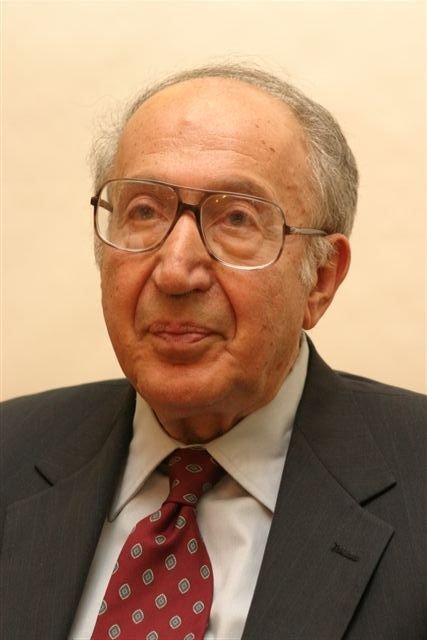
Richard Pipes
Sign in to saveAlso known as Richard Edgar Pipes, Richard E. Pipes
American historian (1923–2018)
OverviewAI-generated
Richard Pipes (1923–2018) was an author who produced 61 works. His notable publications include *Den ryska revolutionen*, *Reflections on the nationality problems in the Soviet Union*, *Peter B. Struve*, *Détente and reciprocity*, and *Rossii︠a︡ pri bolśhevikah*. He was recognized in the American Academy Arts Sciences collection.
Pipes was born on July 11, 1923, and died on May 17, 2018. His bibliography includes five works listed in Crossref. He is referenced by 258 other encyclopedia articles.
Synthesized by Vinony from 18 facts across 7 sources: Wikidata, Open Library, Last.fm, Crossref, MusicBrainz, Vinony collections, Vinony graph. Generated from structured data (not the Wikipedia text) and checked against those facts — may still contain errors.
Person · Open Library
- Born
- 11 JUl 1923
- Died
- 17 May 2018
- Works
- 61
Top works
- The genesis of Soviet national policy
- Den ryska revolutionen
- Reflections on the nationality problems in the Soviet Union
- Peter B. Struve
- Détente and reciprocity
via Open Library + Wikidata
Music · MusicBrainz
- Type
- Other
- Gender
- Not applicable
- Origin
- [Worldwide]
Discography
- Гагаку (Японская Старинная Музыка)1974
- [unknown]1975
- A White Christmas1991
- Jude On A Ragga Tip (U.K. Mix) / How Does It Feel! (The New Order Remix)1992
- Bagpipe Marches and Music of Scotland: With Brass and Accordion Accompaniment1994
- Runaway Train1994
- Best of Ballroom: Tango1995
- Floorbangers1995
- More Floorbangers1995
- The Smurfs1995
via MusicBrainz · CC0
Listeners · Last.fm
- Listeners
- 11
- Total plays
- 469
<a href="https://www.last.fm/music/Richard+Pipes">Read more on Last.fm</a>
Recent publications · Crossref
5 total works indexed
- The Measurement of Observer Agreement for Categorical Data
· 1977 · cited 63,369x
- The Sequence Alignment/Map format and SAMtools
· 2009 · cited 59,247x
- Fast and accurate short read alignment with Burrows–Wheeler transform
· 2009 · cited 47,657x
- ImageNet: A large-scale hierarchical image database
· 2009 · cited 47,271x
- Highly accurate protein structure prediction with AlphaFold
· 2021 · cited 43,600x
via Crossref · CC0
Quotes
- “In Western Europe since Roman times, private property was considered sacrosanct. The principle enunciated by the Roman Stoic philosopher Seneca that kings rule by the will of the people became fundamental to Western civilization, together with private property, which was the main source of productive wealth.”
- “We need to keep a very keen eye on our own government. It's getting too rich and redistributing wealth is a sure way of robbing us of our private property rights and other rights along with them.”
- “The third factor inhibiting inquiries into the influence of Bolshevism on Fascism and National Socialism was the insistence of Moscow on banishing from the vocabulary of ‘progressive’ thought the adjective ‘totalitarian’ in favor of ‘Fascist’ to describe all anti-Communist movements and regimes.”
- “[T]he view that anti-Communism equals Fascism remained obligatory in countries subject to Communist censorship until the advent of Mikhail Gorbachev’s glasnost. It was prevalent also in foreign ‘progressive’ circles. Western scholars who had the temerity to link Mussolini or Hitler with Communism in any way or to depict their regimes as genuine mass movements risked verbal or other forms of harassment.”
- “In 1925, Mussolini adopted the term [totalitarian] and assigned it a positive meaning. He defined Fascism as ‘totalitarian’ in the sense that it politicized everything ‘human’ as well as ‘spiritual’: ‘Everything within the state, nothing outside the state, nothing against the state.’”
- “No prominent European socialist before World War I resembled Lenin more closely than Benito Mussolini. Like Lenin, he headed the antirevisionist wing of the country’s Socialist Party; like him, he believed that the worker was not by nature a revolutionary and had to be prodded to radical action by an intellectual elite.”
via Wikiquote · CC BY-SA
Key facts
- Born
- Richard Edgar Pipes , ( 1923-07-11 ) July 11, 1923, Cieszyn , Poland
- Died
- May 17, 2018 (2018-05-17) (aged 94), Cambridge, Massachusetts , U.S.
- Citizenship
- Poland (1923–1943), United States (after 1943)
- Occupation
- Historian
- Spouse
- Irene Eugenia Roth ( married</span>"}]]}'>m. 1946 )
- Children
- 2, including Daniel
- Awards
- National Humanities Medal
- Education
- Muskingum College Cornell University Harvard University
- Doctoral advisor
- Michael Karpovich
- Sub discipline
- Russian history
- Doctoral students
- John V. A. Fine , Anna Geifman , Abbott Gleason , Edward L. Keenan , Peter Kenez , Eric Lohr , Michael Stanislawski , Richard Stites , Lee In-ho
via Wikipedia infobox
~16 min read
Encyclopedic overview
Richard Edgar Pipes (Polish: Ryszard Pipes; July 11, 1923 – May 17, 2018) was an American historian who specialized in Russian and Soviet history. Pipes was a frequent interviewee in the press on the matters of Soviet history and foreign affairs. His writings also appear in Commentary, The New York Times, and The Times Literary Supplement.
At Harvard University, Pipes taught large courses on Imperial Russia as well as the Russian Revolution and guided over 80 graduate students to their PhDs. In 1976, he headed Team B, a team of analysts organized by the Central Intelligence Agency (CIA), which analyzed the strategic capacities and goals of the Soviet military and political leadership. Pipes is the father of American historian Daniel Pipes.
Excerpted from Wikipedia’s “Richard Pipes” article, available under the CC BY-SA 4.0 licence.