File:Riemann_zeta_function_absolute_value.png · Wikimedia Commons · See Wikimedia Commons
Riemann hypothesis
Sign in to saveAlso known as RH
conjecture in mathematics linked to the repartition of prime numbers
The Riemann hypothesis is a famous conjecture in mathematics that describes a pattern in how prime numbers are distributed across all numbers. If proven true, it would answer a centuries-old question about the underlying order of primes and would have major implications for cryptography, computer science, and our fundamental understanding of numbers.
AI-generated from the Wikipedia summary — may contain errors.
Wikidata facts
- Instance of
- mathematical problem
- Part of
- list of theorems
- Named after
- Bernhard Riemann
- Image
- VignetteRiemannHypothesis.svg
Show 4 more facts
- Stack Exchange tag
- mathoverflow.net/tags/riemann-hypothesis
- Commons category
- Riemann hypothesis
- on focus list of Wikimedia project
- Wikipedia:Vital articles/Level/4
- maintained by WikiProject
- WikiProject Mathematics
via Wikidata · CC0
~40 min read
Encyclopedic overview
Unsolved problem in mathematics
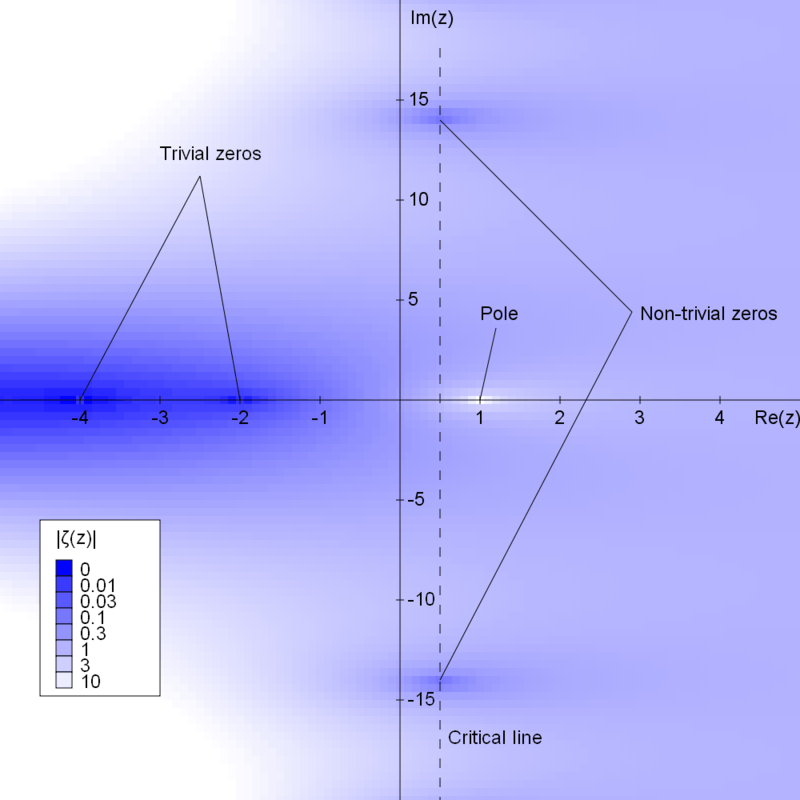
Do all non-trivial zeros of the Riemann zeta function have a real part equal to one half?
Excerpted from Wikipedia’s “Riemann hypothesis” article, available under the CC BY-SA 4.0 licence.