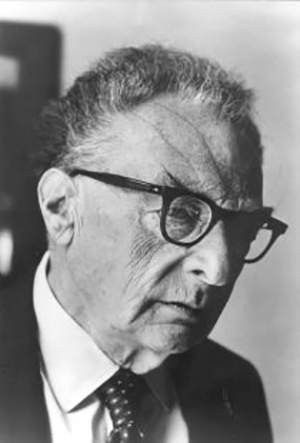
File:Roman_Jakobson_Idoso.jpg · Wikimedia Commons · See Wikimedia Commons
Roman Jakobson
Sign in to saveAlso known as Roman Osipovich Jakobson, Roman Osipovič Jakobson
Russian linguist (1896–1982)
Roman Jakobson was a Russian linguist who lived from 1896 to 1982 and made influential contributions to the study of language and communication. His work matters because he developed important theories about how language functions, including his analysis of the basic elements and patterns that underlie all human languages.
AI-generated from the Wikipedia summary — may contain errors.
Wikidata facts
- Instance of
- human
- Family name
- Jakobson
- Gender
- male
- Citizenship
- United States
- Place of birth
- Moscow
- Place of death
- Boston
- Occupation
- university teacher
- Employer
- Masaryk University
- Languages spoken
- Czech
- Religion
- Judaism
- Award
- Hegel Prize
- Doctoral student
- Morris Halle
- Field of work
- literary studies
- Image
- Roman Jakobson.jpg
- Work location
- Prague
Show 9 more facts
- date of death
- 1982-07-18
- place of burial
- Mount Auburn Cemetery
- Commons category
- Roman Jakobson
- date of birth
- 1896-09-28
- member of
- Polish Academy of Sciences
- nominated for
- Nobel Prize in Literature
- P8168
- rolling country
- on focus list of Wikimedia project
- Wikipedia:Vital articles/Level/4
- ethnic group
- Ashkenazi Jews
via Wikidata · CC0
~15 min read
Encyclopedic overview
Roman Osipovich Jakobson (born Roman Iosel-Berovich Yakobson; 10 October [O.S. 28 September] 1896 – 18 July 1982) was a Russian linguist and literary theorist. A pioneer of structural linguistics, Jakobson was one of the most celebrated and influential linguists of the twentieth century. With Nikolai Trubetzkoy, he developed revolutionary new techniques for the analysis of linguistic sound systems, in effect founding the modern discipline of phonology. Jakobson went on to extend similar principles and techniques to the study of other aspects of language such as syntax, morphology and semantics. He made numerous contributions to Slavic linguistics, most notably two studies of Russian case and an analysis of the categories of the Russian verb. Drawing on insights from C. S. Peirce's semiotics, as well as from communication theory and cybernetics, he proposed methods for the investigation of poetry, music, and the visual arts including cinema.
Through his decisive influence on Claude Lévi-Strauss and Roland Barthes, among others, Jakobson became a pivotal figure in the adaptation of structural analysis to disciplines beyond linguistics, including philosophy, anthropology and literary theory; his development of the approach pioneered by Ferdinand de Saussure, known as "structuralism", became a major post-war intellectual movement in Europe and the United States. Meanwhile, though the influence of structuralism declined during the 1970s, Jakobson's work has continued to receive attention in linguistic anthropology, especially through the ethnography of communication developed by Dell Hymes and the semiotics of culture developed by Jakobson's former student Michael Silverstein. Jakobson's concept of underlying linguistic universals, particularly his celebrated theory of distinctive features, decisively influenced the early thinking of Noam Chomsky, who became the dominant figure in theoretical linguistics during the second half of the twentieth century.
Excerpted from Wikipedia’s “Roman Jakobson” article, available under the CC BY-SA 4.0 licence.
Gallery (4)
Available in 58 languages
- Español
- Français
- Deutsch
- 中文
- 日本語
- Русский
- Português
- Italiano
- العربية
- हिन्दी
- Albanian
- Armenian
- Azerbaijani
- Bahasa Indonesia
- Bangla
- Basque
- Belarusian
- Bulgarian
Show 39 more
- Catalan
- Croatian
- Czech
- Danish
- Egyptian Arabic
- Esperanto
- Estonian
- Finnish
- Galician
- Georgian
- Greek
- Hebrew
- Hungarian
- Icelandic
- Ido
- Kannada
- Latin
- Lithuanian
- Macedonian
- Malagasy
- Malayalam
- Nederlands
- Norwegian
- Norwegian Nynorsk
- Polski
- Punjabi
- Romanian
- Serbian
- Slovak
- Slovenian
- Svenska
- Tamil
- Tiếng Việt
- Türkçe
- Ukrainian
- Upper Sorbian
- Uzbek
- فارسی
- 한국어
via Wikidata sitelinks · CC0