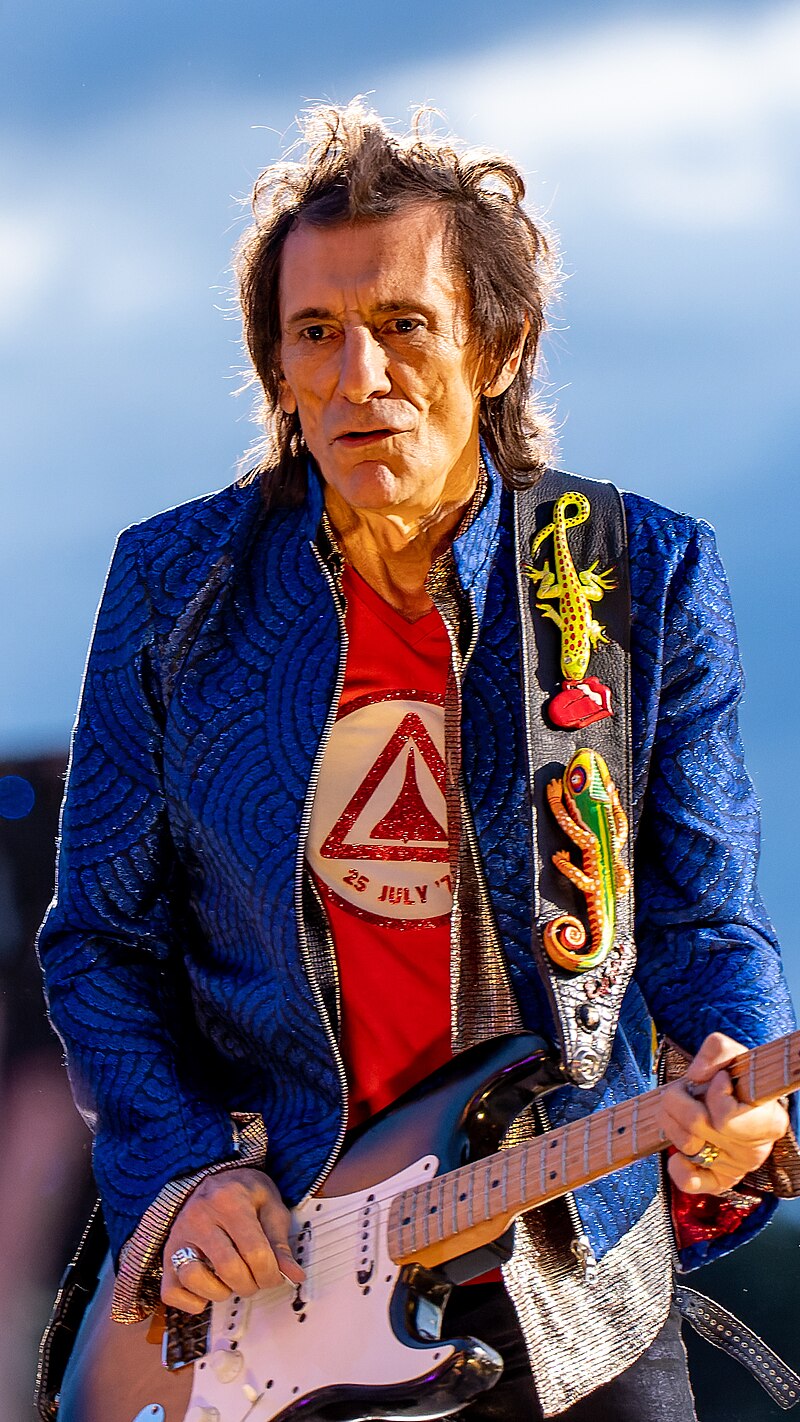
File:RStonesHydePark030722_(91_of_125)_(Ronnie_Wood).jpg · Wikimedia Commons · See Wikimedia Commons
Also known as Ronald David Wood, Ronald Wood, Ron Wood, Ronald "Ron" David Wood, Woody
British rock guitarist, member of The Rolling Stones
Top works
via Open Library + Wikidata
Acting · Hillingdon, Middlesex, England, UK
Ronald David Wood (born 1 June 1947) is an English rock musician, best known as a member of the Rolling Stones since 1975, and a member of Faces and the Jeff Beck Group. Wood began his career in 1964, playing lead guitar with several British rhythm and blues bands in short succession, including the Birds and the Creation. He joined the Jeff Beck Group in 1967 as a guitarist and bassist, playing…
羅納德·大衛·伍德(英語:Ronald David Wood,1947年6月1日-)為英國搖滾音樂家、作曲人、多樂器演奏家、藝術家、作家與廣播主持人,最為人熟知的身分是自1975年成為滾石樂團的成員,他同時也是臉樂隊和的成員。 伍德在1964年加入開始了音樂生涯,在這之後他也短暫加入摩德組合且出現於其少量單曲裡。伍德在1967年以貝斯手身分加入傑夫·貝克樂隊,但在這期間樂隊所發行的專輯《》和《》也僅有中等的成績。 在傑夫·貝克樂隊於1969年解散後,伍德與隊友洛·史都華一同與前小臉樂隊成員:、和改組為臉樂隊。樂隊在英國與歐洲大陸獲得巨大的成功,但在美國就不是那麼一回事。 1974年,在臉樂隊開始分裂時,伍德開始了個人計畫,並錄製了第一張個人專輯《》。參與該專輯錄製的人包括隊友伊恩·麥克拉根、前披頭士成員喬治·哈里森、以及伍德的長年好友—滾石樂團的基思·理查茲。在離開滾石之後,理查茲很快的邀請了伍德加入,而伍德也在1975年成為滾石的固定成員至今。 除了《I've Got My Own Album to Do》以外,伍德還錄製了其他個人作品。《》以及與羅尼·蓮恩合作的原聲帶專輯《》發行於1975年。1979年的《》、1981年的《》均有不錯的成績。最後則是1992年的《》、2002年的《》和2010年的《》。羅尼·伍德入選過搖滾名人堂兩次,第一次是1989年作為滾石樂團的成員,第二次是2012年作為臉樂隊的成員。
Abstract from DBpedia / Wikipedia · CC BY-SA
via TMDB
Tags
Ronald David Wood (born 01 June 1947 in Hillingdon, London, England) is an English guitarist, singer/songwriter, painter and writer, best known as a member of The Rolling Stones (since 1975). Some of his solo albums are credited to Ron Wood, others to Ronnie Wood. Ronnie was raised in a musical family. His older brothers, Art and Ted, were active in the skiffle & traditional jazz scenes. Ronnie has been in The Rolling Stones since 1975. He previously <a href="https://www.last.fm/music/Ron+Woo
5 total works indexed
· 1991 · cited 9,939x
· 2019 · cited 8,752x
· 2008 · cited 8,347x
· 1997 · cited 8,109x
· 2015 · cited 8,103x
via Crossref · CC0
via Wikipedia infobox
Homepage - Ronnie Wood
ronniewood.com →A two-time inductee into the Rock and Roll Hall of Fame (with the Rolling Stones and the Faces), Ronnie has played in some of the most influential rock groups of all time and guested with a who’s who of British music. At the same time, he’s enjoyed a remarkable parallel career as a highly regarded artist and, as a natural raconteur, has won a record three prestigious Sony Radio Personality awards. Descending from a long line of travelling barge people, Ronnie grew up in a lively musical and artistic West London household. His father played in a harmonica orchestra, while older brothers Ted and Art were both accomplished musicians and graphic designers. With Ronnie showing creative flair at a young age, his brothers chipped in to buy him an acoustic guitar and at the age of 14, he purchased his first electric model. Soon after, Ronnie embarked on his musical career when he joined local group The Birds, dropping out of Ealing Art College to focus on the band. Signed to the Stones’ label, Decca, the group’s incendiary take on R & B made them a popular live act up and down the country. However, their popularity failed to translate into record sales and the group eventually parted ways. 1967 marked a career milestone when Ronnie joined the Jeff Beck Group as bassist. With frontman Rod Stewart’s raw vocals, blues maverick Beck’s blazing guitar work and Ronnie’s instinctive bass lines, the Jeff Beck Group would write the blueprint for British hard rock. Despite an intense musical chemistry, band tensions often ran high and Ronnie briefly jumped ship to cult mod band, the Creation. Inevitably, the Jeff Beck Group would split for good in 1969 – just two weeks prior to a slot at Woodstock – but not before releasing two classic albums, wowing US audiences with their live performances and laying the groundwork for burgeoning rock acts like Led Zeppelin. After a blink-and-you-miss it stint in Quiet Melon, with brother Art, fortune smiled again on Ronnie. After the departure of singer Steve Marriott, the remaining three members of the Small Faces approached Ronnie and Rod with the offer of starting a new band. Renaming themselves the Faces, the band would inject a buccaneering rock-and-roll spirit into a dreary music scene, drawing huge audiences for their rollicking live shows and influencing a generation of punk musicians waiting in the wings. Back on 6 string guitar, Ronnie helped pen some of the Faces’ finest and best known songs like ‘Ooh La La’ and ‘Stay With Me’, whilst also making major contributions to Rod Stewart’s first solo albums. Album cover for Ronnie's first solo album I've Got My Own Album To Do. With a growing confidence in his abilities, Ronnie also released his own solo efforts during this time. With their unique, rough-hewn charm, I’ve Got My Own Album To Do (1974) and Now Look (1975) boasted a list of starry cameos, including George Harrison, Rod Stewart, Bobby Womack and future bandmates Keith Richards and Mick Jagger. These albums helped to reinforce Ronnie’s credentials as a first-rate musician and songwriter. In 1975 fate would once again intervene for Ronnie. With the Faces finally falling apart at the same time as Mick Taylor’s departure from the Rolling Stones, a chance encounter with Mick Jagger at a party would lead to Ronnie finally landing his dream job as the Rolling Stones’ guitarist. With his musical versatility and bonhomie, Ronnie proved a natural fit for the group and he’s long established himself as a vital part of the Rolling Stones sound. Keith Richards best describes his and Ronnie’s bluesy guitar interplay as, “the ancient art of weaving”, magically blurring the lines between rhythm and lead. Even while a member of the Stones, Ronnie has continued to perform with a string of musical legends, ranging from Dylan to Bo Diddley. He formed the super-group the New Barbarians, featuring Keith Richards, former Faces keyboardist Ian McLagan, bassist Stanley Clarke, the Stones’ saxoph
Read more on their site →Excerpt from the official site · 6,159 chars · not written by Vinony
via Wikidata · CC0
via Wikidata sitelinks · CC0
Discovered by embedding cosine similarity (sentence-transformers MiniLM, 384-dim).