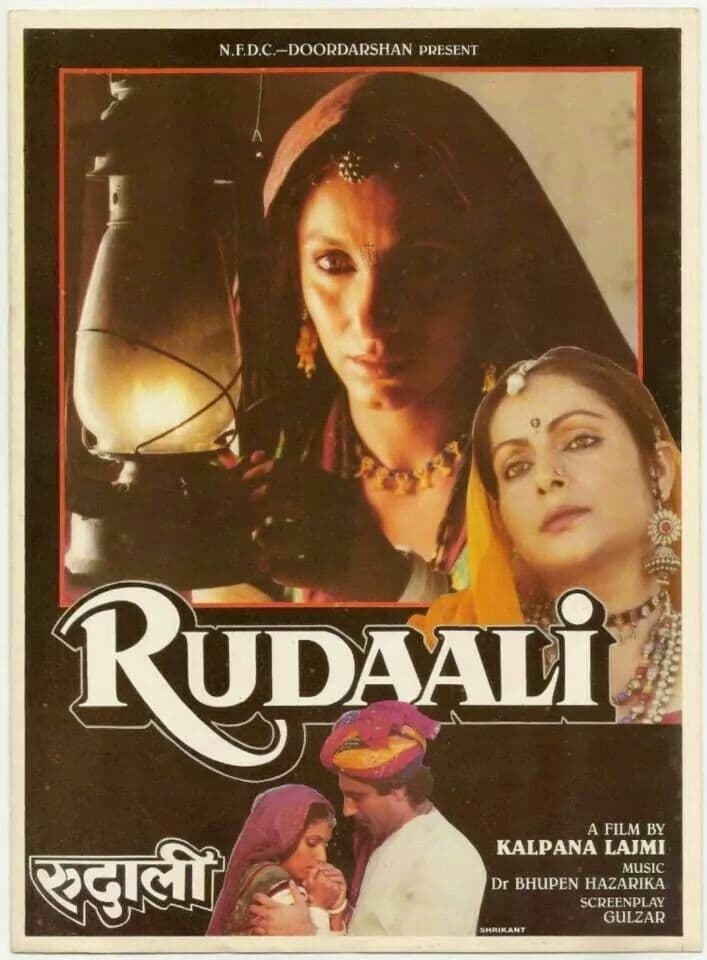
Poster from TMDB
Rudaali
Sign in to saveRudaali (pronounced "roo-dah-lee"; ) is a 1993 Indian Hindi-language drama film directed by Kalpana Lajmi, written by Lajmi and Gulzar and based on a 1979 short story of the same name by Bengali author Mahasweta Devi. Set in a small village in Rajasthan, the film stars Dimple Kapadia as Shanichari, a lonely and hardened woman who, despite a lifetime of misfortune and abandonment, is unable to express grief through crying and is challenged with a new job as a professional mourner. Raakhee, Raj Babbar, and Amjad Khan appear in supporting roles. Produced by the National Film Development Corporati
Film · TMDB
4.7Shanichari is a beautiful girl born in lower cast and her life is full of sufferings because of lower cast, poor finances, lost parents, drunken husband, mischievous son. The title refers to a custom in some parts of Rajasthan—where aristocratic women were long kept secluded and veiled—of hiring professional women mourners on the death of a male relative, a rudaali (pronounced “roo-dah-lee”—literally, a female “weeper”) to publicly express the grief that family members, constrained by their high social status, were not permitted to display—or at times, perhaps did not feel. Underwritten by the National Film Development Corporation (NFDC) and Doordarshan (Indian national television) and based on a short story by famed Bengali author Mahasweta Devi—whose tales often focus on the travails of low-caste women.
Cast
- Dimple Kapadia as Shanichari
- Rakhee Gulzar as Bhikni
- Raj Babbar as Thakur
- Raghubir Yadav as Budhwa
- Sushmita Mukherjee as Mungri
- Amjad Khan as Thakur Ramavtar Singh
Themes
- woman director
This product uses the TMDB API but is not endorsed or certified by TMDB.
Key facts
- Film.name
- Rudaali
- Film.image
- Rudaali.jpg
- Film.caption
- Poster
- Film.director
- Kalpana Lajmi
- Film.producer
- Ravi GuptaRavi MalikNFDCDoordarshan
- Film.writer
- Gulzar
- Film.starring
- Dimple KapadiaRaj BabbarRaakheeAmjad Khan
- Film.music
- Bhupen Hazarika
- Film.cinematography
- Santosh Sivan Dharam Gulati
- Film.runtime
- 115 minutes
- Film.country
- India
- Film.language
- Hindi
- Album.name
- Rudaali
- Album.type
- soundtrack
- Album.artist
- Bhupen Hazarika
- Album.alt
- Rudaali Audio CD
- Album.released
- 1 January 1993 1 May 1993
- Album.genre
- Feature film soundtrack
via Wikipedia infobox
Wikidata facts
- Instance of
- film
- Genre
- drama film
- Country of origin
- India
- Original language
- Hindi
- Director
- Kalpana Lajmi
- Cast member
- Amjad Khan
- Composer
- Bhupen Hazarika
- Cinematographer
- Santosh Sivan
- Narrative location
- Rajasthan
Show 2 more facts
- publication date
- 1993-01-01
- title
- रुदाली
Sources (3)
via Wikidata · CC0
~21 min read
Encyclopedic overview
13 sectionsContents
- Plot
- Cast
- Production
- Soundtrack
- Themes
- Release and reception
- Legacy
- Awards and honours
- See also
- Notes
- References
- Bibliography
- External links
Rudaali (pronounced "roo-dah-lee"; ) is a 1993 Indian Hindi-language drama film directed by Kalpana Lajmi, written by Lajmi and Gulzar and based on a 1979 short story of the same name by Bengali author Mahasweta Devi. Set in a small village in Rajasthan, the film stars Dimple Kapadia as Shanichari, a lonely and hardened woman who, despite a lifetime of misfortune and abandonment, is unable to express grief through crying and is challenged with a new job as a professional mourner. Raakhee, Raj Babbar, and Amjad Khan appear in supporting roles. Produced by the National Film Development Corporation of India and Doordarshan, the film was labelled part of India's neo-realist parallel cinema, but it employed several of the common elements of mainstream Hindi cinema, including songs composed by Bhupen Hazarika.
Rudaali was a critical and unexpected commercial success. Particular critical praise was directed at Kapadia's performance, with further appreciation of the film's script, music, technical achievements, and Lajmi's direction. The film won three National Film Awards, including Best Actress for Kapadia, and was nominated for three Filmfare Awards, earning Kapadia a Critics Award for Best Performance. Kapadia won Best Actress honours at the 8th Damascus International Film Festival and the 38th Asia-Pacific Film Festival, where Hazarika was awarded for his music. The film was selected as the Indian entry for Best Foreign Language Film at the 66th Academy Awards, but was not nominated.
Excerpted from Wikipedia’s “Rudaali” article, available under the CC BY-SA 4.0 licence.