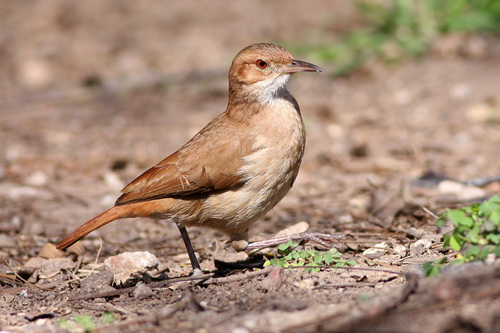
(c) Ron Knight, some rights reserved (CC BY) · cc-by
OverviewAI-generated
The Rufous Hornero, scientifically classified as *Furnarius rufus*, is a species of bird within the genus *Furnarius*. It is diurnal and has a mass of 53. The species is also referred to by the common names Hornero común, Rosttöpfer, and Fournier roux.
Its range includes Brazil, Goiás, and South America. The IUCN Red List assessed its conservation status as Least Concern in 2024. Reproductive details indicate a litter size of 3.2 and an egg incubation period of 16.
Synthesized by Vinony from 22 facts across 4 sources: Wikidata, iNaturalist, IUCN Red List, Vinony graph. Generated from structured data (not the Wikipedia text) and checked against those facts — may still contain errors.
Species
Least ConcernRufous Hornero
species
Das Verbreitungsgebiet des Rosttöpfers Der Rosttöpfer (Furnarius rufus), auch Töpfervogel oder Lehmhans genannt, ist eine südamerikanische Art der Familie der Töpfervögel (Furnariidae).
via IUCN
Wikidata facts
- Instance of
- taxon
- Parent taxon
- Furnarius
- Mass
- 53
- Image
- Flickr - Dario Sanches - JOÃO-DE-BARRO (Furnarius rufus) (3).jpg
Show 11 more facts
- taxon rank
- species
- IUCN conservation status
- Least Concern
- taxon name
- Furnarius rufus
- Commons category
- Furnarius rufus
- Commons gallery
- Furnarius rufus
- litter size
- 3.2
- egg incubation period
- 16
- taxon common name
- forneiro-ruivo
- taxon range
- Goiás
- diel cycle
- diurnality
- short name
- F. rufus
via Wikidata · CC0
~9 min read
Encyclopedic overview
The rufous hornero (Furnarius rufus) is a medium-sized ovenbird in the family Furnariidae. It occurs in eastern South America and is the national bird of Argentina. Also known as the red ovenbird, it is common in savannas, second-growth scrub, pastures, and agricultural land and is synanthropic. Its range includes midwestern, southeastern, and southern Brazil, Bolivia, Paraguay, Uruguay, and northern and central Argentina, extending as far south as northern Patagonia. The species is most closely related to the crested hornero of Paraguay and Argentina. There are four accepted subspecies.
The rufous hornero is medium-sized with a square tail and very slightly decurved bill. The plumage is overall reddish brown with a dull brown crown and a whitish throat. Sexes are alike and juvenile birds are slightly paler below (probably because they are cleaner). Rufous horneros feed on insects and other arthropods obtained by foraging on the ground while walking. They sometimes feed on scraps such as bread crumbs. Songs in the rufous hornero are sexually distinct. The rapid trill that is usually heard as part of the duet is faster in the male and slower in the female, and both beat their wings at their sides while singing and the wings beat at the same rate as their trill. Thus, while watching an observer may identify the sex by how fast their wings beat while singing.
Excerpted from Wikipedia’s “Rufous Hornero” article, available under the CC BY-SA 4.0 licence.