
Ruanda
Sign in to saveAlso known as Republic of Rwanda, The Land of a Thousand Hills
país de África oriental
OverviewAI-generated
Rwanda, officially the Republic of Rwanda, is a landlocked sovereign state and republic located in Eastern Africa. Its capital is Kigali. The country shares borders with Uganda, Tanzania, Burundi, and the Democratic Republic of the Congo. It contains the Northern, Eastern, Southern, and Western Provinces. The highest point is Mount Karisimbi.
Paul Kagame serves as head of state, while Anastase Murekezi, Édouard Ngirente, and Justin Nsengiyumva are heads of government. The currency is the Rwandan franc and Rwanda and Burundi franc. Rwanda is a member of the United Nations, Commonwealth of Nations, African Union, and World Trade Organization. Its top-level Internet domain is .rw, and the telephone country code is 250. The anthem is Rwanda Nziza.
The population is recorded as 14,104,969 and 14,256,567. The area is 26,338. The time zone is UTC+02:00. The forest area percentage is 11.3092825293879, and the renewable energy percentage is 79.9. Life expectancy is 68.017 years. The urban population percentage is 29.8849714294083, and internet users percentage is 31.70330048. The GDP in USD is 14,251,642,235.0968.
Synthesized by Vinony from 68 facts across 9 sources: Wikidata, REST Countries, Openweathermap, Open Meteo, World Bank, OpenStreetMap, PubMed, Vinony graph, Geo. Generated from structured data (not the Wikipedia text) and checked against those facts — may still contain errors.
Weather now
cached 8h ago7-day forecast
via Open-Meteo
Country
- Capital
- Kigali
- Population
- 14,104,969
- Region
- Africa · Eastern Africa
- Demonym
- Rwandan
- Currencies
- RWF (Fr)
- Languages
- English, French, Kinyarwanda
- Calling code
- +250
- Drives on
- Right
- Gini
- 43.7 (2016)
- FIFA code
- RWA
- TLD
- .rw
- Timezones
- UTC+02:00
- Borders
- BDI, COD, TZA, UGA
via REST Countries
Indicators · World Bank
- GDP
- $14.3B(2024)
- Population
- 14,256,567(2024)
- Life expectancy
- 68 yrs(2024)
- Unemployment
- 11.4 %(2025)
- Urban population
- 29.9 %(2024)
- Internet users
- 31.7 %(2024)
- Forest area
- 11.3 %(2023)
- Renewable energy
- 79.9 %(2022)
via World Bank Open Data · CC BY 4.0
Wikipedia views (30d)
120,999 totalvia Wikimedia Pageviews API
Key facts
- Country.conventional_long_name
- Republic of Rwanda
- Country.common_name
- Rwanda
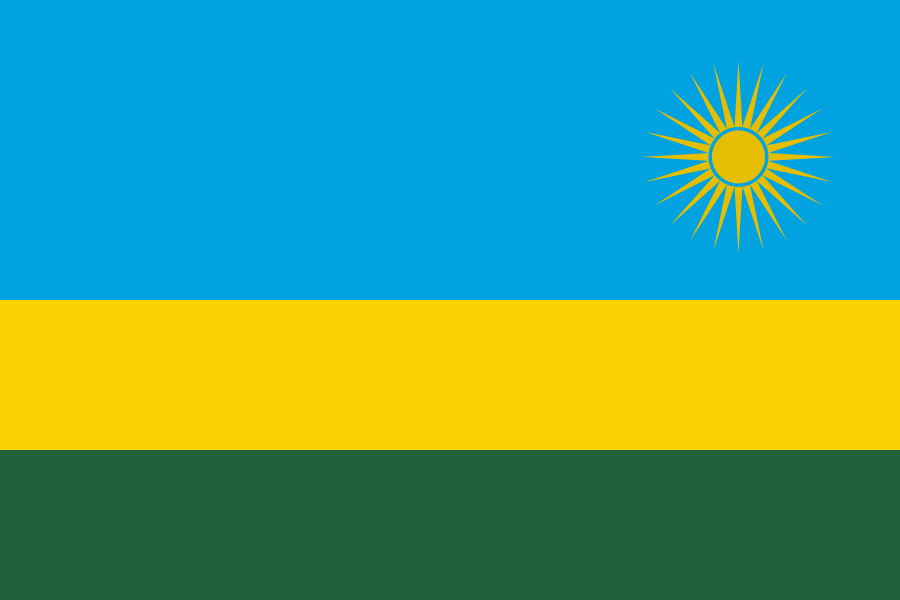
- Country.image_flag
- Flag of Rwanda.svg
- Country.alt_flag
- The flag of Rwanda: blue, yellow and green stripes with a yellow sun in top right corner
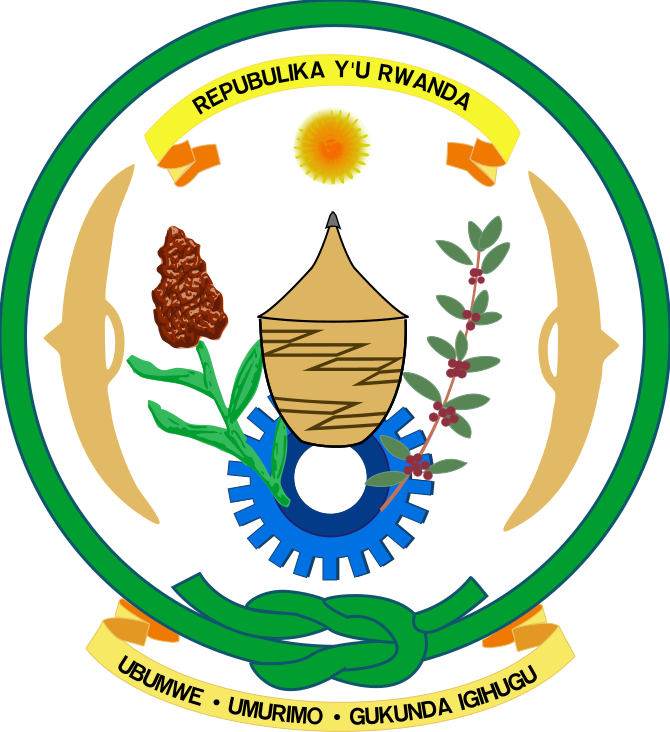
- Country.image_coat
- Coat of arms of Rwanda.svg
- Country.alt_coat
- The seal of Rwanda: central tribal devices, surmounted on a cog wheel and encircled by a square knot
- Country.national_anthem
- ""()
- Country.capital
- Kigali
- Country.largest_city
- Kigali
- Country.languages_type
- National language
- Country.languages
- Kinyarwanda
- Country.languages2_type
- Working language
- Country.languages2
- English
- Country.ethnic_groups
- 100% Banyarwanda 85% Hutu 14% Tutsi 1% Twa
- Country.ethnic_groups_year
- 1994
- Country.government_type
- Unitary semi-presidential republic under an authoritarian dictatorship
- Country.leader_title1
- President
- Country.leader_name1
- Paul Kagame
via Wikipedia infobox
Research
9,681 papers- Review of the Micronutrient Situation in Rwanda.ReviewFood and nutrition bulletin · 2021Arsenault JE, Olney DKDOI: 10.1177/0379572120975298
- Impact of Human Papillomavirus Vaccination, Rwanda and Bhutan.ReviewEmerging infectious diseases · 2021Baussano I, Sayinzoga F, Tshomo U et al.DOI: 10.3201/eid2701.191364
- Development of forensic medicine in Rwanda- past, present, and future perspectives.ReviewJournal of forensic and legal medicine · 2023Nteziryayo D, Xinshe LDOI: 10.1016/j.jflm.2023.102573
- Eradicating cervical cancer: Lessons learned from Rwanda and Australia.ReviewInternational journal of gynaecology and obstetrics: the official organ of the International Federation of Gynaecology and Obstetrics · 2021Kramer JDOI: 10.1002/ijgo.13601
- Rwanda.Department of State publication. Background notes series · 1989United States. Department of State. Bureau of Public Affairs
- Rwanda.Department of State publication. Background notes series · 1985United States. Department of State. Bureau of Public Affairs
- [Rwanda].Jeune Afrique (Paris, France : 1980) · 1996
- Rwanda's health-care transformation: a case study for war-torn countries.Lancet (London, England) · 2023Uwishema ODOI: 10.1016/S0140-6736(23)00452-X
via PubMed
Wikidata facts
- Instance of
- republic
- Official name
- Jamhuri ya Rwanda
- Demonym
- Ruandach
- Country
- Rwanda
- Contains
- Kigali
- Continent
- Africa
- Capital
- Kigali
- Official language
- Swahili
- Currency
- Rwanda and Burundi franc
- Population
- 14569341
- Area
- 26338
- Time zone
- UTC+02:00
- Head of government
- Justin Nsengiyumva
- Head of state
- Paul Kagame
- Form of government
- semi-presidential system
- Legislature
- Parliament of Rwanda
- Anthem
- Rwanda Nziza
- Shares border with
- Tanzania
- Highest point
- Mount Karisimbi
- Official website
- www.gov.rw
- Image
- An aerial of Kigali Convention Center on June 19, 2019. Photo by Emmanuel Kwizera.jpg
- Life expectancy
- 67.129
- Nominal GDP
- 14251642230
Show 61 more facts
- GDP (PPP)
- 58120000000
- Unemployment rate
- 1
- Calling code
- +250
- Licence plate code
- RWA
- Electrical plug type
- BS 1363
- Mains voltage
- 230
- Motto
- Undod, Gwaith, Gwladgarwch
- Flag
- flag of Rwanda
- Coat of arms
- Emblem of Rwanda
- top-level Internet domain
- .rw
- Commons category
- Rwanda
- member of
- African Continental Free Trade Area
- topic's main category
- Category:Rwanda
- Commons gallery
- Rwanda
- category for people born here
- Category:Births in Rwanda
- category for films shot at this location
- Category:Films shot in Rwanda
- category of associated people
- Category:Rwandan people
- diplomatic relation
- Russia
- topic's main Wikimedia portal
- Portal:Rwanda
- mobile country code
- 635
- lowest point
- Ruzizi River
- nickname
- Pays Des Mille Collines
- driving side
- right
- geography of topic
- Geography of Rwanda
- age of majority
- 18
- trunk prefix
- 0
- marriageable age
- 21
- category for people who died here
- Category:Deaths in Rwanda
- office held by head of government
- Prime Minister of Rwanda
- language used
- Rwandan Sign Language
- located in/on physical feature
- East Africa
- total fertility rate
- 3.7
- maritime identification digits
- 661
- inception
- 1962-01-01
- Unicode character
- 🇷🇼
- central bank
- National Bank of Rwanda
- native label
- Rwanda
- history of topic
- history of Rwanda
- culture
- culture of Rwanda
- VAT rate
- 18
- BTI Status Index
- 4.65
- BTI Governance Index
- 5.25
- economy of topic
- economy of Rwanda
- demographics of topic
- demographics of Rwanda
- Democracy Index
- 3.10
- Human Development Index
- 0.578
- hashtag
- Rwanda
- Happy Planet Index score
- 39.2
- Gini coefficient
- 43.7
- Inequality-adjusted Human Development Index
- 0.399
- P12749
- U Thant
- birth rate
- 29.474
- male population
- 6741039
- death rate
- 5.847
- rural population
- 11335329
- female population
- 7035658
- urban population
- 2441369
- executive body
- Cabinet of Rwanda
- GS1 country code
- 632
- Commonwealth Sport country code
- RWA
- public holiday
- Boxing Day
Sources (15)
via Wikidata · CC0
Travel guide
Understand
Rwanda has come a long way since the civil war and the 1994 Genocide against the Tutsi devastated this small country. Shake off your memories of tragic history and expect a warm and friendly welcome to the beautiful country now that this country is modernizing. It is a fast-growing country in Africa in terms of a lot of categories. It is sometimes called "The Singapore of Africa", due to both countries' similarities in geography, politics and modern history.
Get around
thumb|Countryside road in Rwanda
See
thumb|Genocide Memorial site in Kigali
Eat
thumb|Filled plate at a buffet restaurant in Kigali
The local "Brochettes" (skewers) are delicious and are available in most bars and restaurants, as well as ubiquitous vendors along the roads. Small bars will primarily serve goat brochettes, and goat liver brochettes are often of higher quality to the locals. Zingalo is goat intestine, sometimes also served as a brochette. Some locals prefer this and it could be brought to you without asking at very "local" places. So, if you prefer not to eat zingalo, try to see whether other diners seem to be enjoying the spiral looking treat and specify you do not want it when you order ("OYA zingalo"). Some restaurants also serve beef and fish brochettes, and a few will serve chicken. Brochettes are usually served with french fries ("frites") or fried or grilled ibitoke.
If Rwanda has a staple food, it is ibitoke (sing. igitoke). Ibitoke are starchy, potato-like bananas, which are not sweet like plantains. While plantains are available in Rwanda, they are not seen as particularly Rwandan food. Igitoke/banana are served boiled in sauce, grilled, or even fried. You can also refer to them as matoke, which is usually easier for foreigners to pronounce. The sweet bananas in Rwanda are delicious but considerably smaller than the matoke bananas. If you want this type of banana, ask for small banana or sweet banana.
In urban areas a local buffet known as "Melange" is sold at lunchtime. This consists of a buffet of mostly carbohydrates such as…
Drink
In most shops you will find milk, water, juices and soft drinks. In most bars the choice is limited to their offering of about 5 soft drinks and 4 beers, Turbo King, Primus, Mützig and Amstel. Primus and Mützig are available in small and large sizes, whereas Amstel is available only in 330 ml bottles. Rwandans are known for their fondness for large beers and when you order Amstel, it is common for a server to bring out 2 bottles at a time. Bralirwa in the west of the Rwanda produces most of the beer and soft drinks available in Rwanda. Inyange produces juices and soft drinks.
There are also local banana beer preparations called Urwagwa, normally brewed at home and available only in plastic containers but now also sold in bottles at some shops and bars. You can also buy a canned version on this drink under the brand Akarusho, produced by the Rwandan enterpreneur Sina Gérard.
Milk is extremely popular in Rwanda, to the point where people often go to dedicated milk bars to grab a glass. Besides fresh milk, you can also get a type of fermented milk called ikivuguto, which is thick and tangy.
Sleep
thumb|Ubumwe Grande Hotel
Kigali has a wide range of accommodation, from international chains to budget guesthouses. At the top end, the Kigali Marriott Hotel, Radisson Blu Hotel & Convention Centre, Mövenpick Hotel Kigali, and The Retreat by Heaven offer international standard rooms. The Hotel des Mille Collines and Chez Lando are long established Kigali favourites (though film buffs should note that Hotel Rwanda was filmed in South Africa, not at the Mille Collines).
Mid-range hotels and boutique guesthouses are plentiful in neighbourhoods like Kimihurura, Kacyiru, and Remera, typically costing US$50–100 per night.
Budget accommodation is available from around US$15–30 for a basic but clean room. Hostels and guesthouses can be found across the city. Airbnb is also widely used in Kigali.
Outside Kigali, accommodation options are more limited. The national park areas (Musanze for gorilla trekking, Huye for the south, and the Lake Kivu towns) have a mix of lodges and guesthouses. Lodges near Volcanoes National Park tend to be at the higher end, catering to gorilla trekking visitors. Along Lake Kivu, there are options at every budget level.
Accommodation across Rwanda is generally more expensive than neighbouring Uganda and Tanzania.
Stay safe
thumb|Giraffes in Akagera National Park
Rwanda is generally a safe country for visitors. It ranks among the safest in Africa according to both the Gallup Global Safety Report and the Numbeo Safety Index. Violent crime against tourists is extremely rare, and Kigali is safe to walk around at night in most neighbourhoods, with main roads well lit.
The possible exceptions are certain places along the Congolese and Burundian borders, where the security situation can change. Gisenyi and Kibuye are considered safe, but check travel advisories and local sources before travelling to border areas. Gorilla trekking near the DRC border is generally considered safe due to the continuous Rwandan security presence.
Visitors should follow typical precautions: avoid flaunting expensive jewellery, keep a close eye on wallets and bags in crowded markets and bus stations. The Rwandan police maintain a visible presence throughout the country. If you need assistance, dial 112.
Begging and aggressive panhandling is fairly rare. Usually a firm but polite "no thank you" is enough to be left alone. Raising your voice even slightly will almost certainly end the conversation.
When travelling by bus or car in the countryside, expect to pass through several police checkpoints. These are routine checks of vehicle registration and insurance, not passenger IDs. However, it is still wise to carry your passport (or a copy) with you at all times.
Photography near certain high-level government buildings su…
Stay healthy
Despite being close to the equator, Rwanda's high altitude (Kigali sits at around 1,500 m) keeps the climate temperate rather than tropical hot. Precautions should still be taken against sunburn due to the strong equatorial sun, and dehydration when hiking at higher elevations. Sunscreen may be difficult to find outside of larger supermarkets and pharmacies; fair skinned visitors should bring their own.
Tap water is not drinkable. Bottled water is widely available for around FRw500–1,000. Pay attention when purchasing bottled water from smaller kiosks, as they may "recycle" old bottles by filling them with tap water. Always make sure the seal around the bottle cap is unbroken. Avoid drinks with ice, as the ice is almost certainly made from tap water.
Pharmacies stocked with over-the-counter medications, Band-Aids, etc. are found throughout the country. The staff are well-trained, though English may not be spoken to a high proficiency. Bring your own supplies of any specialist or prescription medication.
If you do need medical attention, Kigali has decent facilities. King Faisal Hospital in Kacyiru (+250 788 123 200, or dial 3939 locally) is the main referral hospital, and CHUK ( University Teaching Hospital of Kigali) is in the city centre. Outside Kigali, district hospitals exist in major towns but are more basic. Travel insurance with medical evacuation cover is strongly recommended.
Malaria risk in Kigali is low thanks to the altitude, but increases in lower lying area…
Respect
thumb|Skulls in Nyamata Memorial Site Rwanda is a very conservative society, and most people dress modestly, especially women. Wearing shorts or tight skirts and skimpy tops is likely to get you stared at twice as much as normal.
It is unusual for a couple to make public displays of affection, even though many men walk hand in hand with male friends. Also, Rwandans will generally never eat or drink in public, apart from restaurants. Rwandan women are rarely seen smoking in public or out in bars unaccompanied.
Although there is no smoking ban in most public places like bars and restaurants, generally it's not encouraged. Sometimes people may complain of being disturbed with people's smoking.
Rwandans are very private, reserved people and loud public confrontations (shouting matches) or obvious displays of emotion (such as crying) are also frowned upon. If you feel you are being overcharged by a trader, quietly persisting with the negotiation (or your complaint!) is likely to produce results much faster than an angry outburst.
It is also impolite to make eye contact with an elder.
Rwanda is still recovering from a civil war and genocide in which over 800,000 people, perhaps a million, mostly Tutsi, were killed. Many Rwandans lost relatives and friends. Remember to be sensitive to this sad fact when dealing with Rwandans. Most people today are trying to forget the tribal divisions and would rather be referred to as Rwandans than Hutu or Tutsi. It is considered impolite to a…
Travel guide from Wikivoyage (CC BY-SA 4.0)
Article · Español
Ruanda, cuyo nombre oficial es República de Rwanda (en kiñaruanda, Repubulika y'u Rwanda; en inglés, Republic of Rwanda; en francés, République du Rwanda), es un país en África Oriental sin salida al mar. Limita al norte con Uganda, al este con Tanzania, al sur con Burundi y al oeste con la República Democrática del Congo. Es un pequeño país ubicado en la región de los Grandes Lagos de África; conocido como las «nieblas de África», también por su fauna salvaje, principalmente por sus gorilas de montaña, por sus ciudades típicas y por los parques nacionales y parajes naturales que ofrece su paisaje montañoso. Su terreno fértil y montañoso, que le da el título de «Tierra de las mil colinas» (en francés, Pays des Mille Collines; /pei de mil kɔ.lin/), debe soportar las poblaciones más densas del continente africano. Ruanda es un país de rentas bajas, que en la última década está consiguiendo las cuotas de crecimiento más altas del continente. Gran parte de la población trabaja en la agricultura, principalmente de subsistencia, pero hay una creciente producción mineral y procesamiento de productos agrícolas. El turismo es actualmente la principal fuente de renta del país, y desde 2008 la minería ha sobrepasado al café y té como principal fuente de productos para exportación. Aunque es recordado aún hoy por las sangrientas guerras que lo azotaron a final del pasado siglo, y particularmente por el genocidio ocurrido en 1994, en el que las muertes superaron el millón de personas, Ruanda es, dos décadas más tarde, el país más seguro del continente y el quinto a nivel mundial, según el informe Gallup 2015, el cual mide la sensación de seguridad ciudadana; según el Foro Económico Mundial, es igualmente el más seguro del continente y el noveno del mundo. Por otra parte, el Índice de Paz Global, que incluye factores como el nivel de militarización o las relaciones exteriores, coloca a Ruanda en el puesto 103° del mundo, siendo el peor dato la proporción de población encarcelada, aún muy elevado tras los juicios por el genocidio. Ruanda ha desarrollado algunas de las políticas más favorables del mundo para las mujeres. La Constitución ruandesa ha exigido que las mujeres ocupen un 30 por ciento de los puestos electos. Hoy, con 49 mujeres en el parlamento, el porcentaje asciende al 61 por ciento: el más alto del mundo. Cuatro de los siete puestos del tribunal supremo están ocupados por mujeres.
Abstract from DBpedia / Wikipedia · CC BY-SA
Gallery (59)
On the map
9 mapped locations
Available in 256 languages
- Español
- Français
- Deutsch
- 中文
- 日本語
- Русский
- Português
- Italiano
- العربية
- हिन्दी
- Abkhazian
- abstract
- Achinese
- Afrikaans
- Albanian
- Albanian
- Amharic
- ami
Show 237 more
- Angika
- Aragonese
- Armenian
- Arpitan
- Asturian
- azb
- Azerbaijani
- Bahasa Indonesia
- Balinese
- Bambara
- Bangla
- Banjar
- Bashkir
- Basque
- bat_smg
- Bavarian
- be_x_old
- Belarusian
- Betawi
- Bhojpuri
- Bikol
- Bishnupriya
- Bislama
- Bosnian
- Breton
- Bulgarian
- Buriat
- Burmese
- Catalan
- cbk_zam
- cdo
- Cebuano
- Central Kurdish
- Chechen
- Chuvash
- Cornish
- Corsican
- Crimean Tatar
- Croatian
- Czech
- dag
- Danish
- Dinka
- Divehi
- dty
- Dzongkha
- Egyptian Arabic
- Esperanto
- Estonian
- Ewe
- Extremaduran
- Faroese
- Fiji Hindi
- Filipino
- Finnish
- fiu_vro
- Fon
- Frafra
- Friulian
- Fula
- Gagauz
- Galician
- Ganda
- gcr
- Georgian
- Gilaki
- gpe
- Greek
- Guarani
- Gujarati
- Haitian Creole
- Hakka Chinese
- Hausa
- Hebrew
- Hungarian
- hyw
- Icelandic
- Ido
- Igbo
- Iloko
- Inari Sami
- Interlingua
- Interlingue
- Irish
- Jamaican Creole English
- Javanese
- Kabyle
- kai
- Kannada
- Kanuri
- Kara-Kalpak
- Karachay-Balkar
- Kashmiri
- Kazakh
- kbp
- kge
- Kikuyu
- Kinyarwanda
- Komi-Permyak
- Kongo
- Kotava
- Kurdish
- Kyrgyz
- Ladino
- Latin
- Latvian
- Ligurian
- Limburgish
- Lingala
- Lingua Franca Nova
- Lithuanian
- lld
- Lombard
- Low German
- Lower Sorbian
- Luxembourgish
- Macedonian
- Malagasy
- Malay
- Malayalam
- Maltese
- Manipuri
- Manx
- Māori
- Marathi
- Mari
- Mazanderani
- Minangkabau
- Mingrelian
- mnw
- Moksha
- Mongolian
- Moroccan Arabic
- nds_nl
- Nederlands
- Nepali
- Newari
- Nigerian Pidgin
- Northern Frisian
- Northern Sami
- Northern Sotho
- Norwegian
- Norwegian Nynorsk
- Novial
- nup
- Obolo
- Occitan
- Odia
- Old English
- olo
- Oromo
- Ossetic
- Pampanga
- Papiamento
- Pashto
- Piedmontese
- Polski
- Punjabi
- Quechua
- Romanian
- Rundi
- Rusyn
- Samoan
- Sango
- Sanskrit
- Santali
- Sardinian
- Saterland Frisian
- Scots
- Scottish Gaelic
- Serbian
- Serbian (Latin)
- Shan
- Shona
- Sicilian
- Silesian
- simple
- Sindhi
- Sinhala
- Slovak
- Slovenian
- Somali
- Southern Sotho
- Standard Moroccan Tamazight
- Sundanese
- Svenska
- Swahili
- Swati
- szy
- Tajik
- Talysh
- Tamil
- Taroko
- Tatar
- tay
- Telugu
- Tibetan
- Tiếng Việt
- Tigrinya
- Toki Pona
- Tsonga
- Tswana
- Tumbuka
- Türkçe
- Turkmen
- Tyap
- Udmurt
- Ukrainian
- Upper Sorbian
- Urdu
- Uyghur
- Uzbek
- Venetian
- Veps
- Volapük
- Walloon
- Waray
- Welsh
- West Flemish
- Western Frisian
- Western Mari
- Western Panjabi
- Wolof
- Wu Chinese
- Xhosa
- Yakut
- Yiddish
- Yoruba
- Zaza
- Zeelandic
- zh_min_nan
- zh_yue
- Zhuang
- Zulu
- فارسی
- ไทย
- 한국어
via Wikidata sitelinks · CC0