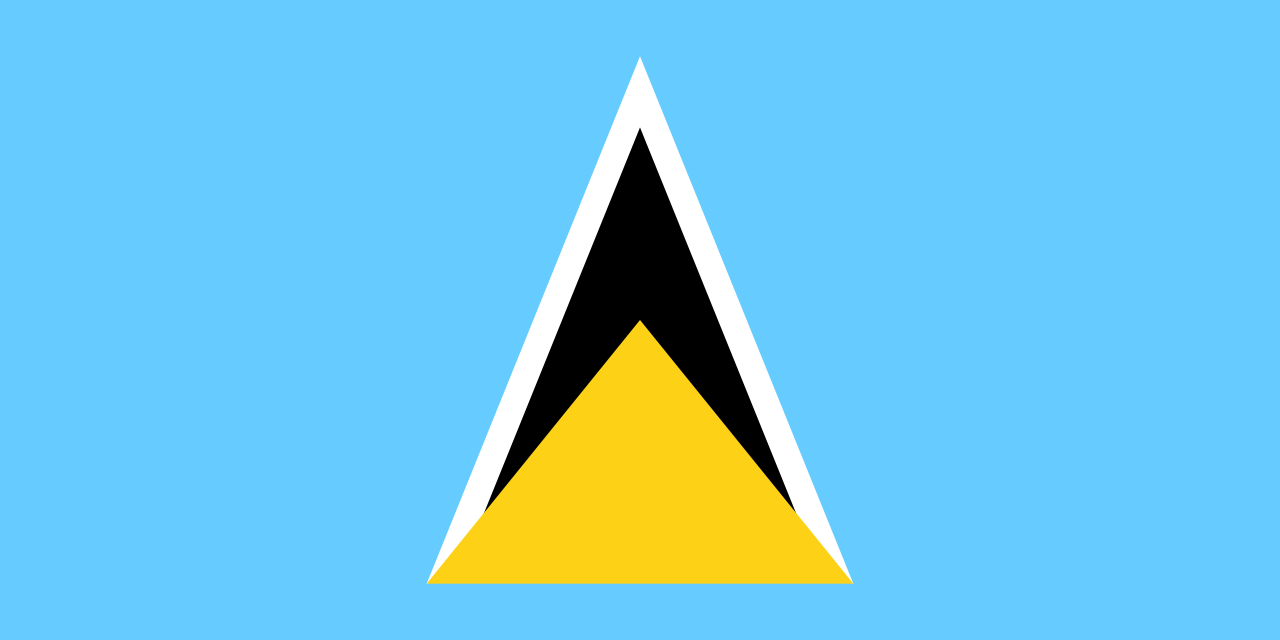
Saint Lucia
Sign in to saveAlso known as lc, St. Lucia, St Lucia, Iyonola, Hewanorra, lca
Saint Lucia is an island country in the eastern Caribbean. Part of the Windward Islands of the Lesser Antilles, it is located north/northeast of the island of Saint Vincent, northwest of Barbados and south of Martinique. It covers a land area of 617 km2 (238 sq mi) with an officially estimated population of over 184,100 people as of mid 2023. The nation's capital and largest city is Castries.
OverviewAI-generated
Saint Lucia is an island country and sovereign state located in the Caribbean region of North America. Its capital is Castries, and it operates as a constitutional monarchy with the Parliament of Saint Lucia as its legislative body. The official language is English, and the currency used is the Eastern Caribbean dollar. The nation is a member of the United Nations, the Commonwealth of Nations, the World Trade Organization, and the Caribbean Community.
The country has a population of approximately 184,100 people and covers an area of 616 square kilometers. Its highest point is Mount Gimie, and it contains administrative entities such as the Anse la Raye Quarter, Castries Quarter, Choiseul Quarter, and Dauphin Quarter. Saint Lucia follows the time zone UTC-04:00 and uses the top-level Internet domain .lc. It was named after Saint Lucy and has at various times been associated with the West Indies Federation.
Synthesized by Vinony from 67 facts across 9 sources: Wikidata, Openweathermap, Open Meteo, World Bank, OpenStreetMap, REST Countries, PubMed, Vinony graph, Geo. Generated from structured data (not the Wikipedia text) and checked against those facts — may still contain errors.
In the Vinony graph
Vinony catalogs Saint Lucia in its Countries collection (215 entries).
Within Vinony's link graph, Saint Lucia is referenced by 6,380 other articles, and connects out to Pitons, Eastern Caribbean dollar and Saint Lucian Creole.
The entry is geolocated on the map in adm1st.
Vinony files it under 1800s establishments in the Caribbean, 1803 establishments in North America and 1803 establishments in the British Empire.
Weather now
cached 23h ago7-day forecast
via Open-Meteo
Country
- Capital
- Castries
- Population
- 184,100
- Region
- Americas · Caribbean
- Demonym
- Saint Lucian
- Currencies
- XCD ($)
- Languages
- English
- Calling code
- +1758
- Drives on
- Left
- Gini
- 51.2 (2016)
- FIFA code
- LCA
- TLD
- .lc
- Timezones
- UTC-04:00
via REST Countries
Indicators · World Bank
- GDP
- $2.5B(2024)
- Population
- 179,744(2024)
- Life expectancy
- 72.8 yrs(2024)
- Unemployment
- 9.5 %(2025)
- Urban population
- 29.1 %(2024)
- Internet users
- 68.2 %(2024)
- Forest area
- 34 %(2023)
- Renewable energy
- 9.7 %(2022)
via World Bank Open Data · CC BY 4.0
Wikipedia views (30d)
76,018 totalvia Wikimedia Pageviews API
Research
1,318 papers- Treatment of dry age-related macular degeneration: A review.ReviewClinical & experimental ophthalmology · 2023Girgis S, Lee LRDOI: 10.1111/ceo.14294
- Major Hospital Fire in Saint Lucia.Prehospital and disaster medicine · 2021Greenidge C, Cawich SO, Burt R et al.DOI: 10.1017/S1049023X21000947
- Saint Lucia revisited.Parasitology today (Personal ed.) · 1988Bos R, Février M, Knudsen ABDOI: 10.1016/0169-4758(88)90029-4
- "The Secret" to Success? The Psychology of Belief in Manifestation.Personality & social psychology bulletin · 2025Dixon LJ, Hornsey MJ, Hartley NDOI: 10.1177/01461672231181162
- Macrophage-to-myofibroblast transition and its role in cardiac fibrosis.ReviewInternational immunopharmacology · 2025Shen S, Wang L, Liu Q et al.DOI: 10.1016/j.intimp.2024.113873
- The COVID-19 Infodemic.Revista panamericana de salud publica = Pan American journal of public health · 2021García-Saisó S, Marti M, Brooks I et al.DOI: 10.26633/RPSP.2021.56
- Reply.Gastroenterology · 2025McGahan W, Gill AJDOI: 10.1053/j.gastro.2024.12.019
- Survey of Schistosomiasis in Saint Lucia: Evidence for Interruption of Transmission.The American journal of tropical medicine and hygiene · 2020Gaspard J, Usey MM, Fredericks-James M et al.DOI: 10.4269/ajtmh.19-0904
via PubMed
Wikidata facts
- Instance of
- country
- Named after
- Saint Lucy
- Official name
- Sainte-Lucie
- Demonym
- لوسيات
- Country
- Saint Lucia
- Contains
- Laborie Quarter
- Continent
- North America
- Capital
- Castries
- Official language
- English language
- Currency
- Eastern Caribbean dollar
- Population
- 167591
- Area
- 617.012867
- Elevation
- 330
- Head of government
- Philip J. Pierre
- Head of state
- Charles III
- Form of government
- constitutional monarchy
- Legislature
- Parliament of Saint Lucia
- Shares border with
- Venezuela
- Highest point
- Mount Gimie
- Follows
- West Indies Federation
- Official website
- www.govt.lc
- Image
- Saint Lucia.png
Show 53 more facts
- Life expectancy
- 71
- Nominal GDP
- 2065027556
- Calling code
- +1758
- Licence plate code
- WL
- Electrical plug type
- BS 1363
- Mains voltage
- 240
- Motto
- Prydferthwch syml
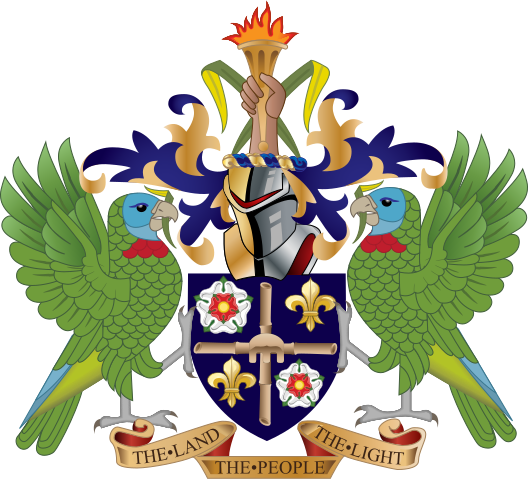
- Coat of arms
- coat of arms of Saint Lucia
- topic's main Wikimedia portal
- Portal:Saint Lucia
- top-level Internet domain
- .lc
- Commons category
- Saint Lucia
- topic's main category
- Category:Saint Lucia
- category for people who died here
- Category:Deaths in Saint Lucia
- category for people born here
- Category:Births in Saint Lucia
- category for films shot at this location
- Category:Films shot in Saint Lucia
- category of associated people
- Category:Saint Lucian people
- Commons gallery
- Saint Lucia
- lowest point
- Caribbean Sea
- inception
- 1967-03-01
- driving side
- left
- geography of topic
- geography of Saint Lucia
- emergency phone number
- 999
- marriageable age
- 18
- diplomatic relation
- United States
- language used
- Saint Lucian Creole
- number of out-of-school children
- 5974
- has characteristic
- free country
- total fertility rate
- 1.89
- maritime identification digits
- 343
- Unicode character
- 🇱🇨
- described by source
- Encyclopædia Britannica 11th edition
- history of topic
- history of Saint Lucia
- native label
- Saint Lucia
- economy of topic
- economy of Saint Lucia
- demographics of topic
- demographics of Saint Lucia
- P8168
- 4617 Zadunaisky
- Human Development Index
- 0.715
- P11012
- Donnersbergkreis
- central bank
- Eastern Caribbean Central Bank
- hashtag
- SaintLucia
- on focus list of Wikimedia project
- Wikipedia:Vital articles/Level/4
- Gini coefficient
- 51.2
- Inequality-adjusted Human Development Index
- 0.559
- P12749
- John Lennon
- birth rate
- 11.316
- male population
- 88948
- death rate
- 10.151
- rural population
- 145594
- female population
- 90909
- urban population
- 34263
- Commonwealth Sport country code
- LCA
Sources (15)
via Wikidata · CC0
Travel guide
Understand
Tourism is vital to Saint Lucia's economy. Its economic importance is expected to continue to increase as the market for bananas becomes more competitive. Tourism tends to be more substantial during the dry season (January through April), although there are a handful of events held at other times of the year attracting visitors including the St. Lucia Jazz and Arts Festival (May), Carnival (July), and the Creole Heritage Month (October). The island is called the "Helen of the West Indies", due to its striking beauty.
Get in
500px|thumbnail|Visa policy of Saint Lucia
Get around
thumb|300px|Soufriere The main way for tourists to get around Saint Lucia is by taxi, either arranged by the hotel, taxi agency or individual operators. The tours arranged by resorts are usually the most expensive way to travel but might offer food and drink. Using a local taxi operator to plan your own adventure will be much more affordable. Your hotel staff should provide you with a number of a taxi agency or operator that they use regularly. The prices are generally fixed but you can shop around to get the best rate if given several numbers. Many taxi drivers that run from the resorts to the marketplaces will offer tours of the island for around $145 per van load. Each van will hold between 6 and 12 people.
For the budget travellers or the more adventurous tourists, local buses provide a cheap and fun way of getting around. They are small vans which hold around 10-14 people and vary in quality. They run irregularly, but frequently from rural towns to urban centers, (i.e. Soufriere to Castries, Soufriere to Vieux Fort, Vieux Fort to Castries), each day most travelling to Castries in the morning and returning to Soufriere late afternoon. They are very affordable and provide a unique experience each time; the vehicle operators often decorate the interiors and play their own music, either a mix of Caribbean flavours or country. If you want to try to take a transport discuss your route and travel time with one of the local staff familiar with the bus system. Many of them likel…
See
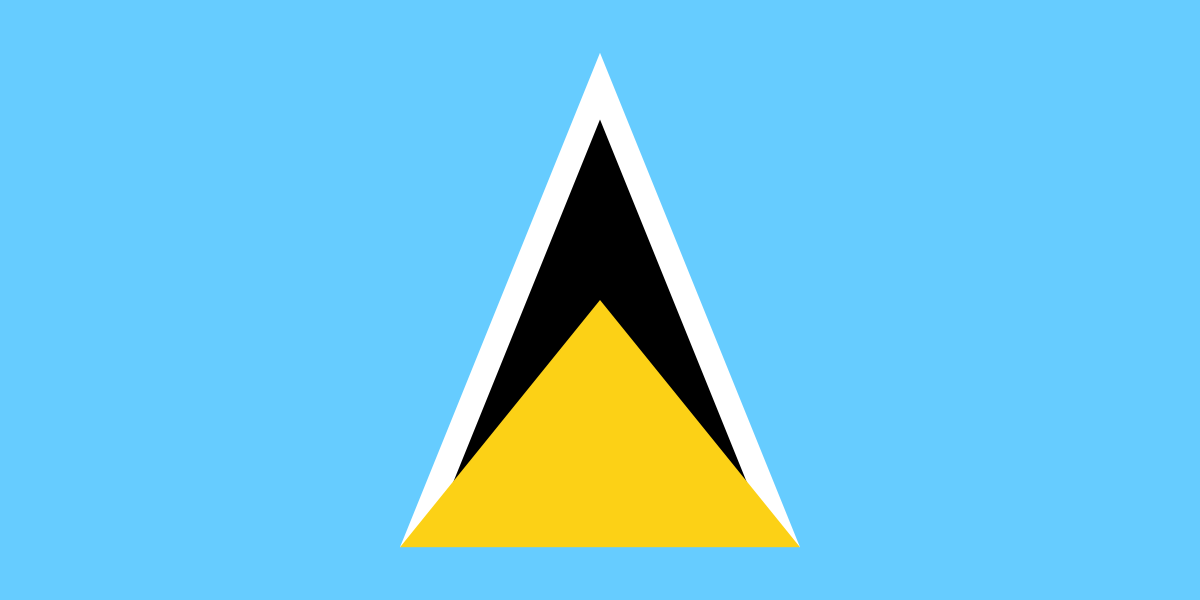
thumb|See the resemblance? The Pitons - Two volcanic plugs arising from the sea created by volcanic activity in the past. They are listed as a UNESCO World Heritage Site and depicted in the national flag. Pigeon Island nature reserve - just north of Gros Islet, the park has some of the oldest buildings on Saint Lucia and affords views across to Martinique. The green flash, if you're very lucky. This is sometimes seen in the tropics in the last split-second of sunset, when just as the sun vanishes the sky above it is momentarily a brilliant green. Conditions have to be just right: you need a hot calm day, with a clear view out to the sea horizon. Even then, most evenings all you'll get is a false flash, when staring towards the sunset leaves a green after-image on your vision. You'll begin to doubt it exists, but keep watching for it every clear sunset. Once seen, never forgotten.
Do
thumbnail|Gros Piton and Petit Piton
thumbnail|Toraille Waterfall
The Sulfur Springs - just south of Soufriere, these hot springs are one of the main attractions on the island. There is a pool that the hot water runs through, so make sure to take your swimming trunks and go for a dip! Rainforest hikes - there are several official hiking routes on the island. The Ministry of Agriculture Forestry and Fisheries site has links to information about the ones they support. Climbing the Gros Piton is an achievable goal for most people. The trailhead begins at an elevation of about 600 feet (approx. 180 m) above sea level and requires about two hours of moderate to strenuous hiking to reach the summit of about 2600 feet (approx. 800 m) above sea level. A further 1½ hours are needed to descend. Guides are required and entrance costs US$50. Taxis or local buses can be used to reach the trail head. Snorkeling is popular and a number of beaches are suitable. Scuba diving - done at Pigeon Island, one of the island's Historical Landmarks, as well as between The Pitons, a World Heritage Site. /. Ziplining - Several courses are offered throughout the island. The courses in the northern part of the island are more complex and offer views of the rainforests. The course at the Morne Coubaril Estate by Soufriere is simpler and provides a view of the Pitons.
Drink
Saint Lucia Distillers produces a variety of rums across a wide price range.
1931 - A super premium series of rum that's produced in limited quantity batches each year Chairman's Reserve - Premium rum that includes a spiced rum, a white rum, and two dark rums Crystal Lime - A rum-based lime liqueur Bounty - A mass market red rum that's commonly drunk on the island Marigot Bay Liqueurs - Rum-based cream liqueurs. Varieties include coconut and banana
In addition to rums, Piton Lager beer is brewed and bottled on the island and is quite good. It has 5% alcohol by volume, a slightly greater percentage than most American beers but very much in line with many European beers.
Sleep
Saint Lucia is home to a huge number of resort hotels as well as small boutique hotels and self-catering villas, condos, and vacation apartments.
Stay safe
St Lucia is not an incredibly dangerous place, but rates of homicide, rape, and mugging have increased drastically over the past several years. You should exercise the same caution as you would at home. You should also try to stay in groups and be careful in any secluded area. Muggings at gunpoint while you are in the water have become increasingly popular criminal activities, so make sure to hide your valuables. Pickpockets are in every country - just be careful in crowded areas.
Wearing clothing with a camouflage design or otherwise looking like a military uniform is illegal in Saint Lucia if you're not military personnel. This extends even to luggage, so if you show up at the airport with a camo-colored bag, it may be confiscated.
Street vendors are decidedly less aggressive than most Caribbean nations. A simple "no thank you" is sufficient.
Some of the locals will offer gifts when you stop, but don't be naive: they expect something in return, so either refuse the gift in the first place or be prepared to pay a dollar or two for the proffered "gift". These people are very poor and unemployment is high, so tourists are often the sole means they have to make some money.
Driving can be fun, but you should be a confident driver as driving is on the left, the roadways can be narrow, steep and in rough condition. A 4x4 or similar high-clearance vehicle is necessary if you decide to venture into the mountains. There's only one main roadway so it is difficult to get lost, but…
Stay healthy
This island is a series of hills and mountains. The main west coast roadway is the most hair-raising series of winding hair pin turns you have ever seen, particularly between Castries and Soufriere. The east coast roadway is more direct but it still takes approximately 90 minutes to drive from the airport in Hewannora (UVF) to Castries and Gros Islet in the north. In preparation for the shuttle, people who are staying in the north and are prone to motion sickness should bring Dramamine and take it immediately upon arrival at Hewannora Airport.
Tap water is safe to drink; however, bottled water is widely available for those who desire it.
Respect
All beaches on St. Lucia are open to the public. Nude sunbathing is illegal in St. Lucia.
Travel guide from Wikivoyage (CC BY-SA 4.0)
~31 min read
Encyclopedic overview
Saint Lucia (also written as St. Lucia) is an island country in the eastern Caribbean. Part of the Windward Islands of the Lesser Antilles, it is located north/northeast of the island of Saint Vincent, northwest of Barbados and south of Martinique. It covers a land area of 617 km (238 sq mi) with an officially estimated population of over 184,100 people as of mid 2023. The nation's capital and largest city is Castries.
The first proven inhabitants of the island, the Arawaks, are believed to have been the first to settle on the island in 200–400 AD. In 800 AD, the island was taken over by the Kalinago. The French were the first European colonists to settle on the island, and they signed a treaty with the native Caribs in 1660. The English took control of the island in 1663. In ensuing years, England and France fought 14 times for control of the island; consequently control over this immensely valuable geopolitical position changed frequently. Eventually, the British took complete control in 1814, shortly after the victory over French Emperor Napoleon I. Because the island switched so often between British and French control, Saint Lucia was also known as the "Helen of the West" after the Greek mythological character, Helen of Troy.
Excerpted from Wikipedia’s “Saint Lucia” article, available under the CC BY-SA 4.0 licence.
Gallery (16)
On the map
Available in 201 languages
- Español
- Français
- Deutsch
- 中文
- 日本語
- Русский
- Português
- Italiano
- العربية
- हिन्दी
- Afrikaans
- Albanian
- Albanian
- Amharic
- ami
- Angika
- Aragonese
- Armenian
Show 182 more
- Arpitan
- Asturian
- Aymara
- azb
- Azerbaijani
- Bahasa Indonesia
- Balinese
- Bangla
- Bashkir
- Basque
- bat_smg
- Bavarian
- be_x_old
- Belarusian
- Betawi
- Bikol
- Bishnupriya
- Bislama
- Bosnian
- Breton
- Bulgarian
- Buriat
- Burmese
- Catalan
- cbk_zam
- cdo
- Cebuano
- Central Kurdish
- Chechen
- Cornish
- Crimean Tatar
- Croatian
- Czech
- dag
- Danish
- Divehi
- dty
- Egyptian Arabic
- Erzya
- Esperanto
- Estonian
- Ewe
- Extremaduran
- Faroese
- Fiji Hindi
- Filipino
- Finnish
- fiu_vro
- Gagauz
- Galician
- gcr
- Georgian
- Gilaki
- Goan Konkani
- Greek
- Guarani
- Haitian Creole
- Hakka Chinese
- Hausa
- Hebrew
- Hungarian
- Icelandic
- Ido
- Iloko
- Inari Sami
- Interlingue
- Irish
- Jamaican Creole English
- Javanese
- Kabyle
- Kannada
- Kara-Kalpak
- Karachay-Balkar
- Kazakh
- Kinyarwanda
- Komi
- Kurdish
- Kyrgyz
- Ladino
- Latin
- Latvian
- Ligurian
- Limburgish
- Lingala
- Lingua Franca Nova
- Lithuanian
- lld
- Lombard
- Low German
- Lower Sorbian
- Luxembourgish
- Macedonian
- Madurese
- Malagasy
- Malay
- Malayalam
- Maltese
- Manipuri
- Manx
- Māori
- Marathi
- Mazanderani
- Minangkabau
- Mingrelian
- Moksha
- Mongolian
- Moroccan Arabic
- Nederlands
- Newari
- Northern Frisian
- Norwegian
- Norwegian Nynorsk
- Novial
- Occitan
- Old English
- olo
- Oromo
- Ossetic
- Papiamento
- Pashto
- Picard
- Piedmontese
- Polski
- Punjabi
- Quechua
- rki
- Romanian
- Samoan
- Sanskrit
- Sardinian
- Scots
- Scottish Gaelic
- Serbian
- Serbian (Latin)
- Shan
- Shona
- Sicilian
- Silesian
- simple
- Sindhi
- Sinhala
- Slovak
- Slovenian
- Sundanese
- Svenska
- Swahili
- Swati
- Tajik
- Tamil
- Tatar
- Telugu
- Tetum
- Tibetan
- Tiếng Việt
- Tongan
- Türkçe
- Udmurt
- Ukrainian
- Upper Sorbian
- Urdu
- Uyghur
- Uzbek
- Venetian
- Veps
- Volapük
- Waray
- Welsh
- Western Frisian
- Western Panjabi
- Wolof
- Wu Chinese
- Yakut
- Yoruba
- Zaza
- Zeelandic
- zh_classical
- zh_min_nan
- zh_yue
- Zhuang
- فارسی
- ไทย
- 한국어
via Wikidata sitelinks · CC0