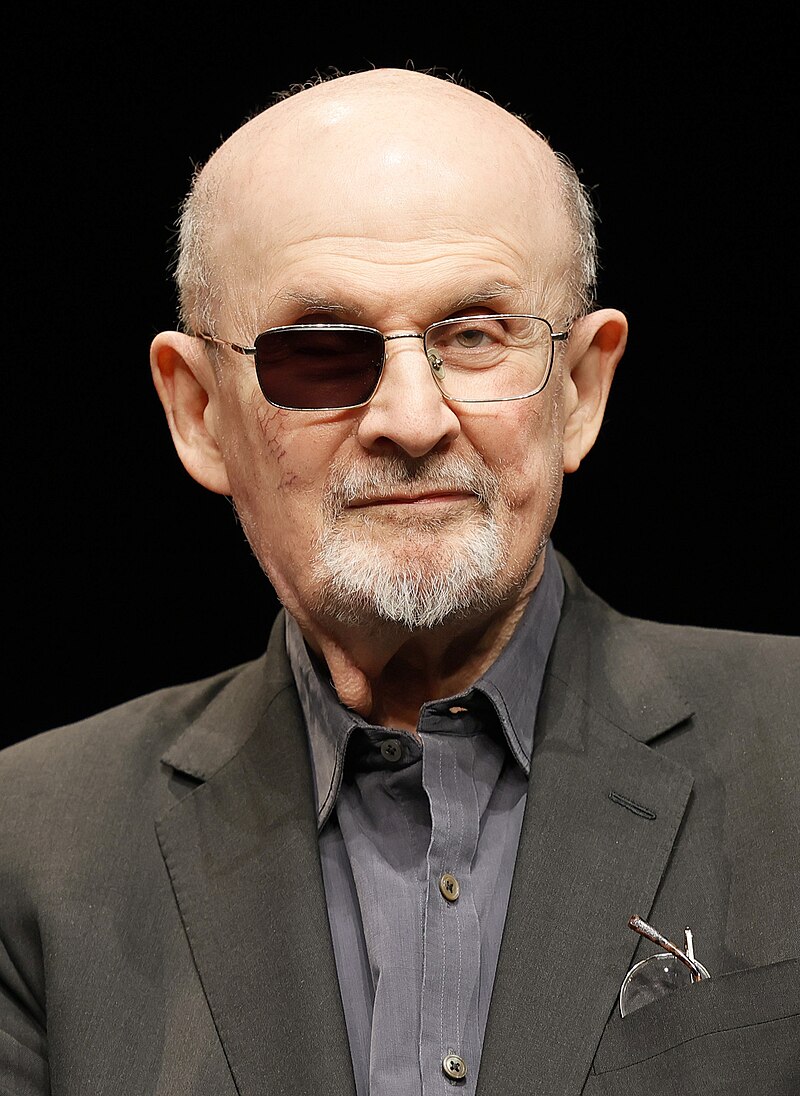
File:Salman_Rushdie,_2024.jpg · Wikimedia Commons · See Wikimedia Commons
Salman Rushdie
Sign in to saveAlso known as Sir Ahmed Salman Rushdie, Rushdie, Ahmed Salman Rushdie, Joseph Anton
Indian-born British-American novelist (born 1947)
Salman Rushdie is an Indian-born British-American novelist known for his literary works that blend magical realism with contemporary themes. He became one of the most prominent and influential figures in modern literature, though his work and life have been marked by significant controversy and challenges.
AI-generated from the Wikipedia summary — may contain errors.
Film & TV
Mumbai, India
Sir Ahmed Salman Rushdie FRSL is a British Indian novelist and essayist. His second novel, Midnight's Children, won the Booker Prize in 1981 and was deemed to be "the best novel of all winners" on two separate occasions, marking the 25th and the 40th anniversary of the prize.
Known for
- Knife: The Attempted Murder of Salman Rushdie — Self2026
- Orwell: 2+2=5 — Self (archive footage)2025
- Salman Rushdie: Through a Glass Darkly — Self - Interviewed Guest2024
- Einübung ins Paradies - Nachdenken über 1989 — Self2019
- Salman Rushdie: Death on a Trail — Self - Writer2019
- Angela Carter: Of Wolves & Women — Himself - Contributor2018
- Firing Line with Margaret Hoover — Self2018
- Bosch: The Garden of Dreams — Self2016
- Mylène Farmer : Sur les pas d'une icône — Self2015
- Concerning the Bodyguard — voice2015
via TMDB
Wikidata facts
- Instance of
- human
- Gender
- male
- Citizenship
- India
- Place of birth
- Mumbai
- Occupation
- author
- Educated at
- Cathedral and John Connon School
- Employer
- Emory University
- Languages spoken
- Kashmiri
- Native language
- Kashmiri
- Notable work
- The Satanic Verses
- Noble title
- Knight Bachelor
- Field of work
- history
- Genre
- magic realism
- Movement
- historical criticism
- Official website
- salmanrushdie.com
- Image
- Salman Rushdie 2014 (cropped).jpg
- Work location
- New York City
- Significant event
- stabbing of Salman Rushdie
Show 17 more facts
- Commons category
- Salman Rushdie
- date of birth
- 1947-00-00
- Commons gallery
- Salman Rushdie
- topic's main category
- Category:Salman Rushdie
- social media followers
- 1201851
- name in native language
- سلمان رشدی
- influenced by
- Gabriel García Márquez
- start of work period
- 1975-00-00
- IPA transcription
- sælˈmɑːn ˈrʊʃdi
- nominated for
- Locus Award for Best Fantasy Novel
- has works in the collection
- Smithsonian American Art Museum
- short name
- Salman Rushdie
- on focus list of Wikimedia project
- Wikipedia:Vital articles/Level/4
- writing language
- Kashmiri
- birth name
- احمد سلمان رشدی
- topic has template
- Template:Salman Rushdie
Sources (13)
via Wikidata · CC0
Works in European collections
1 object attributed to Salman Rushdie, held across European museums, libraries & archives · via Europeana

~40 min read
Encyclopedic overview
Sir Ahmed Salman Rushdie (born 19 June 1947) is an Indian-born British and American novelist. His work often combines magical realism with historical fiction and primarily deals with connections, disruptions, and migrations between Eastern and Western civilizations, typically set on the Indian subcontinent. Rushdie's second novel, Midnight's Children (1981), won the Booker Prize in 1981 and was deemed to be "the best novel of all winners" on two occasions that marked the 25th and the 40th anniversary of the prize.
After his fourth novel, The Satanic Verses (1988), Rushdie became the subject of several assassination attempts and death threats because of what was seen by some to be an irreverent depiction of Muhammad. The controversy involving the Satanic Verses included a fatwa calling for his death issued by Ruhollah Khomeini, the supreme leader of Iran. The book was banned in 20 countries. Numerous killings and bombings have been carried out by extremists who cited the book as motivation, sparking a debate about censorship and religiously motivated violence. In 2022, Rushdie survived a stabbing at the Chautauqua Institution that led to loss of his right eye and damage to his liver and hands. Two of the men who went to his aid were awarded the Carnegie Medal for heroism in 2025.
Excerpted from Wikipedia’s “Salman Rushdie” article, available under the CC BY-SA 4.0 licence.
Gallery (7)
Available in 103 languages
- Español
- Français
- Deutsch
- 中文
- 日本語
- Русский
- Português
- Italiano
- العربية
- हिन्दी
- Afrikaans
- Aragonese
- Armenian
- Assamese
- Asturian
- azb
- Azerbaijani
- Bahasa Indonesia
Show 84 more
- Bangla
- Bashkir
- Basque
- be_x_old
- Belarusian
- Bhojpuri
- Bikol
- Breton
- Bulgarian
- Catalan
- Central Kurdish
- Chuvash
- Cornish
- Croatian
- Czech
- Danish
- Egyptian Arabic
- Esperanto
- Estonian
- Fiji Hindi
- Finnish
- Galician
- Georgian
- Greek
- Hausa
- Hebrew
- Hungarian
- Icelandic
- Ido
- Irish
- Kannada
- Kashmiri
- Kurdish
- Kyrgyz
- Latin
- Latvian
- Lithuanian
- Macedonian
- Malagasy
- Malay
- Malayalam
- Marathi
- Mazanderani
- Mirandese
- Mongolian
- Moroccan Arabic
- Nederlands
- Nepali
- Newari
- Norwegian
- Norwegian Nynorsk
- Occitan
- Odia
- Pampanga
- Pashto
- Polski
- Punjabi
- Romanian
- Sanskrit
- Scots
- Serbian
- Serbian (Latin)
- simple
- Sindhi
- Slovak
- Slovenian
- Svenska
- Tamil
- Telugu
- Tiếng Việt
- Toki Pona
- Türkçe
- Ukrainian
- Urdu
- Uzbek
- Waray
- Welsh
- Wu Chinese
- Yiddish
- Yoruba
- zh_yue
- فارسی
- ไทย
- 한국어
via Wikidata sitelinks · CC0