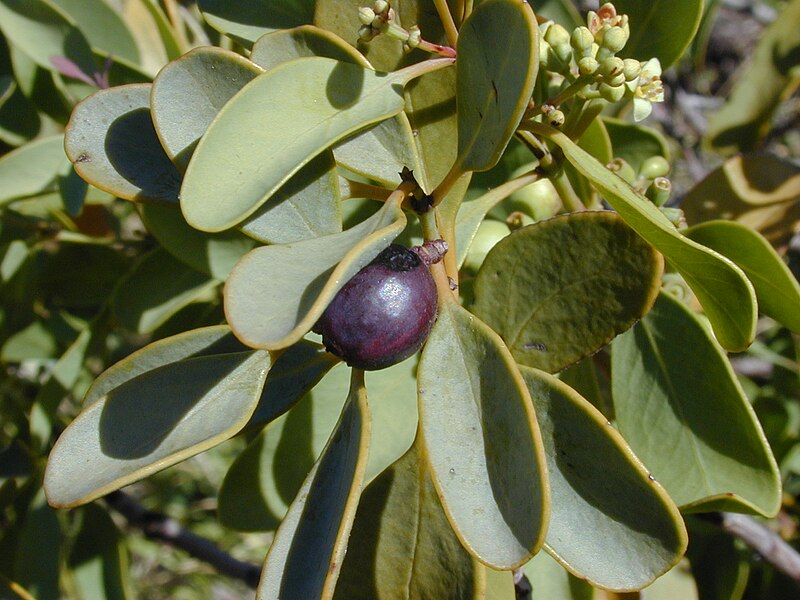
File:Starr_021209-0016_Santalum_ellipticum.jpg · Wikimedia Commons · See Wikimedia Commons
Santalaceae
Sign in to saveAlso known as mistletoe family
thumb|Santalum album The Santalaceae, the sandalwood family, are a family of flowering plants (including trees, shrubs, and herbs) which, like other members of Santalales, are partially parasitic on other plants. Its flowers are often unisexual or bisexual. Modern treatments of the Santalaceae include the family Viscaceae (mistletoes), previously considered distinct. They are widely distributed worldwide, primarily across temperate and tropical regions. Many members of Santalaceae have a long history of human use. Due to overexploitation, several Santalaceae are of conservation concern.
OverviewAI-generated
Santalaceae is a family of plants within the order Santalales. It belongs to the class Magnoliopsida, phylum Tracheophyta, and kingdom Plantae. The family includes the type genus Santalum and has the synonyms Viscaceae and Amphorogynaceae. Common names for the group include Sandelhoutfamilie, сандали, 檀香科, lanikovke, and mistelteinfamilien.
The family is distributed across various regions, with records from Mexico, the United States, South Africa, Brazil, and Colombia. There are ten genera of Santalaceae present in New Guinea. The taxon is currently accepted.
Synthesized by Vinony from 40 facts across 8 sources: Wikidata, GBIF, PubMed, Gbif Occ, Plants of the World, WoRMS, iDigBio, Vinony graph. Generated from structured data (not the Wikipedia text) and checked against those facts — may still contain errors.
Species
mistelteinfamilien
Santalaceae
FAMILY
- KingdomPlantae
- PhylumTracheophyta
- ClassMagnoliopsida
- OrderSantalales
- FamilySantalaceae
General: There are ten genera of Santalaceae in New Guinea, of which
via GBIF · Kew POWO
Museum specimens
- Specimen records
- 1,056
- With media
- 829
- Family
- Santalaceae
- Collections
- MADUG-UG, UCMP, IGL-UNAM, A, NY, UFPB
- Recorded in
- Mexico, United States, South Africa, Brazil, Colombia, Papua New Guinea, Brasil, Indonesia
Research
768 papers- The Argentine Mistletoes Ligaria cuneifolia (Ruiz & Pav.) Tiegh (Loranthaceae) and Phoradendron liga (Gillies ex Hook. & Arn.) Eichler (Santalaceae). Thirty Years of Research.Chemistry & biodiversity · 2022
- A review of the ethnobotany, contemporary uses, chemistry and pharmacology of the genus Thesium (Santalaceae).Journal of ethnopharmacology · 2020
- Microsatellites reveal divergence in population genetic diversity, and structure of osyris lanceolata (santalaceae) in Uganda and Kenya.BMC ecology and evolution · 2023
- Effect of the leaves aqueous extract of Jodina rhombifolia (Hook. & Arn.) Reissek (Santalaceae) on intestinal function and its acute toxicity.Journal of ethnopharmacology · 2020
- [Textual research on Zitan].Zhongguo Zhong yao za zhi = Zhongguo zhongyao zazhi = China journal of Chinese materia medica · 2024
via PubMed
Wikidata facts
- Instance of
- taxon
- Parent taxon
- Santalales
- Image
- Starr 021209-0016 Santalum ellipticum.jpg
Show 8 more facts
- Commons category
- Santalaceae
- taxon rank
- family
- taxon name
- Santalaceae
- topic's main category
- Category:Santalaceae
- taxon common name
- lanikovke
- taxonomic type
- Santalum
- Montana Plant Life URL
- montana.plant-life.org/cgi-bin/family03.cgi?Santalaceae
Sources (1)
via Wikidata · CC0
~6 min read
Encyclopedic overview
13 sectionsContents
- Description
- Flowers
- Leaves
- Roots and stems
- Seeds
- Taxonomy
- Ecology
- Uses
- Conservation
- Genera
- Formerly placed here
- References
- External links
thumb|Santalum album The Santalaceae, the sandalwood family, are a family of flowering plants (including trees, shrubs, and herbs) which, like other members of Santalales, are partially parasitic on other plants. Its flowers are often unisexual or bisexual. Modern treatments of the Santalaceae include the family Viscaceae (mistletoes), previously considered distinct. They are widely distributed worldwide, primarily across temperate and tropical regions. Many members of Santalaceae have a long history of human use. Due to overexploitation, several Santalaceae are of conservation concern.
== Description == === Flowers === Santalaceae flowers are highly variable. They are generally small with a valvate perianth in a single whorl. The stamens are fused to the corolla, with a reduced calyx. Flowers may be unisexual by abortion ("flower drop"). The ovary varies from fully to partially inferior and occasionally superior, as in the tribe Anthoboleae.
Excerpted from Wikipedia’s “Santalaceae” article, available under the CC BY-SA 4.0 licence.