Saturn Devouring His Son
Sign in to saveAlso known as Saturn Eating His Child, Saturn Eats His Children, Saturn Devouring His Son (from The Black Paintings), Cronus Devouring His Son
painting by Francisco de Goya
Key facts
- Artist
- Francisco Goya
- Year
- c. 1820–1823
- Medium
- Mixed media mural transferred to canvas
- Movement
- Romanticism
- Dimensions
- 143.5 cm × 81.4 cm (56.5 in × 32.0 in)
- Location
- Museo del Prado , Madrid
via Wikipedia infobox
Described at
Saturn - The Collection - Museo Nacional del Prado
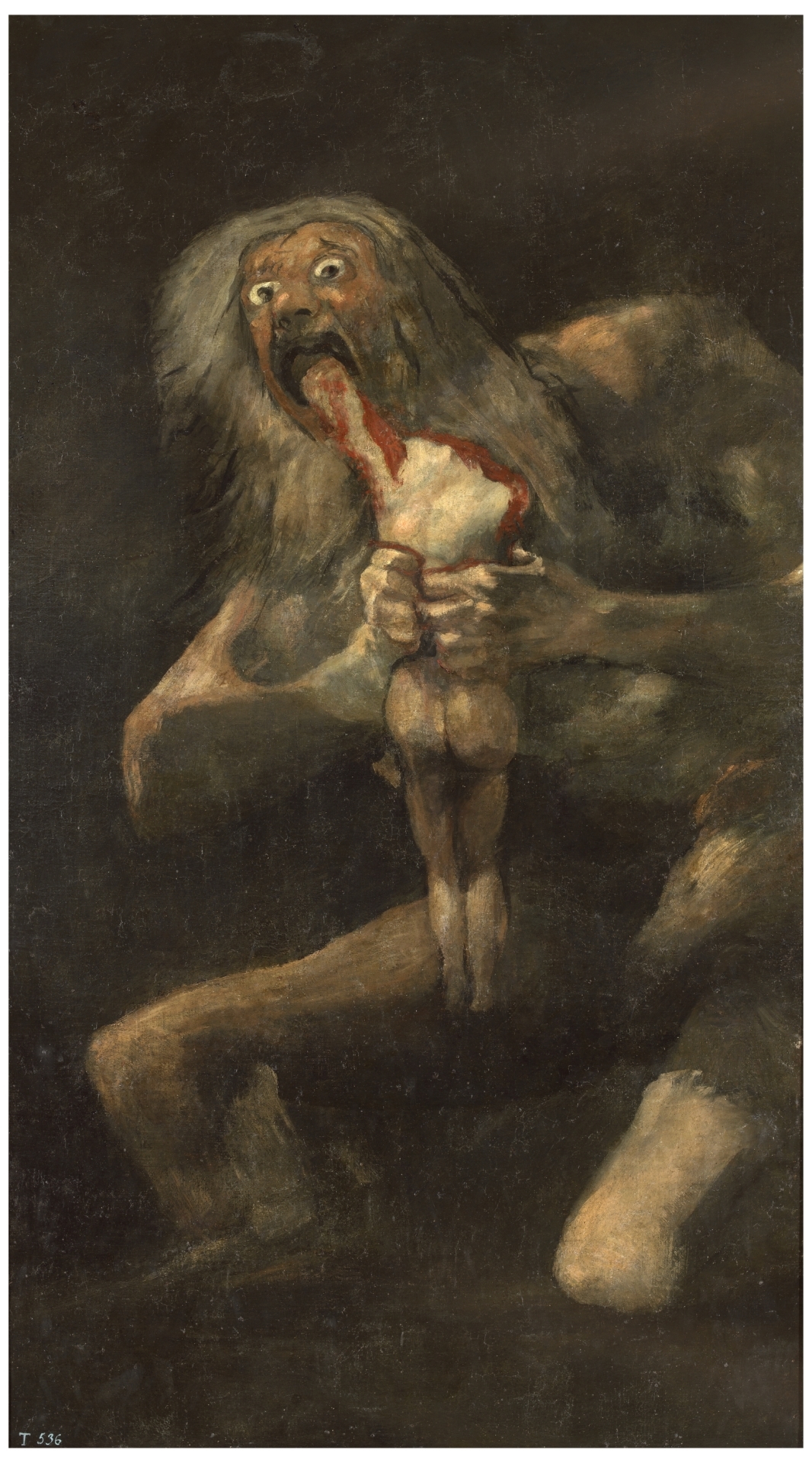
The mural paintings that decorated the house known as “la Quinta del Sordo,” where Goya lived have come to be known as the Black Paintings, because he used so many dark pigments and blacks in them, and also because of their somber subject matter.
museodelprado.es →The itinerary TITULORECORRIDO has been successfully created. Now you can add in works from the Collection browser The mural paintings that decorated the house known as “la Quinta del Sordo ,” where Goya lived have come to be known as the Black Paintings , because he used so many dark pigments and blacks in them, and also because of their somber subject matter. The private and intimate character of that house allowed the artist to express himself with great liberty. He painted directly on the walls in what must have been mixed technique, as chemical analysis reveals the use of oils in these works. The Baron Émile d´Erlanger acquired “la Quinta” in 1873 and had the paintings transferred to canvas. The works suffered enormously in the process, losing a large amount of paint. Finally, the Baron donated these… + The mural paintings that decorated the house known as “la Quinta del Sordo ,” where Goya lived have come to be known as the Black Paintings , because he used so many dark pigments and blacks in them, and also because of their somber subject matter. The private and intimate character of that house allowed the artist to express himself with great liberty. He painted directly on the walls in what must have been mixed technique, as chemical analysis reveals the use of oils in these works. The Baron Émile d´Erlanger acquired “la Quinta” in 1873 and had the paintings transferred to canvas. The works suffered enormously in the process, losing a large amount of paint. Finally, the Baron donated these paintings to the State, and they were sent to the Prado Museum , where they have been on view since 1889. Saturn devouring one of his sons is one of the most expressive images from his Black Paintings . It occupied the wall across from Leocadia Zorrilla ( P00754 ) on the ground floor of “la Quinta del Sordo .” This mythological god could be the personification of such a human feeling as the fear of losing one´s power. The mural paintings from “la Quinta del Sordo ” (the Black Paintings ), have been determinant in the modern-day consideration of this painter from Aragon . The German Expressionists and the Surrealist movement, as well as representative of other contemporary artistic movements, including literature and even cinema, have seen the origins of modern art in this series of compositions by an aged Goya, isolated in his own world and creating with absolute liberty. See work in timeline Sade and Goya: Sovereign Imagination and Critical Imagination. Georges Didi-Huberman (Original Version) TECHNICAL STUDY: The Snowstorm or Winter. Goya y Lucientes, Francisco de (1786) The exhibition Rome in your pocket. Sketchbooks and artistic learning in the XVIII Century
Excerpt from a page describing this subject · 40,000 chars · not written by Vinony
Wikidata facts
- Instance of
- painting
- Part of
- Black Paintings
- Genre
- Expressionism
- Country of origin
- Spain
- Based on
- Greek mythology
- Depicts
- Saturn
- Movement
- Romanticism
- Material used
- canvas
- Creator
- Francisco Goya
- Collection
- Museo del Prado
- Location
- Museo del Prado
- Image
- Francisco de Goya, Saturno devorando a su hijo (1819-1823).jpg
- Height
- 143.5
- Width
- 81.4
Show 10 more facts
- Commons category
- Saturno devorando a su hijo
- inception
- 1820-01-01
- catalog code
- 1624
- title
- Saturn Devouring His Son (from The Black Paintings)
- inventory number
- P000763
- depicts Iconclass notation
- 91B11141
- copyright status
- public domain
- time period
- Romanticism
- described at URL
- www.museodelprado.es/en/the-collection/art-work/saturn/18110a75-b0e7-430c-bc73-2a4d55893bd6
- fabrication method
- mural
Sources (7)
via Wikidata · CC0
~10 min read
Encyclopedic overview
Saturn Devouring His Son (Spanish: Saturno devorando a su hijo; also known as Saturn) is a painting by Spanish artist Francisco Goya. The work is one of the 14 so-called Black Paintings that Goya painted directly on the walls of his house some time between 1820 and 1823. It was transferred to canvas after Goya's death and is now in the Museo del Prado in Madrid.
The painting is traditionally considered a depiction of the Greek myth of the Titan Cronus, whom the Romans called Saturn, eating one of his children out of fear of a prophecy by Gaea that one of his children would overthrow him. Like all of the Black Paintings, it was not originally intended for public consumption and Goya did not provide a title or notes. Thus, its interpretation is disputed.
Excerpted from Wikipedia’s “Saturn Devouring His Son” article, available under the CC BY-SA 4.0 licence.