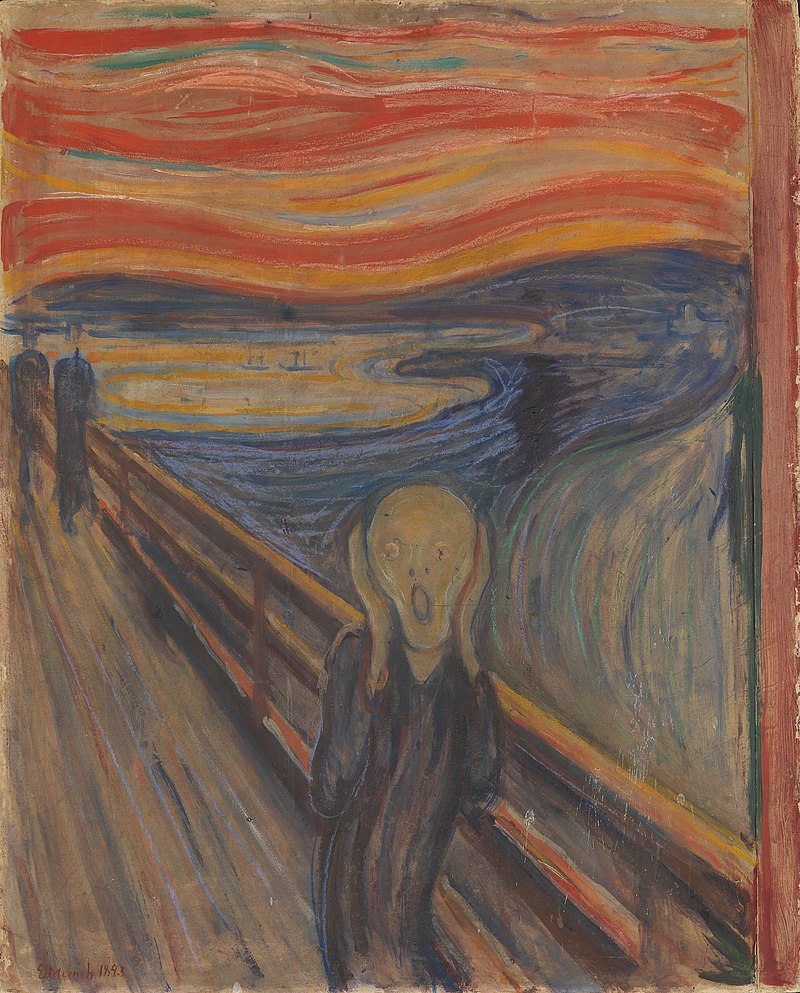
File:Edvard_Munch,_1893,_The_Scream,_oil,_tempera_and_pastel_on_cardboard,_91_x_73_cm,_National_Gallery_of_Norway.jpg · Wikimedia Commons · See Wikimedia Commons
Expressionism
Sign in to savethumb|Ernst Ludwig Kirchner, Czardas Dancers, oil on canvas, 1908/1920, [[Kunstmuseum Den Haag]] Expressionism is a modernist movement, initially in poetry and painting, originating in Northern Europe around the beginning of the 20th century. Its typical trait is to present the world solely from a subjective perspective, distorting it radically for emotional effect in order to evoke moods or ideas. Expressionist artists have sought to express the meaning of emotional experience rather than physical reality.
Expressionism is a modernist movement that started in Northern Europe around 1900, primarily in poetry and painting, where artists deliberately distort reality from their personal perspective to create powerful emotional effects. Rather than trying to show the world as it actually looks, Expressionist artists aim to convey the inner feelings and meanings of emotional experience.
AI-generated from the Wikipedia summary — may contain errors.
Key facts
- Art movement.name
- Expressionism
- Art movement.image
- Edvard Munch, 1893, The Scream, oil, tempera and pastel on cardboard, 91 x 73 cm, National Gallery of Norway.jpg
- Art movement.caption
- Edvard Munch, The Scream, 1893, oil, tempera and pastel on cardboard, 91 × 73 cm, National Gallery of Norway, inspired 20th-century expressionists.
- Art movement.yearsactive
- The years before WWI and the interwar years
- Art movement.country
- Predominantly Germany
- Art movement.influenced
- American Figurative Expressionism, generally, and Boston Expressionism, in particular
- Art movement.majorfigures
- Artists loosely categorized within such groups as Die Brücke, Der Blaue Reiter; the Berlin Secession, the School of Paris and the Dresden Secession
- Art movement.commons
- yes
via Wikipedia infobox
Described at

5.6: Expressionism (1912-1935) - Humanities LibreTexts
At the beginning of the new 20th century, artists in Europe were dissatisfied with the academic standards and style of the art community. They began experimenting with new ideas for the modern world …
human.libretexts.org →At the beginning of the new 20th century, artists in Europe were dissatisfied with the academic standards and style of the art community. They began experimenting with new ideas for the modern world and expanding cities. As part of the European transformations, Expressionism was born in Germany; art charged with emotions and subject matter found in the urban settings. The director of a German museum stated, "The German artist looks not for harmony of outward appearance but much more for the mystery hidden behind the external form. He or she is interested in the soul of things and wants to lay this bare."[[1]]( As part of a pre-World War II change, Expressionism included art, literature, theatre, and music, fueled by young people from Germany and Russia pushing for change in the social and political structures. The movement started at the turn of the century. It continued until the 1930s when the National Socialists (Nazis) grew in power, a government rejecting Expressionism in all forms and condemned it as 'degenerate.' The Post-Impressionists influenced the Expressionists, using bold colors and unusual forms to create expressive, exaggerated images. Instead of duplicating realistic images, the artists wanted to express inner feelings and used simple shapes and broad brushstrokes to illustrate their emotional ideas. Two different groups were dominant in the movement, Die Brucke (the bridge), led by Ernst Ludwig Kirchner, and Der Blaue Reiter (the blue rider), started by Wassily Kandinsky and Franz Marc. The new art styles of Expressionism flourished were displayed in museums and were purchased by collectors. In 1933, after Adolf Hitler was named to head the government, the Nazis started dismantling the artwork and removed 20,000 artworks from the museums owned by the state. "In 1937, 740 modern works were exhibited in the defamatory show Degenerate Art in Munich to 'educate' the public on the 'art of decay.'"[[2]]( The pictures in the exhibit were hung overlapping or askew, and graffiti was written on the walls with crude sayings. The work was defined as blasphemous, art defaming women or art from Jewish or communist artists. The exhibition encouraged the people to see the art as a plot against Germany. Many of the works were subsequently destroyed, sold to make money for the government, or hidden and discovered at a much later date. Ernst Ludwig Kirchner (1880-1938), born in Germany, studied architecture and fine art at one of the experimental art schools. He belonged to the Die Brucke (The Bridge), a group of artists who brought Post-Impressionists and Art Nouveau exhibitions to Germany. The group also started Expressionism at the beginning of the 20th century wanting to pursue nontraditional methods bridging the centuries. With the advent of World War I, he was drafted into the army, then discharged because of a breakdown, and spent time in hospitals. After the war, he went to Berlin, staying in his room, painting; others' images displayed his mental instability. He moved to Switzerland and continued to move in and out of sanitoriums, painting and making woodcuts. By 1920, he improved, and moved to back to Germany with his companion and model. His art was successful until the Nazi party rose to party in Germany, destroyed art, and shut down museums. Kirchner used bold colors and angles, capturing modern city life as viewed in Street, Berlin (5.6.1). The local prostitutes walk down the street, talking, the men looking down, unhappy expressions. When Kirchner formed the bodies, he gave them unusual angles and forms. The dark colors are illuminated by the reflective light of the women's white accessories. The painting was one of a series he made about prostitutes. Paula Modersohn-Becker (1876-1907), born in Germany, is considered one of the essential artists of early Expressionism in Germany. Her artistic ability was recognized when she was younger, and she trained with private instructors before going to Paris multiple
Excerpt from a page describing this subject · 37,849 chars · not written by Vinony
Wikidata facts
- Instance of
- art style
Show 7 more facts
- influenced by
- The Blue Rider
- Commons category
- Expressionism
- topic's main category
- Category:Expressionism
- different from
- expressivism
- start time
- 1900-00-00
- on focus list of Wikimedia project
- Wikipedia:Vital articles/Level/4
via Wikidata · CC0
~28 min read
Encyclopedic overview
21 sectionsContents
- Etymology and history
- Notable Expressionists
- Groups of painters
- The School of Paris
- In the United States
- Representative paintings
- In other arts
- Dance
- Sculpture
- Cinema
- Literature
- Journals
- Drama
- Poetry
- Prose
- Music
- Architecture
- See also
- References
- Further reading
- External links
thumb|Ernst Ludwig Kirchner, Czardas Dancers, oil on canvas, 1908/1920, [[Kunstmuseum Den Haag]] Expressionism is a modernist movement, initially in poetry and painting, originating in Northern Europe around the beginning of the 20th century. Its typical trait is to present the world solely from a subjective perspective, distorting it radically for emotional effect in order to evoke moods or ideas. Expressionist artists have sought to express the meaning of emotional experience rather than physical reality.
Expressionism developed as an avant-garde style before the First World War. It remained popular during the Weimar Republic, particularly in Berlin. The style extended to a wide range of the arts, including expressionist architecture, painting, literature, theatre, dance, film and music. Paris became a gathering place for a group of Expressionist artists, many of Jewish origin, dubbed the School of Paris. After World War II, figurative expressionism influenced artists and styles around the world.
Excerpted from Wikipedia’s “Expressionism” article, available under the CC BY-SA 4.0 licence.
Gallery (22)
Available in 86 languages
- Español
- Français
- Deutsch
- 中文
- 日本語
- Русский
- Português
- Italiano
- العربية
- हिन्दी
- Afrikaans
- Albanian
- Albanian
- Armenian
- Asturian
- Azerbaijani
- Bahasa Indonesia
- Bangla
Show 67 more
- Banjar
- Basque
- be_x_old
- Belarusian
- Bosnian
- Bulgarian
- Catalan
- Cornish
- Croatian
- Czech
- Danish
- Egyptian Arabic
- Esperanto
- Estonian
- Finnish
- Galician
- Georgian
- Greek
- Haitian Creole
- Hebrew
- Hungarian
- Icelandic
- Kazakh
- Kotava
- Kurdish
- Kyrgyz
- Latin
- Latvian
- Lithuanian
- Macedonian
- Malayalam
- Mongolian
- nds_nl
- Nederlands
- Northern Frisian
- Norwegian
- Norwegian Nynorsk
- Occitan
- Ossetic
- Polski
- Punjabi
- Romanian
- Rusyn
- Saterland Frisian
- Serbian
- Serbian (Latin)
- simple
- Sindhi
- Slovak
- Slovenian
- Svenska
- Tajik
- Tatar
- Tiếng Việt
- Türkçe
- Ukrainian
- Urdu
- Uzbek
- Welsh
- Western Frisian
- Western Panjabi
- Wu Chinese
- Zeelandic
- zh_yue
- فارسی
- ไทย
- 한국어
via Wikidata sitelinks · CC0