Described at
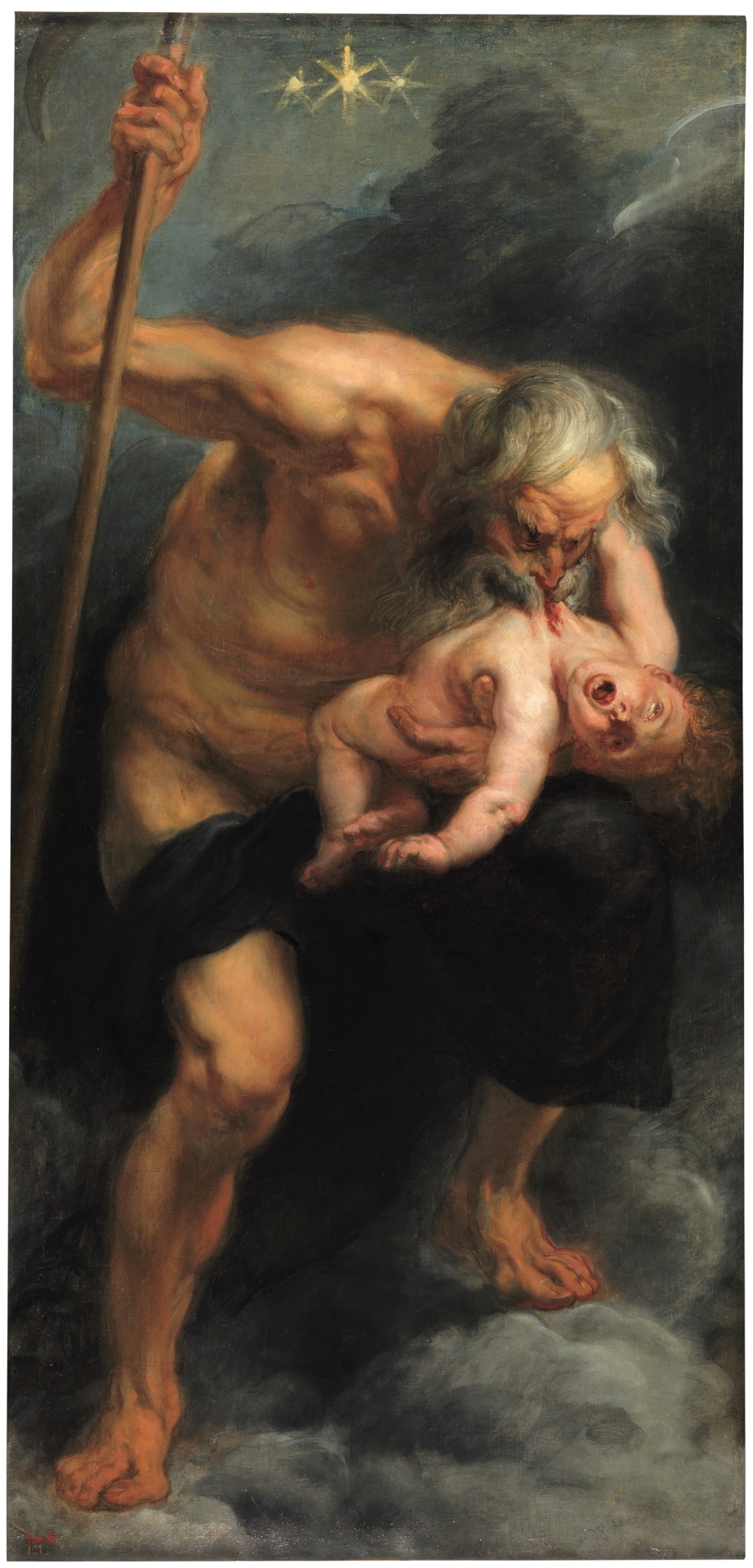
Saturn devouring a Son - The Collection - Museo Nacional del Prado
Portrayed as an old man in accordance with the conventional method that was faithful to prevailing iconographic precepts, in his right hand the god Saturn clasps a scythe, his inveterate attribute, using it to steady himself.
museodelprado.es →The itinerary TITULORECORRIDO has been successfully created. Now you can add in works from the Collection browser Portrayed as an old man in accordance with the conventional method that was faithful to prevailing iconographic precepts, in his right hand the god Saturn clasps a scythe, his inveterate attribute, using it to steady himself. At the same time, with impressive bestial energy, he leans over a boy, into whom he sinks his teeth to devour him, while the defenceless creature attempts to kick himself free, writhing and screaming for help, and directs his anguished gaze at the viewer. The stars in the firmament above the cruel old man remind us that Saturn is also the name given, back in antiquity, to the sixth planet in the Solar System that is visible to the naked eye. However, this is an odd… + Portrayed as an old man in accordance with the conventional method that was faithful to prevailing iconographic precepts, in his right hand the god Saturn clasps a scythe, his inveterate attribute, using it to steady himself. At the same time, with impressive bestial energy, he leans over a boy, into whom he sinks his teeth to devour him, while the defenceless creature attempts to kick himself free, writhing and screaming for help, and directs his anguished gaze at the viewer. The stars in the firmament above the cruel old man remind us that Saturn is also the name given, back in antiquity, to the sixth planet in the Solar System that is visible to the naked eye. However, this is an odd arrangement: beside the main gleam of light are two smaller stars whose presence is not quite clear. It is now known that Saturn is surrounded by a ring that can only be seen with a telescope. When Galileo Galilei discovered this phenomenon in 1610, he believed that the ring was two satellites positioned on either side. Was perhaps Rubens familiar with this interpretation? Certainly, the painter followed all the advances of his age with extreme interest; however, this hypothesis would have to be examined at length in order to be given serious consideration. Even so, the idea is not far-fetched, as Rubens was in the Eternal City during the period in which the famous sage worked. Saturn was also the ancient Italic god of agriculture. And in very ancient times he was identified with Cronos , the son of Uranus) and Gaea) , the personification of Time , and with the Greek god of the same name, the youngest of the Titans. He and his wife Rhea) reigned on Earth, which was then enjoying the benefits of a splendid Golden Age . To prevent his sons from seizing the throne from him, as he himself had done with his father, he decided to kill them all by devouring them as soon as they were born. The desperate Rhea) devised a plot: when she gave birth to a new son, Zeus , she handed her husband a rock wrapped in swaddling cloths instead of the newborn. The trusting Saturn gobbled up the rock without discovering the trick, while the baby was hidden on the island of Crete . Later, when Zeus was a man, he defeated his father and forced him to vomit his offspring, earlier victims of his repulsive cannibalism, and expelled him from Olympus. The vengeful deity thus fled to the Italic Peninsula, where he was welcomed as god of fertility and agriculture. One of the best examples of the account of this peculiar legend is found in Ovid´s Fasti) . This painting is one of the works executed by the master himself and belongs to the series of large mythological paintings produced between 1636 and 1637, many of which are housed in the Museo del Prado . The set was painted to decorate the Torre de la Parada , the hunting lodge used by Philip IV in the Monte del Pardo woodlands just outside Madrid . Decades later the splendid paintings became dispersed among other palaces belonging to the Spanish Crown as new residences were built and older ones renovated. The style is an excellent example of the accomplished, brilliant mature period of Rubens , who succeeds in hinting at the
Excerpt from a page describing this subject · 40,000 chars · not written by Vinony
Wikidata facts
- Instance of
- painting
- Country
- Spain
- Owned by
- Ferdinand VII of Spain
- Depicts
- Poseidon
- Material used
- canvas
- Creator
- Peter Paul Rubens
- Collection
- Museo del Prado
- Location
- Royal Palace of Madrid
- Image
- Rubens saturn.jpg
- Height
- 182.5
- Width
- 87
Show 8 more facts
- inception
- 1637-00-00
- described at URL
- www.museodelprado.es/en/the-collection/art-work/saturn-devouring-a-son/d022fed3-6069-4786-b59f-4399a2d74e50
- Commons category
- Saturn devouring a Son (Rubens - Museo del Prado)
- inventory number
- P001678
- catalog code
- 476
- copyright status
- public domain
- title
- Saturn (Ovid, Fasti, IV, 197-200)
- depicts Iconclass notation
- 91B111412
via Wikidata · CC0