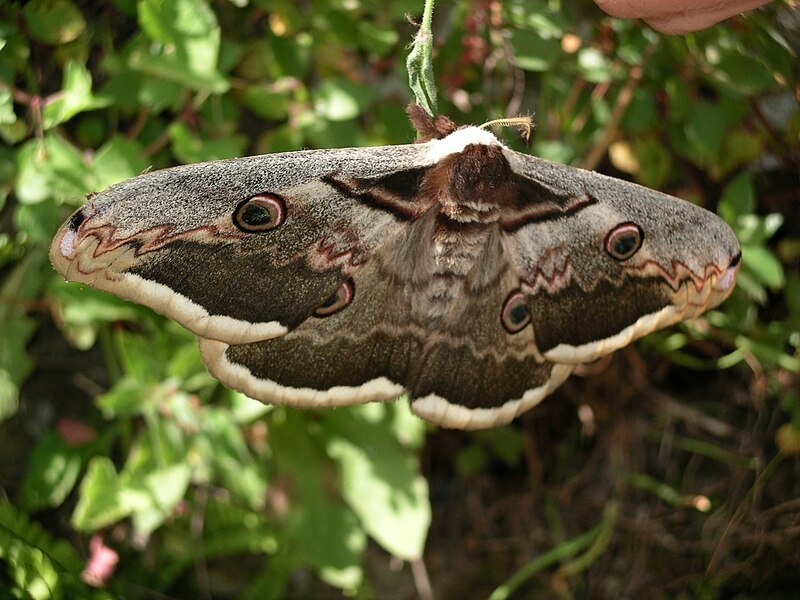
File:Saturnia_pyri.jpg · Wikimedia Commons · See Wikimedia Commons
Saturnia pyri
Sign in to saveAlso known as giant peacock moth, great peacock moth, giant emperor moth, Viennese emperor
species of insect
OverviewAI-generated
Saturnia pyri, also referred to by the common names gaint peacock moth, grote nachtpauwoog, and ymerawdwr y gellyg, is a species within the genus Saturnia. It belongs to the family Saturniidae in the order Lepidoptera, class Insecta, phylum Arthropoda, and kingdom Animalia. The species utilizes Juglans regia, Malus, Populus, and Fraxinus as host plants.
Records for this taxon are held by institutions including UMNH, RBINS-SCIENTIFIC HERITAGE, YPM, DMNS, and LACM. Occurrence data indicates presence in Spain, Israel, Hungary, Austria, and Turkey. The species is referenced by 30 other encyclopedia articles.
Synthesized by Vinony from 23 facts across 5 sources: Wikidata, GBIF, Gbif Occ, iDigBio, Vinony graph. Generated from structured data (not the Wikipedia text) and checked against those facts — may still contain errors.
Species
SPECIES
- KingdomAnimalia
- PhylumArthropoda
- ClassInsecta
- OrderLepidoptera
- FamilySaturniidae
via GBIF
Museum specimens
- Specimen records
- 61
- With media
- 4
- Family
- Saturniidae
- Collections
- UMNH, RBINS-SCIENTIFIC HERITAGE, YPM, DMNS, LACM, CLEVELAND MUSEUM OF NATURAL HISTORY, OH (CLEV)
- Recorded in
- Spain, Israel, Hungary, Austria, Turkey, France, Italy, Croatia
Wikidata facts
Show 7 more facts
via Wikidata · CC0
~1 min read
Encyclopedic overview
Saturnia pyri, the giant peacock moth, great peacock moth, giant emperor moth or Viennese emperor, is a Saturniid moth which is native to Europe. The species was first described by Michael Denis and Ignaz Schiffermüller in 1775. It is the largest European moth, with a wingspan reaching 15–20 cm (6–8 in).
The giant peacock moth has a range that includes the Iberian Peninsula, southern France, northern Hungary, central and southern Serbia, Croatia, Montenegro, southern and eastern Bulgaria, southern Greece southern Turkey, south Kyrgyzstan, western Syria, Lebanon, north Israel, southern Romania, Russia, Ukraine, Czech Republic, Slovak Republic, Slovenia, North Macedonia and Italy and extends into Siberia and North Africa. It is absent from the UK, though a small handful of individuals have been recorded, likely of captive origin.
Excerpted from Wikipedia’s “Saturnia pyri” article, available under the CC BY-SA 4.0 licence.