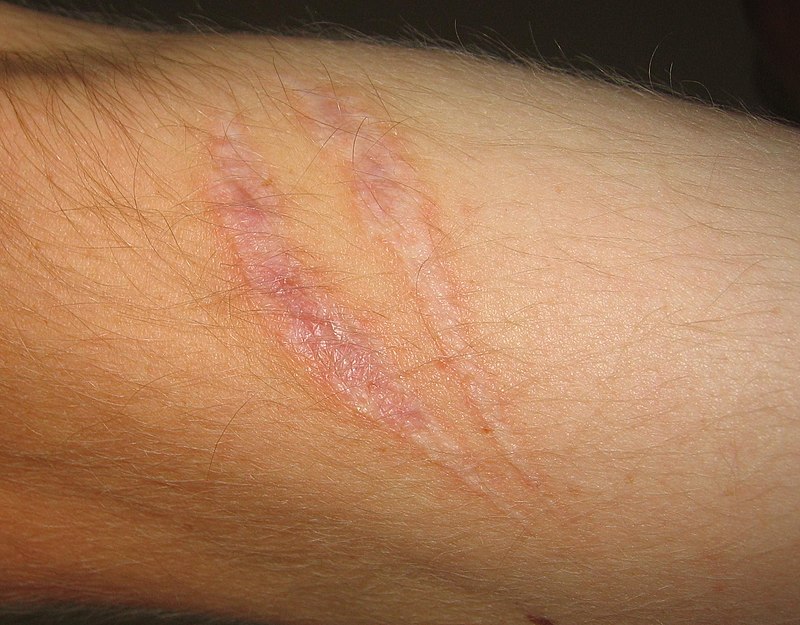
File:Scar_(xndr).jpg · Wikimedia Commons · See Wikimedia Commons
scar
Sign in to saveAlso known as scars, cicatrix, scarring
A scar (or scar tissue) is an area of fibrous tissue that replaces normal skin following an injury. Scars result from the biological process of wound repair in the skin, as well as in other organs and tissues of the body. Thus, scarring is a natural part of the healing process. With the exception of very minor lesions, every wound (for example, after an accident, disease, or surgery) results in some degree of scarring. An exception is animals with complete regeneration, which regrow tissue without scar formation. Scar tissue is composed of the same protein (collagen) as the tissue that it repl
A scar is an area of fibrous tissue that forms when your body heals a wound from an injury, disease, or surgery. Scarring matters because it's a normal and unavoidable part of how your body repairs itself, though the scar tissue looks and feels different from your original skin.
AI-generated from the Wikipedia summary — may contain errors.
Key facts
- Medical condition (new).name
- Scar
- Medical condition (new).synonyms
- Cicatrix
- Medical condition (new).image
- File:Scar (xndr).jpg
- Medical condition (new).caption
- Scar tissue on an arm
- Medical condition (new).field
- Dermatology, plastic surgery
via Wikipedia infobox
Research
93,297 papersvia PubMed
Wikidata facts
- Subclass of
- tissue
- Image
- Scar (xndr).jpg
Show 8 more facts
- Commons category
- Scars
- health specialty
- dermatology
- different from
- rumen
- exact match
- purl.obolibrary.org/obo/HP_0100699
- described by source
- Brockhaus and Efron Encyclopedic Dictionary
- NCI Thesaurus ID
- C34483
- topic's main category
- Category:Scarring
- hashtag
- scar
via Wikidata · CC0
~20 min read
Encyclopedic overview
29 sectionsContents
- Types
- Hypertrophic
- Keloid
- Atrophic
- Stretch marks
- Umbilical
- Pathophysiology
- Collagen synthesis
- Fibroblasts
- Myofibroblast
- Mechanical stress
- Treatment
- Chemical peels
- Filler injections
- Laser treatment
- Radiotherapy
- Dressings and topical silicone
- Verapamil-containing silicone gel
- Steroids
- Surgery
- Vitamins
- Other
- Society and culture
- Intentional scarring
- Etymology
- Research
- See also
- References
- External links
A scar (or scar tissue) is an area of fibrous tissue that replaces normal skin following an injury. Scars result from the biological process of wound repair in the skin, as well as in other organs and tissues of the body. Thus, scarring is a natural part of the healing process. With the exception of very minor lesions, every wound (for example, after an accident, disease, or surgery) results in some degree of scarring. An exception is animals with complete regeneration, which regrow tissue without scar formation. Scar tissue is composed of the same protein (collagen) as the tissue that it replaces, but the fiber composition of the protein is different; instead of a random basketweave formation of the collagen fibers found in normal tissue, in fibrosis the collagen cross-links and forms a pronounced alignment in a single direction. This collagen scar tissue alignment is usually of inferior functional quality to the normal collagen randomised alignment. For example, scars in the skin are less resistant to ultraviolet radiation, and sweat glands and hair follicles do not grow back within scar tissues. A myocardial infarction, commonly known as a heart attack, causes scar formation in the heart muscle, which leads to loss of muscular power and possibly heart failure. However, there are some tissues (e.g. bone) that can heal without any structural or functional deterioration.
== Types == thumb|right|Man with visible facial scars All scarring is composed of the same collagen as the tissue it has replaced, but the composition of the scar tissue, compared to the normal tissue, is different. Scar tissue also lacks elasticity unlike normal tissue which distributes fiber elasticity. Scars differ in the amounts of collagen overexpressed. Labels have been applied to the differences in overexpression. Two of the most common types are hypertrophic and keloid scarring, both of which experience excessive stiff collagen bundled growth overextending the tissue, blocking off regeneration of tissues. Another form is atrophic scarring (sunken scarring), which also has an overexpression of collagen blocking regeneration. This scar type is sunken, because the collagen bundles do not overextend the tissue. Stretch marks (striae) are regarded as scars by some.
Excerpted from Wikipedia’s “scar” article, available under the CC BY-SA 4.0 licence.