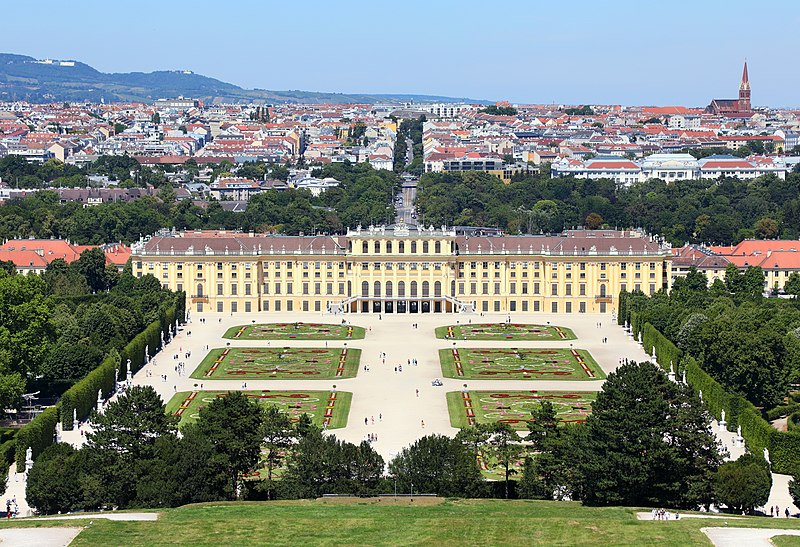
File:Wien_-_Schloss_Schönbrunn.JPG · Wikimedia Commons · See Wikimedia Commons
Schönbrunn Palace is a grand royal residence located in Vienna, Austria, that served as the summer home of the Habsburg emperors. It is one of the most important historical landmarks in Austria and a major tourist attraction that reflects the power and wealth of the Austrian monarchy.
AI-generated from the Wikipedia summary — may contain errors.
Wikidata facts
- Instance of
- royal palace
- Has part
- Palmenhaus Schönbrunn
- Country
- Austria
- Located in
- Hietzing
- Area
- 260.64
- Elevation
- 193
- Owned by
- Leopold I, Holy Roman Emperor
- Official website
- www.schoenbrunn.at
- Image
- Schloss Schönbrunn Wien 2014 (Zuschnitt 2).jpg
Show 11 more facts
- hashtag
- SchlossSchönbrunn
- Commons category
- Palace of Schönbrunn
- topic's main category
- Category:Schönbrunn Palace
- architect
- Nicolò Pacassi
- inception
- 1638-01-01
- Commons Institution page
- Schönbrunn Palace
- architectural style
- baroque architecture
- street address
- Schönbrunner Schloßstraße 47
- commissioned by
- Leopold I, Holy Roman Emperor
- native label
- Schloss Schönbrunn
- P12749
- Nelson Prudêncio
Sources (10)
via Wikidata · CC0
~11 min read
Encyclopedic overview
Schönbrunn Palace (German: Schloss Schönbrunn [ˈʃlɔs ʃøːnˈbʁʊn] ) was the main summer residence of the Habsburg rulers, located in Hietzing, the 13th district of Vienna. The name Schönbrunn (meaning "beautiful spring") has its roots in an artesian well from which water was consumed by the court.
The 1,441-room Baroque palace is one of the most important architectural, cultural, and historic monuments in the country. The history of the palace and its vast gardens spans over 300 years, reflecting the changing tastes, interests, and aspirations of successive Habsburg monarchs. It has been a major tourist attraction since the mid-1950s.
Excerpted from Wikipedia’s “Schönbrunn Palace” article, available under the CC BY-SA 4.0 licence.
Gallery (12)
On the map
Available in 63 languages
- Español
- Français
- Deutsch
- 中文
- 日本語
- Русский
- Português
- Italiano
- العربية
- Aragonese
- Armenian
- Azerbaijani
- Bahasa Indonesia
- Bashkir
- Basque
- Bavarian
- be_x_old
- Belarusian
Show 44 more
- Bosnian
- Breton
- Bulgarian
- Catalan
- Croatian
- Czech
- Danish
- Esperanto
- Estonian
- Finnish
- Georgian
- Greek
- Hebrew
- Hungarian
- Ido
- Irish
- Javanese
- Latin
- Latvian
- Lithuanian
- Macedonian
- Maltese
- Nederlands
- Norwegian
- Piedmontese
- Polski
- Punjabi
- Romanian
- Scots
- Serbian
- Serbian (Latin)
- simple
- Slovak
- Slovenian
- Svenska
- Tiếng Việt
- Türkçe
- Ukrainian
- Waray
- Wu Chinese
- zh_yue
- فارسی
- ไทย
- 한국어
via Wikidata sitelinks · CC0