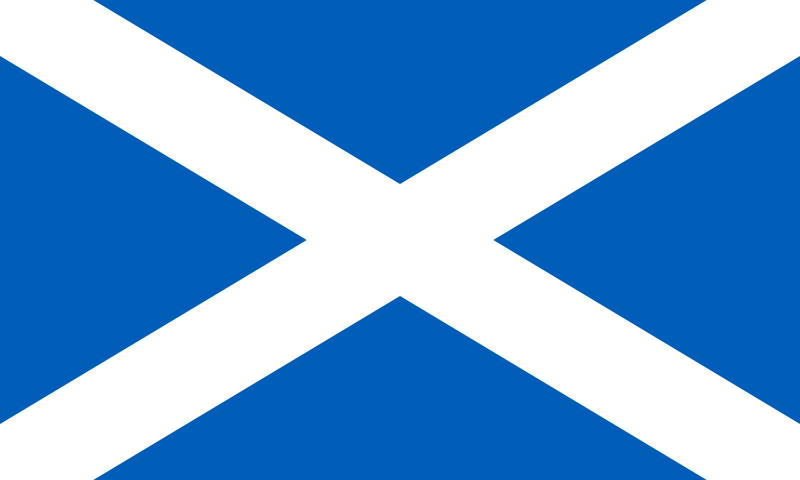
File:Flag_of_Scotland.svg · Wikimedia Commons · See Wikimedia Commons
Scotland
Sign in to saveAlso known as Alba, Scotland, United Kingdom, SCT, Caledonia, Scot, SC, UK-SC, UK-SCT
<!--
OverviewAI-generated
Scotland is a constituent country of the United Kingdom and a nation located in Europe. It shares a border with England and has an inception date of 843. The subject replaces the Kingdom of Scotland. Its native labels are Scotland and Alba. The head of state holds the office of monarch of the United Kingdom. The legislative body is the Scottish Parliament.
The population is 5404700. The currency is pound sterling. Official languages include English language, Scottish Gaelic, and Scots. The patron saint is Andrew the Apostle. The motto is In My Defens God Me Defend, and the anthem is Flower of Scotland. The top-level Internet domain is .scot. The topic’s main Wikimedia portal is Portal:Scotland.
Synthesized by Vinony from 26 facts across 4 sources: Wikidata, PubMed, Vinony graph, Geo. Generated from structured data (not the Wikipedia text) and checked against those facts — may still contain errors.
Key facts
- UK country.image_flag
- Flag of Scotland.svg
- UK country.image_coat
- Coat of arms of the United Kingdom in Scotland (2022).svg
- UK country.symbol_type
- Coat of arms
- UK country.national_anthem
- various, predominantly "Flower of Scotland"
- UK country.status
- Country
- UK country.capital
- Edinburgh
- UK country.largest_city
- Glasgow
- UK country.languages_type
- Official languages
- UK country.languages2_type
- Recognised minority languages
- UK country.languages2
- British Sign Language
- UK country.ethnic_groups_year
- 2022
- UK country.religion_year
- 2022
- UK country.demonym
- ScottishScots
- UK country.legal_jurisdiction
- Scots law
- UK country.government_type
- Devolved parliamentary legislature within a parliamentary constitutional monarchy
- UK country.monarch
- Charles III
- UK country.first_minister
- John Swinney
- UK country.secretary_of_state
- Douglas Alexander
via Wikipedia infobox
Research
200,018 papers- Scotland's alcohol crisis: A clinician's perspective on a public health emergency.ReviewThe journal of the Royal College of Physicians of Edinburgh · 2023MacGilchrist ADOI: 10.1177/14782715221146607
- Thrombosis in Scotland, 1800-1960.ReviewThe journal of the Royal College of Physicians of Edinburgh · 2022Lowe GDOI: 10.1177/14782715221107949
- Sobering assessment of Scotland's NHS.BMJ (Clinical research ed.) · 2024McCartney G, Craig NDOI: 10.1136/bmj.q602
- Scotland's public health palliative care alliance.ReviewAnnals of palliative medicine · 2018Hazelwood MA, Patterson RMDOI: 10.21037/apm.2018.03.13
- SARS-CoV-2 RNA levels in Scotland's wastewater.Scientific data · 2022Scorza LCT, Cameron GJ, Murray-Williams R et al.DOI: 10.1038/s41597-022-01788-3
- Scotland's National Naloxone Programme.Lancet (London, England) · 2019Bird SM, McAuley ADOI: 10.1016/S0140-6736(18)33065-4
- Sharing Scotland's HIV story through blood, sweat, and tears.The lancet. HIV · 2024Ranscombe PDOI: 10.1016/S2352-3018(23)00208-4
- Generation Scotland: an update on Scotland's longitudinal family health study.BMJ open · 2024Milbourn H, McCartney D, Richmond A et al.DOI: 10.1136/bmjopen-2024-084719
via PubMed
Key dates
- Inception
- 843
via Wikidata · CC0
~100 min read
Encyclopedic overview
47 sectionsContents
- Etymology
- History
- Prehistory
- Early history
- Kingdom of Scotland
- Wars of Scottish Independence
- Union of the Crowns
- Treaty of Union
- Industrial age and the Scottish Enlightenment
- World wars and Scotland Act 1998
- 21st century
- Geography
- Geology and geomorphology
- Climate
- Flora and fauna
- Government and politics
- Diplomacy and relations
- Devolution and independence
- Local government
- Military
- Law and order
- Economy
- Income and poverty
- Currency
- Infrastructure and transportation
- Science, technology and energy
- Demographics
- Population
- Urbanisation
- Languages
- Religion
- Education
- Health
- Culture
- World Heritage Sites
- Celtic connections
- Literature and media
- Music
- Cuisine
- Sports
- National identity
- See also
- Notes
- References
- Sources
- Further reading
- External links
Scotland is a country that is part of the United Kingdom. It contains nearly one-third of the United Kingdom's land area, consisting of the northern part of the island of Great Britain and more than 790 adjacent islands, principally in the archipelagos of the Hebrides and the Northern Isles. In 2022, the country's population was about 5.4 million. Its capital city is Edinburgh, whilst Glasgow is the largest city and the most populous of the cities of Scotland. Scotland shares a land border with England to the south-east and is surrounded by the Atlantic Ocean to the north and west, the North Sea to the north-east and east, and the Irish Sea to the south. The legislature, the Scottish Parliament, elects 129 members to represent 73 constituencies. The Scottish Government is the executive arm of the devolved government, headed by the first minister, who chairs the cabinet and is responsible for government policy and international engagement.
The Kingdom of Scotland emerged as a sovereign state in the 9th century. Independence from England was maintained partly through an alliance with France. In 1603, James VI succeeded to the thrones of England and Ireland, forming a personal union of the three kingdoms. On 1 May 1707, Scotland and England combined to create the new Kingdom of Great Britain, with the Parliament of Scotland subsumed into the Parliament of Great Britain. In 1999, a Scottish Parliament was re-established, and has devolved authority over many areas of domestic policy. The country has its own distinct legal system, education system and religious history, which have all contributed to the continuation of Scottish culture and national identity. Scottish English and Scots are the most widely spoken languages in the country, existing on a dialect continuum with each other. Scottish Gaelic speakers can be found all over Scotland, but the language is largely spoken natively by communities within the Hebrides; Gaelic speakers now constitute less than 2% of the total population, although state-sponsored revitalisation attempts have led to a growing community of second language speakers.
Excerpted from Wikipedia’s “Scotland” article, available under the CC BY-SA 4.0 licence.
Gallery (52)
On the map
9 mapped locations
Available in 224 languages
- Español
- Français
- Deutsch
- 中文
- 日本語
- Русский
- Português
- Italiano
- العربية
- हिन्दी
- abstract
- Afrikaans
- Albanian
- Albanian
- Amharic
- Angika
- Aragonese
- Armenian
Show 205 more
- Asturian
- Aymara
- azb
- Azerbaijani
- Bahasa Indonesia
- Balinese
- Bangla
- Bashkir
- Basque
- bat_smg
- Bavarian
- be_x_old
- Belarusian
- Betawi
- Bhojpuri
- Bikol
- blk
- Bosnian
- Breton
- btm
- Bulgarian
- Buriat
- Burmese
- Catalan
- cbk_zam
- cdo
- Cebuano
- Central Kurdish
- Chechen
- Chuvash
- Colognian
- Cornish
- Corsican
- Croatian
- Czech
- Danish
- dty
- Dzongkha
- Egyptian Arabic
- eml
- Esperanto
- Estonian
- Extremaduran
- Faroese
- Fiji Hindi
- Fijian
- Filipino
- Finnish
- fiu_vro
- Galician
- Georgian
- Gilaki
- Goan Konkani
- Gothic
- Greek
- Guarani
- Haitian Creole
- Hakka Chinese
- Hausa
- Hawaiian
- Hebrew
- Hungarian
- hyw
- Icelandic
- Ido
- Iloko
- Inari Sami
- Interlingua
- Interlingue
- Irish
- Javanese
- Kabardian
- Kabyle
- Kannada
- Kanuri
- Kara-Kalpak
- Karachay-Balkar
- Kashmiri
- Kashubian
- Kazakh
- kbp
- kge
- Khmer
- Komi
- Kurdish
- Kyrgyz
- Ladino
- Lao
- Latin
- Latvian
- Ligurian
- Limburgish
- Lingala
- Lingua Franca Nova
- Lithuanian
- lld
- Lombard
- Low German
- Lower Sorbian
- Luxembourgish
- Macedonian
- Malagasy
- Malay
- Malayalam
- Maltese
- Manipuri
- Manx
- Māori
- Marathi
- Mazanderani
- Minangkabau
- Mingrelian
- Mirandese
- mnw
- Mongolian
- Moroccan Arabic
- nds_nl
- Nederlands
- Nepali
- Northern Frisian
- Norwegian
- Norwegian Nynorsk
- Novial
- nrm
- Occitan
- Old English
- Ossetic
- Pampanga
- Papiamento
- Pashto
- Picard
- Piedmontese
- Polski
- Punjabi
- Quechua
- roa_rup
- Romanian
- Romansh
- Rusyn
- Samoan
- Santali
- Sardinian
- Saterland Frisian
- Scots
- Scottish Gaelic
- Serbian
- Serbian (Latin)
- Shan
- Shona
- Sicilian
- Silesian
- simple
- Sindhi
- Sinhala
- Slovak
- Slovenian
- Somali
- Sundanese
- Svenska
- Swahili
- Swati
- Tachelhit
- Tajik
- Talysh
- Tamil
- Tatar
- Telugu
- Tetum
- Tibetan
- Tiếng Việt
- Tok Pisin
- Toki Pona
- Tongan
- Türkçe
- Turkmen
- Tyap
- Udmurt
- Ukrainian
- Upper Sorbian
- Urdu
- Uyghur
- Uzbek
- Venetian
- Veps
- Volapük
- Walloon
- Waray
- Welsh
- West Flemish
- Western Frisian
- Western Panjabi
- Wu Chinese
- Xhosa
- Yakut
- Yiddish
- Yoruba
- Zaza
- Zeelandic
- zh_classical
- zh_min_nan
- zh_yue
- Zulu
- فارسی
- ไทย
- 한국어
via Wikidata sitelinks · CC0