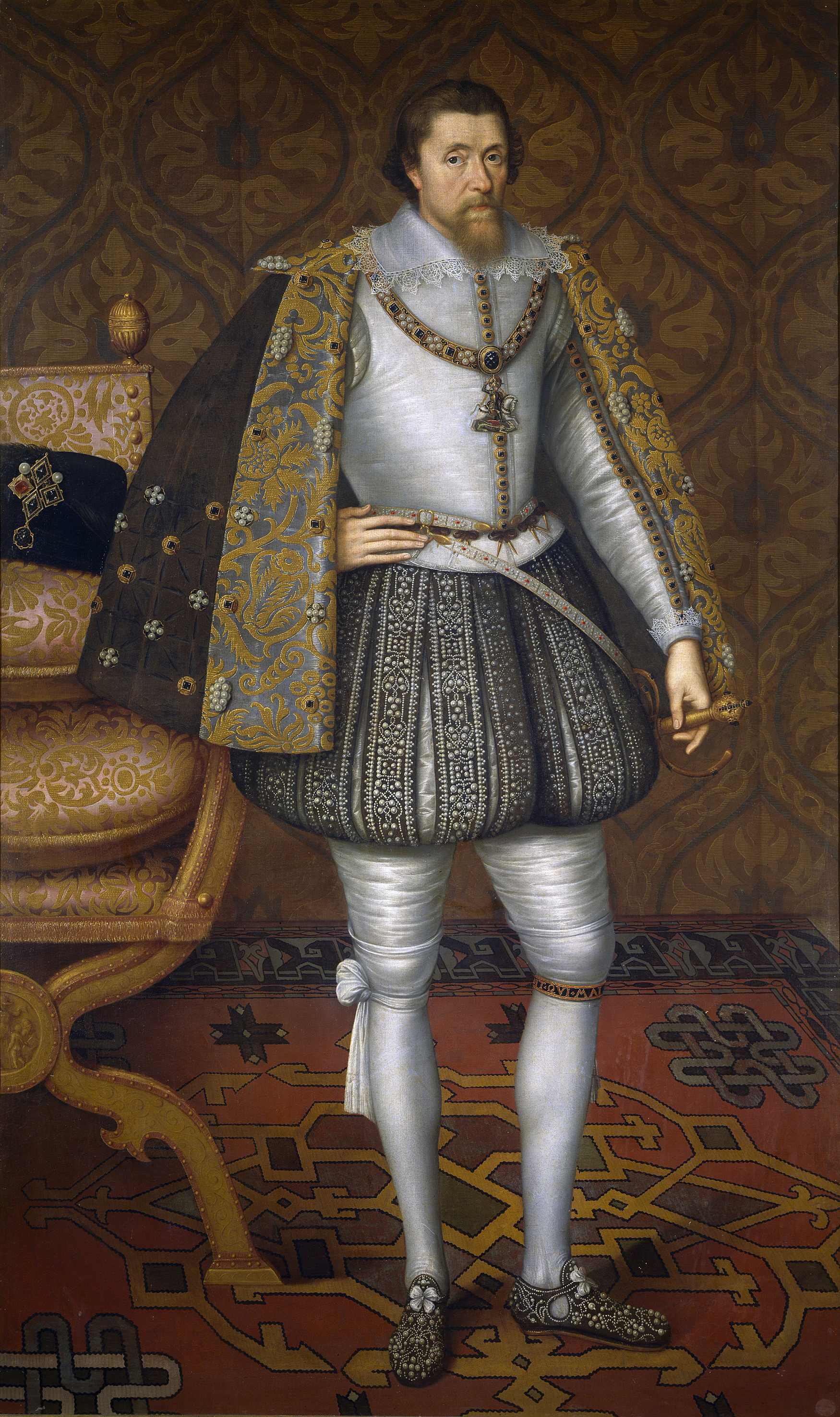
James VI and I
Sign in to saveAlso known as James VI of Scotland, James I of England, James I and VI, C. Philopatris, James I and James VI, James VI of Scotland and I of England, James I, James, King of England and Scotland Jame
James VI and I was King of Scotland as James VI from 24 July 1567, and King of England and Ireland as James I from the union of the Scottish and English crowns on 24 March 1603, until his death in 1625. Though he long attempted to get both countries to adopt a closer political union, the kingdoms of Scotland and England remained sovereign states ruled by James in personal union, with their own parliaments, judiciaries and laws.
OverviewAI-generated
James VI and I was a male monarch, poet, writer, and aristocrat who held the titles of monarch of Scotland, monarch of England, and Duke of Rothesay. Born in 1566 to Mary, Queen of Scots, and Henry Stuart, Lord Darnley, he was a member of the royal social classification. His religious worldview included Anglicanism and the Church of Scotland. He was married to Anne of Denmark, and their children included Henry Frederick, Prince of Wales, Elizabeth Stuart, Queen of Bohemia, Margaret Stuart, and Charles I of England.
He died of dysentery and kidney failure at Theobalds House in 1625, with natural causes recorded as the manner of death. His remains were interred at Westminster Abbey. As an author, he produced works such as *Apologia pro iuramento fidelitatis*, *Triplici nodo, triplex cuneus*, and *A treatise written by Mr. Doctour Carier*. He is described in sources including the *Brockhaus and Efron Encyclopedic Dictionary*, *The Nuttall Encyclopædia*, and the *Encyclopædia Britannica* 11th edition.
Synthesized by Vinony from 26 facts across 2 sources: Wikidata, Open Library. Generated from structured data (not the Wikipedia text) and checked against those facts — may still contain errors.
Person · Open Library
- Born
- 1566
- Died
- 1625
- Works
- 283
Top works
- By the King. The spreading of the infection in our citie of London, and in the places next about it, doeth give us iust cause to be as provident as a carefull prince can bee, to take away all occasion of increasing the same
- Apologia pro iuramento fidelitatis
- Triplici nodo, triplex cuneus
- Lettre dy roy d'Angleterre a Madame la princesse de Condé
- The Lepanto of James the sixt, king of Scotland
via Open Library + Wikidata
Wikipedia views (30d)
195,100 totalvia Wikimedia Pageviews API
Wikidata facts
- Instance of
- human
- Given name
- James
- Gender
- male
- Citizenship
- United Kingdom
- Place of birth
- Edinburgh Castle
- Place of death
- Theobalds House
- Spouse
- Anne of Denmark
- Child
- Jacob Kettler
- Mother
- Mary, Queen of Scots
- Occupation
- aristocrat
- Position held
- Duke of Rothesay
- Educated at
- tutor
- Languages spoken
- English language
- Native language
- Scots
- Religion
- Church of Scotland
- Noble title
- Duke of Albany
- Image
- John de Critz - James VI and I, 1566 - 1625. King of Scotland 1567 - 1625. King of England and Ireland 1603 - 1625 - PG 561 - National Galleries of Scotland.jpg
- Work location
- London
- Residence
- Stirling Castle
Show 22 more facts
- place of burial
- Westminster Abbey
- Commons category
- James I of England
- date of birth
- 1566-06-19
- date of death
- 1625-03-27
- topic's main category
- Category:James VI and I
- Commons Creator page
- James I of England
- described by source
- Encyclopædia Britannica 11th edition
- Commons gallery
- James I of England
- cause of death
- kidney failure
- honorific prefix
- Majesty
- social classification
- royalty
- different from
- James Stuart
- manner of death
- natural causes
- writing language
- English language
- date of baptism
- 1566-12-17
- godparent
- Emanuele Filiberto I, Duke of Savoy
- medical condition
- dysentery
- ethnic group
- Scottish people
- name in native language
- James I (VI)
- on focus list of Wikimedia project
- Wikipedia:Vital articles/Level/4
- P8168
- apothem
- P12749
- Argentine Air Force
Sources (6)
via Wikidata · CC0
~40 min read
Encyclopedic overview
HouseStuart FatherHenry Stuart, Lord Darnley MotherMary, Queen of Scots Signature
James VI and I (James Charles Stuart; 19 June 1566 – 27 March 1625) was King of Scotland as James VI from 24 July 1567, and King of England and Ireland as James I from the union of the Scottish and English crowns on 24 March 1603, until his death in 1625. Though he long attempted to get both countries to adopt a closer political union, the kingdoms of Scotland and England remained sovereign states ruled by James in personal union, with their own parliaments, judiciaries and laws.
Excerpted from Wikipedia’s “James VI and I” article, available under the CC BY-SA 4.0 licence.
Gallery (13)
Available in 87 languages
- Español
- Français
- Deutsch
- 中文
- 日本語
- Русский
- Português
- Italiano
- العربية
- हिन्दी
- Afrikaans
- Albanian
- Armenian
- Asturian
- azb
- Azerbaijani
- Bahasa Indonesia
- Basque
Show 68 more
- Belarusian
- Bosnian
- Breton
- Bulgarian
- Catalan
- Central Kurdish
- Cornish
- Croatian
- Czech
- Danish
- Egyptian Arabic
- Esperanto
- Estonian
- Finnish
- Galician
- Georgian
- Greek
- Hausa
- Hebrew
- Hungarian
- Icelandic
- Ido
- Interlingua
- Irish
- Javanese
- Latin
- Latvian
- Lithuanian
- Luxembourgish
- Macedonian
- Malagasy
- Malay
- Malayalam
- Marathi
- Nederlands
- Northern Frisian
- Norwegian
- Norwegian Nynorsk
- Occitan
- Old English
- Pashto
- Polski
- Romanian
- Sanskrit
- Scots
- Scottish Gaelic
- Serbian
- Serbian (Latin)
- simple
- Slovak
- Slovenian
- Svenska
- Tamil
- Tiếng Việt
- Türkçe
- Tyap
- Ukrainian
- Urdu
- Waray
- Welsh
- Western Frisian
- Western Panjabi
- Wu Chinese
- zh_min_nan
- zh_yue
- فارسی
- ไทย
- 한국어
via Wikidata sitelinks · CC0