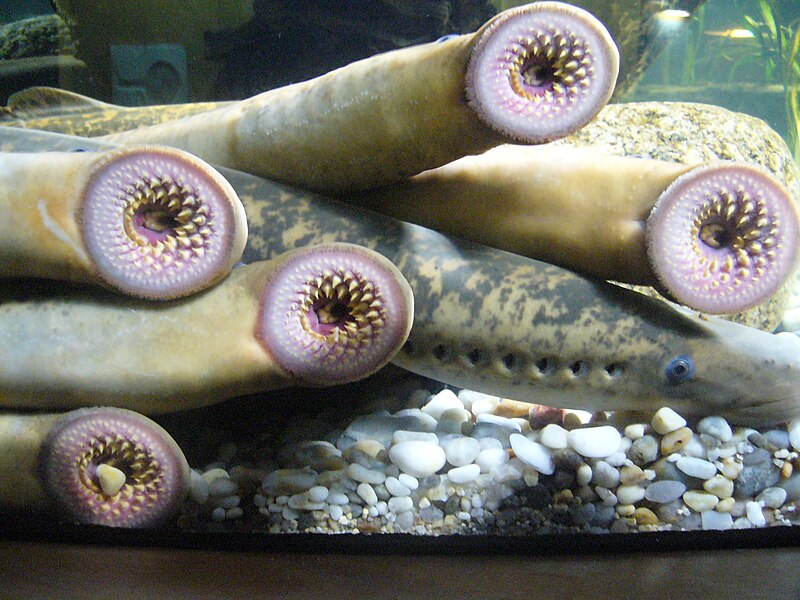
File:Petromyzon_marinus.001_-_Aquarium_Finisterrae.jpg · Wikimedia Commons · See Wikimedia Commons
OverviewAI-generated
The sea lamprey, scientifically named *Petromyzon marinus*, is a species within the family Petromyzontidae. It belongs to the order Petromyzontiformes and the class Petromyzonti, under the phylum Chordata. The species was described by Linnaeus in 1758 and is also referred to as the great sea lamprey. Its parent taxon is *Petromyzon*.
This organism inhabits marine, brackish, and freshwater environments. According to the IUCN Red List, its conservation status was assessed as Least Concern in 2024. However, it holds a regional conservation status of Critically Endangered. The taxon name is accepted, and the species has a sequenced genome.
Synthesized by Vinony from 31 facts across 6 sources: Wikidata, GBIF, Gbif Occ, WoRMS, IUCN Red List, Vinony graph. Generated from structured data (not the Wikipedia text) and checked against those facts — may still contain errors.
Species
Least Concerngreat sea lamprey
GENUS
- KingdomAnimalia
- PhylumArthropoda
- ClassInsecta
- OrderLepidoptera
- FamilyNymphalidae
via GBIF · IUCN
Wikidata facts
- Instance of
- taxon
- Parent taxon
- Petromyzon
- Image
- Petromyzon marinus.001 - Aquarium Finisterrae.jpg
Show 9 more facts
- taxon rank
- species
- IUCN conservation status
- Least Concern
- taxon name
- Petromyzon marinus
- Commons category
- Petromyzon marinus
- Commons gallery
- Petromyzon marinus
- taxon common name
- morski piškur
- sequenced genome URL
- www.ensembl.org/Petromyzon_marinus
- short name
- P. marinus
- regional conservation status
- Critically Endangered
Sources (9)
via Wikidata · CC0
~13 min read
Encyclopedic overview
The sea lamprey (Petromyzon marinus) is a parasitic lamprey native to the Northern Hemisphere. It is sometimes referred to as the "vampire fish".
It was likely introduced to the Great Lakes region through the Erie Canal in 1825 and the Welland Canal in 1919 where it has attacked native fish such as lake trout, lake whitefish, chub, and lake herring. Sea lampreys are considered a pest in the Great Lakes region as each individual has the potential of killing 40 pounds of fish through its 12–18 month feeding period.
Excerpted from Wikipedia’s “sea lamprey” article, available under the CC BY-SA 4.0 licence.