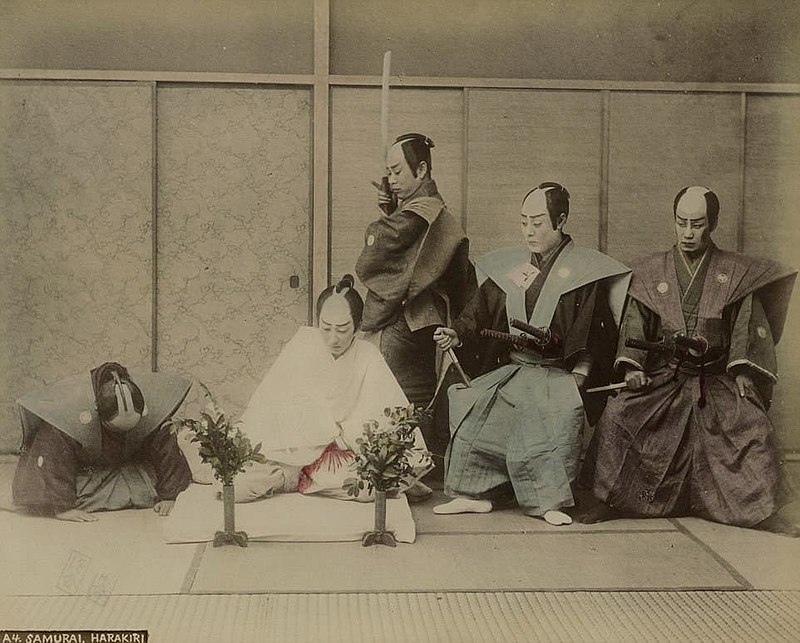
File:Seppuku.jpg · Wikimedia Commons · See Wikimedia Commons
seppuku
Sign in to saveAlso known as harakiri, hari-kari, Hari-Kari
, also called , is a form of Japanese ritualistic suicide by disembowelment. It was originally reserved for samurai in their code of honor, but was also practiced by other Japanese people during the Shōwa era (particularly officers near the end of World War II) to restore honor for themselves or for their families. thumb|Staged seppuku with ritual attire and kaishakunin assistant, 1897 |upright=1.2
Seppuku is a form of ritualistic suicide by disembowelment that originated in Japan's samurai code of honor. While originally reserved for samurai, it was also practiced by other Japanese people during the Shōwa era, particularly by military officers near the end of World War II, as a way to restore honor for themselves or their families.
AI-generated from the Wikipedia summary — may contain errors.
Key facts
- Chinese.title
- Seppuku
- Chinese.pic
- Seppuku (Chinese characters).svg
- Chinese.piccap
- "Seppuku" in kanji
- Chinese.picupright
- 0.35
- Chinese.kanji
- 切腹
- Chinese.romaji
- Seppuku
- Chinese.hiragana
- せっぷく
- Chinese.katakana
- セップク
via Wikipedia infobox
Wikidata facts
- Instance of
- Suicide methods
- Image
- Seppuku-2.jpg
Show 5 more facts
- Commons category
- Seppuku
- topic's main category
- Category:Suicide by seppuku
- described by source
- New International Encyclopedia
- native label
- 腹切り
- uses
- tantō
Sources (3)
via Wikidata · CC0
~22 min read
Encyclopedic overview
18 sectionsContents
- Etymology
- Ritual
- Female ritual suicide
- History
- Religious and social context
- As capital punishment
- Recorded events
- The Kobe Incident
- The Sakai incident
- Other accounts
- In modern Japan
- Notable cases
- In popular culture
- See also
- Notes
- References
- Further reading
- External links
, also called , is a form of Japanese ritualistic suicide by disembowelment. It was originally reserved for samurai in their code of honor, but was also practiced by other Japanese people during the Shōwa era (particularly officers near the end of World War II) to restore honor for themselves or for their families. thumb|Staged seppuku with ritual attire and kaishakunin assistant, 1897 |upright=1.2
The practice dates back as far as the Heian period (794 to 1185), when it was done by samurai who were about to fall into the hands of their enemies and likely be tortured. By the time of the Meiji era (1868 to 1912), it had taken on an association with honor, and had also become a capital punishment for samurai who had committed serious offenses, sometimes involving a ritual imitation of cutting oneself (with a wooden dirk). The ceremonial disembowelment, which is usually part of a more elaborate ritual and performed in front of spectators, consists of plunging a short blade, traditionally a tantō, into the belly and drawing the blade from left to right, slicing the belly open. If the cut is deep enough, it can sever the abdominal aorta, causing death by rapid exsanguination.
Excerpted from Wikipedia’s “seppuku” article, available under the CC BY-SA 4.0 licence.
Gallery (14)
On the map
2 mapped locations
Available in 76 languages
- Español
- Français
- Deutsch
- 中文
- 日本語
- Русский
- Português
- Italiano
- العربية
- Afrikaans
- Albanian
- Armenian
- Azerbaijani
- Bahasa Indonesia
- Bangla
- Basque
- Bavarian
- Belarusian
Show 57 more
- Bosnian
- Bulgarian
- Catalan
- Chechen
- Chuvash
- Croatian
- Czech
- Danish
- Esperanto
- Estonian
- Finnish
- fiu_vro
- Galician
- Georgian
- Greek
- Hebrew
- Hungarian
- Icelandic
- Javanese
- Kazakh
- Latin
- Latvian
- Lithuanian
- Lojban
- Luxembourgish
- Macedonian
- Malay
- Malayalam
- Marathi
- Mongolian
- Nederlands
- Norwegian
- Norwegian Nynorsk
- nup
- Polski
- Punjabi
- Romanian
- Serbian
- Serbian (Latin)
- Sicilian
- simple
- Slovak
- Slovenian
- Svenska
- Tamil
- Tiếng Việt
- Türkçe
- Ukrainian
- Uzbek
- Welsh
- Wu Chinese
- zh_classical
- zh_min_nan
- zh_yue
- فارسی
- ไทย
- 한국어
via Wikidata sitelinks · CC0